There are many team members who work at Carrier Clinic to help teenage and adult patients overcome substance use disorders and mental illness.
One of the newest members moved into her stall earlier this summer.
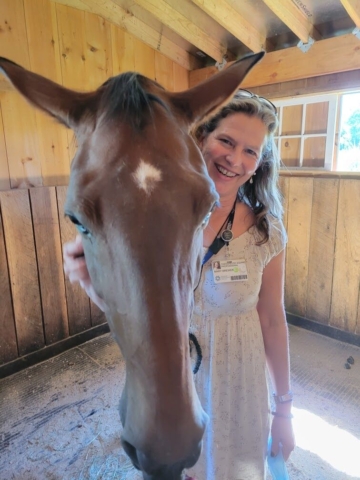
Gemma, an Oldenburg horse, is new to Equine Assisted Psychotherapy (EAP), but not to fostering and sharing love and acceptance with people.
For all of her life, Gemma belonged to a woman named Laurel Septer. Mary Ann Brewer, Carrier’s therapeutic equine professional, knew both of them since Gemma was a foal. Brewer recalls, “Laurel and Gemma shared everything: rides, walks, talks, lunch, and grandchildren. Gemma’s job was to be a friend and companion to Laurel. Gemma was heard, cared for, nurtured, and Laurel was heard, cared for, and nurtured right back.”
After Septer’s sudden passing, Brewer became Gemma’s owner. Brewer has worked in EAP for 15 years, since she and a friend began bringing their horses to a center for adults recovering from substance use disorder.
As Brewer recalls, “We had more than 20,000 participants in our 14 years of facilitating people’s journeys through things like career choices, anxiety, depression, grief, and recovery from various addictions.”
The EAP team at Carrier comprises Brewer, a licensed mental health professional, and horses. They use the Equine Assisted Growth and Learning Association or EAGALA model.
Naturally sensitive and social, horses are highly skilled at reading and communicating nonverbal cues, which are valuable in psychotherapy. Brewer says, “Part of their effectiveness in EAP is their presence.” Like life’s challenges, these animals loom large, and when patients reflect on how to deal with a horse, they often discover strategies that can help them in their lives.
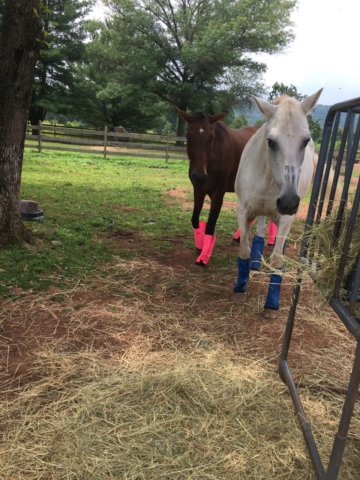
Gemma’s equine partner in her work is her newfound friend, Hope. But it wasn’t love at first sight. Gemma replaced Faith, Hope’s lifelong partner, until Faith passed away. Hope and Faith worked for the Amish before coming to Carrier. Brewer says, “I think when you work together like that, literally yoked together, you learn to anticipate each other. Those two Andalusian horses helped thousands of our residents and patients.”
Brewer says that when Gemma arrived, “Hope stepped up to defend his herd of two donkeys and two goats against this newcomer, and became stallion-like in his insistence on her leaving. He ran after Gemma and bit her on the butt. She could run much faster than him, so she kicked him. Now, Hope and Gemma are good friends, going everywhere together.”
Brewer sees the changes in their relationship as reflective of their work at Carrier. “We get in patterns of behaving with others and we become unconscious to it. When things change, we have an opportunity to change too.”
Brewer herself was inspired by horses to take a risk and make a major change in her life. As a young girl in Monmouth County, her first love was her neighbor’s Paint horse, Dolly. “I kept coming over. My friend would hike me up behind her bareback or in the saddle and we’d ride down the street in the one-road town we lived in.”
Brewer fondly recalls those carefree days. “We galloped double on Dolly through big sand hills, across the battlefields and onto the greens of the golf course. Dolly only had one speed, and that was fast. I cannot tell you how many times I came off the back of that horse, but it never mattered. All I did was learn how to stay on.”
Living in half of a rented duplex house, with her father repairing vending machines and her mother working in retail, there was no money for equine pursuits. “Every year as I asked for a pony for Christmas, and my Mom told me, ‘You can have a horse when you grow up and buy a farm.’”
When Brewer was 14, she spent the summer in Wyoming with friends who owned horses. She notes, “I rode all that summer in the Black Hills of South Dakota. I was hooked.” She married soon after graduating from high school and five years later was the mother of three sons. Cleaning newly constructed homes throughout New Jersey for seven years, she was able to buy the Pemberton farm where she now lives.
The start of a new millennium caused Brewer to do some serious soul searching. “I rearranged my whole life so I could live the dream I talked about every day: go to Horsemanship School. I sold my business, rented out my house, and loaded my horse in a small trailer. I spent three months in Ocala, Florida; six months in the San Juan Mountains in Colorado; and another three months back in Florida. I was home in time for Christmas in 2005.”
When Brewer returned to New Jersey, “I was approached by my friend who had found the world of Equine Assisted Learning. I needed to earn a living, so I hung out my shingle as a Natural Horsemanship Coach. I mostly helped troubled horses and their people get along, and I helped troubled people get along with their horses too. Behavioral problems with horses are my specialty.” She named her business, “In the Company of Horses.”
Brewer has seen real changes in patients at Carrier as a result of their interaction with the horses. She relates, “A young girl and I began walking the horses together, just having fun. Then her horse wouldn’t move forward. I asked, ‘Who do you want the horse to know you to be?’ When she answered, ‘Kind,’ I said, ‘Great, be kind and ask the horse to walk with you.’ He didn’t move. I asked, ‘Who else do you want the horse to know you to be?’ and she said, ‘Honest.’ I said, ‘Great, be honest and ask the horse to walk with you.’”
Brewer was “so impressed when the girl’s horse began to walk and stopped and started every time she asked, all around the field. She was glowing, so happy. When I asked, ‘What made the difference?’ she said, ‘Knowing who I want to be.’ Her therapist had never seen her so happy or cooperative on the unit. After the girl said, ‘I like the animals, I don’t like the people,’ I asked, ‘So, your behavior is a complete choice?’ and she said, ‘I guess it is.’”
Brewer also recalls, “Every week a troubled resident would come to EAP with headphones on. He never shared and always had a 50-yard stare. One day, Faith was recovering from foot surgery and I walked him over to the kid and said, ‘Please walk with Faith; he needs 20 minutes of exercise.’ I handed over the lead rope and turned, not waiting for an answer. For the next 20 minutes they walked. The headphones were now on his neck and no longer on his ears. I saw lots of talking going on but only watched from the periphery.”
Brewer admits, “I have no idea what happened, I just know something did. When time was up, he put Faith back in his stall and removed his halter and looked at me, smiling. After that, every time he came to EAP, there were no headphones and no staring into the distance. He interacted with the other animals and the group.”
Brewer notes that EAP is “client-directed.” Her job is to “be quiet and let the horses do their work.” One aspect of her work at Carrier that she finds difficult is “learning how cruel people can be to people they profess to love and have been given the privilege of guardianship over.” She says that to cope, “I learned self-care early on in this work.”
On a positive note, Brewer states, “I think the greatest gift I’ve received, living and working in the company of horses, is the gift of being in the present moment, fully. It requires my complete attention. That skill has helped in so many areas of my life, and I see that in many who are willing to put in what it takes.”
Brewer adds, “What I love about learning through the horses is that it’s unspoken. It happens in the quiet; without talking; on other levels.” Regarding Gemma, Brewer says, “She brought a whole new way of being to the herd. I’ve seen really nice changes in Hope: He’s kinder, more willing, friendlier, more interested. All Gemma’s years of being in a happy, healthy relationship go with her wherever she goes. I’m thrilled that she has a forever home doing what she has done her whole life: being a friend, and a good listener.”
Carrier Clinic, 252 County Road 601, Belle Mead. 800-933-3579. www.carrierclinic.org.