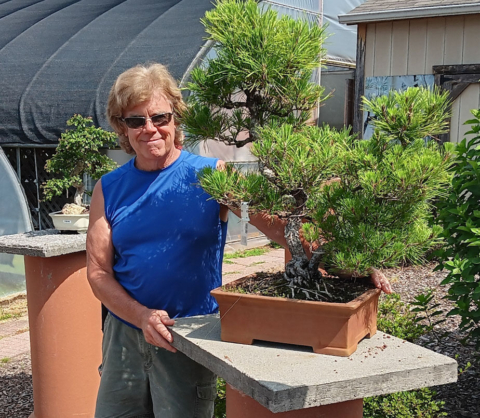
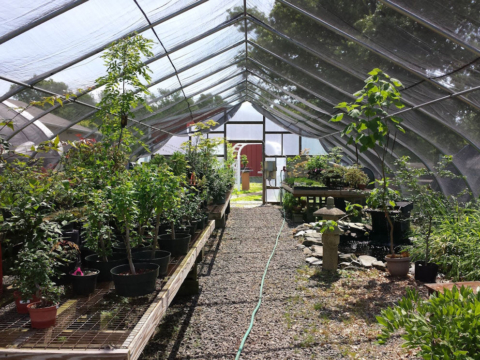
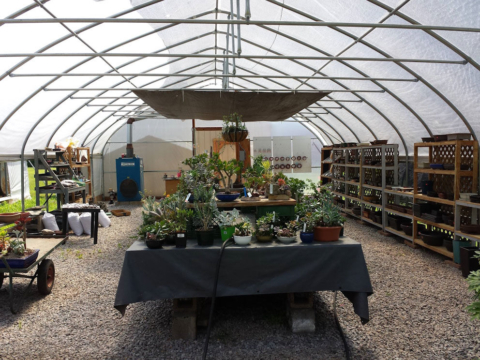
Soon after I began meandering through the 6,000+ square feet of greenhouses and outdoor display benches at Allshapes Bonsai in Ringoes, a feeling of tranquility enveloped me. There’s something about being surrounded by hundreds of carefully tended living works of art that induce a calming sensation. It’s a feeling not unlike the one I’ve experienced during a session of forest bathing; a mindful, guided, meditative walk through a sylvan setting that traces its roots back to Japan. (“Stroll Through a Forest, Leave Stress Behind,” U.S. 1, March 20, 2024)
Simply put, according to Wikipedia and other sources, bonsai is the art and technique of growing and shaping trees in miniature in containers, an art that was developed in China more than 2,000 years ago and, like forest bathing, comes to us via the Japanese, who embraced bonsai 1,300 years later, when Buddhist monks introduced bonsai to Japan following their travels to China.
Allshapes Bonsai is run by Dave and Diane Hall, who, in the course of running a plant nursery on the site beginning in 1981, became interested in the growing and care of bonsai. Over time they have segued to making bonsai their full-time business. As their interest in and knowledge of bonsai has deepened, they have also become sought-after speakers at garden clubs and participants at the New Jersey Flower Show. In addition, they have conducted bonsai workshops at area high schools as well as on-site at Allshapes Bonsai.
What drew Dave and Diane to focusing solely on bonsai? “We started getting our toe in the water by growing unusual ornamentals, things that people don’t normally see in garden centers, and that’s what we were drawn to,” Dave Hall says. “Plants have a lot to offer; foliage has so many different colors and textures, and we were attracted to that. We had access to this land, 23 acres that was passed down through my family. We felt that we had to do something with it, and they gave us full rein to go ahead.
“So we did and started getting plants that we enjoyed growing,” he continues. “Most of them were conifers, and Diane was the first one to get interested in bonsai and begin using the plants to create bonsai art. We sold off a lot of the other nursery stock and stayed with bonsai. We did whatever we needed to do to keep the business going; street fairs, craft shows, advertising in newspapers and on radio, whatever we could do to promote our business. We learned that the best exposure was meeting the public directly through craft shows and the like.
“We eventually got to the point where we didn’t have to do that,” Dave notes, “and since we’ve focused entirely on bonsai our business has grown exponentially. Not that it was all glorious. There were some lean times, too, times when the economy was rough. When they replaced the bridge down at the end of our road everything just stopped for a while.”
Dave notes that the interaction with Allshapes customers is a big part of their continued interest in bonsai. “I think the perks in this business are the people who come in here,” he says. “I can’t say enough about the people who come here; they’re just fabulous. When I talk to people who want to know more about our business, who aren’t afraid to ask questions, I tell them that practically every one of my friends whom I hang with, whom I associate with after hours, all came through the doors of this place.”
How would he describe the typical Allshapes customer? “Our typical customer is somebody who’s in the hobby, who’s committed to the hobby, and who enjoys what they do as much as we do,” Dave explains. “There is an enjoyment in this, there is a serenity in it, there are a lot of lessons about life you can trace back to through this hobby. Because it is about growing, about pruning, about cutting things back, about shaping. And a lot of that does have to do with life, and when I get engaged in it, these are the things that I think about.”
Hall also says that the serenity of caring for bonsai is one of the things he brings up in the classes that he and Diane hold at Allshapes. “I try to get people to forget about their jobs, what they have to do when they go home,” he says. “Our time in class is limited, and I try to stay on schedule, to make sure that they enjoy their time in class and not think about the things that they’ll have to do after they leave here.
“I think about families, about life in general, and when I give them a task to do I ask them what they’re thinking about,” he continues. “And when they’re focused on their tree, not what’s coming after class, that’s what I like to hear. That’s what I think this hobby is about, to disengage from your life for a while, from the stresses of your job, fighting traffic, raising your kids. I love kids, but sometimes you need to get away from them for a bit, so when you return you can love them more.”
The Allshapes website notes that bonsai classes are usually held from January through May of each year. A day-long bonsai workshop on April 26 ($195) focused on Japanese Juniper, one of the most common plants used in bonsai, and included all the materials needed to create your own bonsai, including a five to eight year old plant and a ceramic pot. Attendees were instructed in wiring techniques to shape their tree, proper planting, and post-care. Subscribe to the Allshapes mailing list to be notified when classes are scheduled.
In addition to classes, Allshapes has a retail shop that offers tools and other supplies needed for bonsai success. “We have just about everything here that a bonsai hobbyist needs,” Dave notes. Some tools, such as pruning shears and pruning saws, appear to be Lilliputian versions of gardening tools. Others are unique to the art of bonsai, like bud shears, branch cutters, combination tweezers/rake, root hooks, wire cutters, and branch benders.
Despite decades of specializing in bonsai, Dave freely admits that learning about these living sculptures is a lifelong process. “There’s so much to learn about each plant, there’s so much to learn about each style that you’re trying to achieve” he says. “That’s what keeps it enjoyable.
“I’ve shared with a lot of people that I had been a musician, and I’ve always loved learning new songs, and that tells me that I love learning new things,” he continues. “If you love learning new things, if you’re engaged in plants, this is the hobby for you. It’s always changing. When people want to know what bonsai is like, I tell them that it’s like growing a tree for three years and then cutting off two years worth of growth to make the adjustments and changes that you need in order to create the tree that you’re out to get.”
How does Dave respond when someone who knows nothing about bonsai stops by and asks him how to get started? “I’ll find out what their hobbies are, how much they know about growing plants, whether they’re gardeners, whether they grow plants inside their house,” he says. “I’m a bit of a detective, because I can usually scout out those people who really know about plants versus those people who do it casually. Bonsai is not a casual hobby, and they need to recognize that plants need water, plants need sunlight, plants need fertilizer. Those are going to be my best customers.
“If I have to walk them through what bonsai is about, that’s where I start,” he says. “Because, number one, it’s a plant, and they need to be able to take care of it. Our goal here is to do our best to make sure that they’re dedicated to keeping it alive. Because if they don’t keep it alive, the enjoyment of shaping it, of turning it into something better, it’s rather meaningless.”
What types of plants work best as bonsai? While noting that many types of plants may be used, Hall did offer some general guidelines. “The traditional things we look for (in a plant) are trees that are very woody,” he notes. “A quality that we look for is plants that work with you, plants that we can cut back and that respond by pushing out new growth afterwards. Because of that we can reduce the size of the plant, because that’s what this hobby is about, about making a plant into a miniature, in a landscape perhaps, or a tree in its own wilderness, growing in a small shallow pot. That’s part of the art of bonsai.”
Hall also notes that he and Diane will, for a fee, care for their customers’ bonsai when they’re away. “We do take in trees,” he says. “We call them boarders. The last customer who came in arrived with 20 trees and was going to be away for a month. It’s a service we have to charge for, but I think it’s a whole lot better than leaving trees in the hands of somebody who’s inexperienced. We’re especially busy in the winter, when it seems like people bring them in by the carload.”
Although Hall says that it’s a small part of their business, Allshapes will provide bonsai for events such as weddings. “There are people who are planning their wedding and looking for something different, something that expresses the bride and groom’s love of the outdoors,” he explains. “Most people are very traditional and want bonsai to decorate the tables or as favors for their guests.
“But the one request that stands out the most was for a couple getting married who were avid hikers,” he recalls. “One of their mothers wanted us to add weeds and undergrowth underneath bonsai to replicate a forest setting. We spend part of our day pulling weeds out of our pots, and along comes someone who’s going to pay us to put them back in! We got it done, and the couple was tickled with the result.”
Do Dave and Diane have a personal collection of bonsai? “We used to have a lot more trees that we created over the years, which became very personal,” Dave says. “Diane and I would celebrate anniversaries, birthdays, and we still give one another trees. Over the years we’ve had to sell them off, only because we had too many. We still have our favorite trees, but the size of the collection is smaller than it used to be. They’re here on display, trees that people can take notice of, perhaps when they’re considering purchasing a smaller version and would like to see the full potential of a particular tree.”
Given the serene vibe that permeates the Allshapes greenhouses and the patience and artistry required to be successful with bonsai, I asked Dave Hall if his interest in bonsai has influenced the way he lives his (and Diane’s) life. “A lot of people see me as kind of laid back, and I guess in some ways I am. This hobby is not something you need to get too excited about, and I like it for that reason. It is more relaxing, it is more calming. It is a job that you need to love to do.
“There is no shutting down,” he concludes. “There are a lot of plants here that need to be watered, and during a summer like the one we’re experiencing now, unless we get a deluge of rain, it’s a once a day job, every day. Diane and I run it year ‘round, although we do try to get away for a week. We’re hikers, so we often go to Maine in the fall, to a setting that you might say is a lot like Allshapes Bonsai, but in a more natural way.”
Allshapes Bonsai, 230 Everitt Road, Ringoes. Open Mondays, Thursdays, Fridays, and Saturdays, 9 a.m. to 4 p.m., and Sundays, 1 to 4 p.m. Closed Tuesdays and Wednesdays. 908-788-1938 or allshapesbonsai.com.