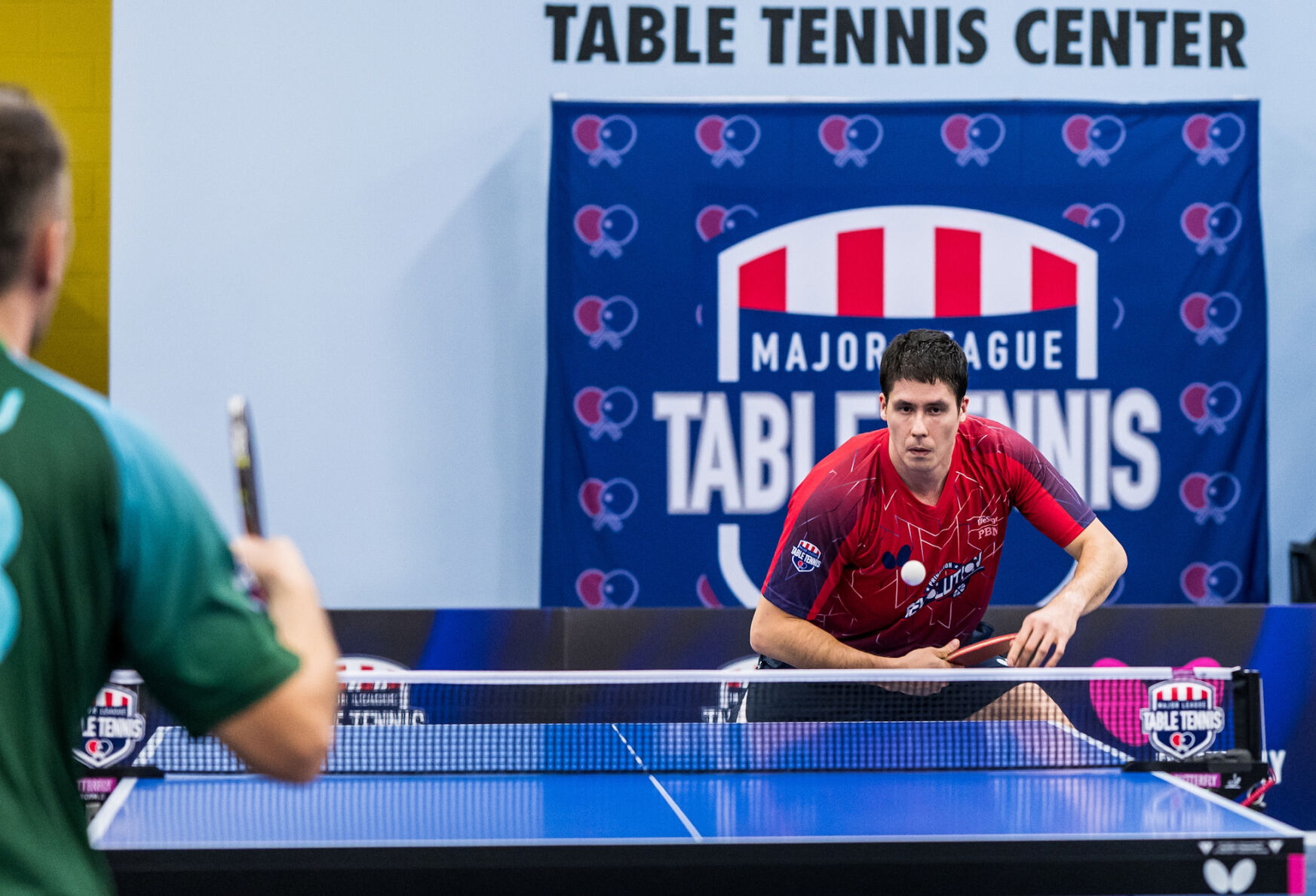
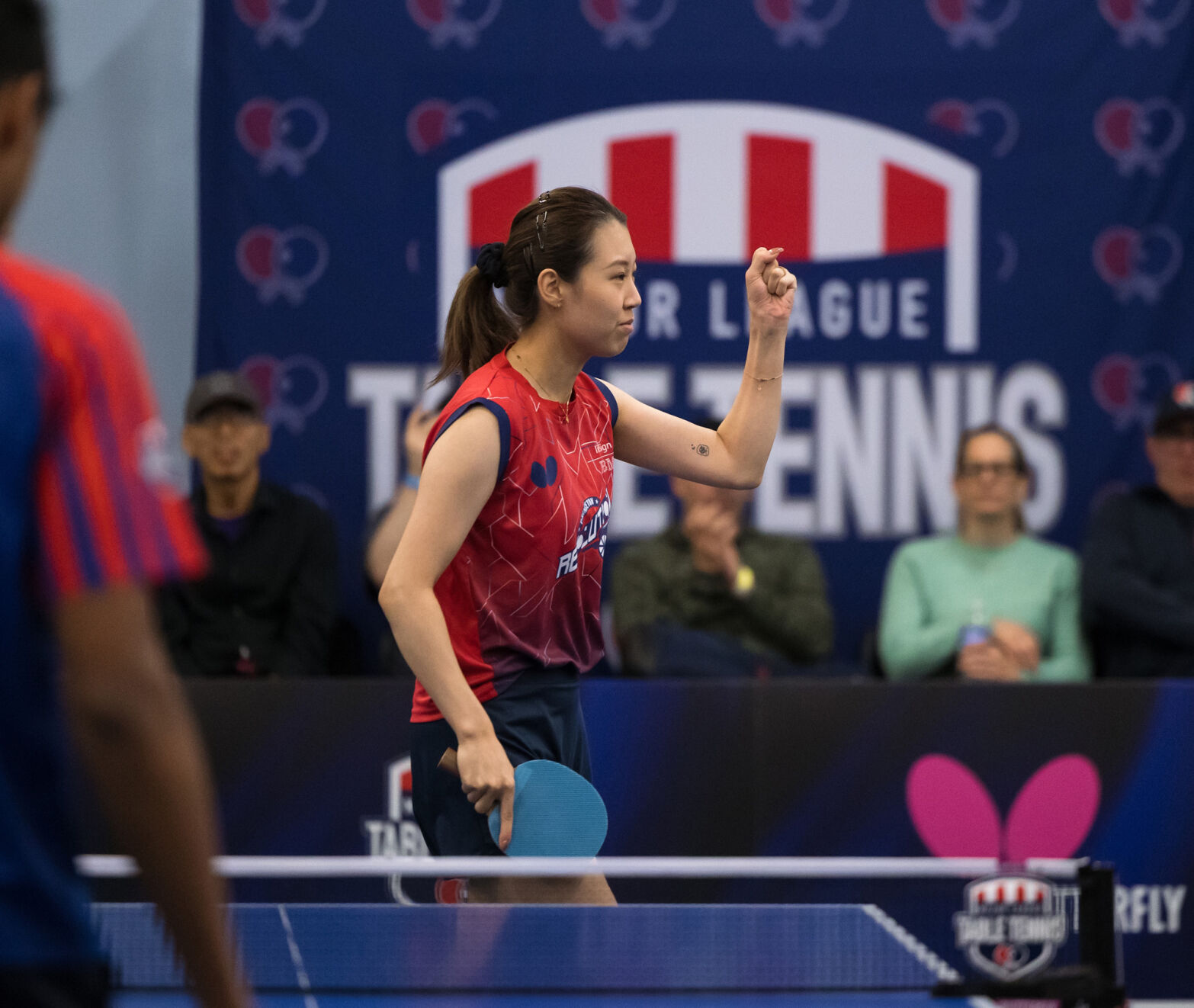
Pop quiz! What are the most popular professional sports in the USA? According to sports data web site statscore.com, they’re American football (NFL), basketball (NBA), baseball (MLB), ice hockey (NHL), and soccer (MLS).
Notably absent from that list is table tennis. Despite being one of the world’s most popular sports, with an estimated 300 million players (Source: pingsunday.com), the USA is completely absent from the list of top countries where table tennis is played the most. China leads that list, while Russia ranks at the bottom (Source: sfsquad.com).
Software entrepreneur and table tennis enthusiast Flint Lane and his business partners are working to change that. In 2023, Lane launched Major League Table Tennis (MLTT), the first professional table tennis league in the USA. In just three seasons, MLTT has grown to East Coast and West Coast divisions of five teams each, headed by owner / investors like NBA Hall of Famer Manu Ginobili (Florida Crocs). Closer to home, world top-10 table tennis star Dima Ovtcharov is a co-owner of the Princeton Revolution.
Further evidence of the growing popularity of MLTT is a recent announcement on CNBC.com that Major League Table Tennis has signed its first-ever national television deal with CBS Sports Network, bringing MLTT matches, exclusive highlights, player profiles, and behind-the-scenes features throughout the season on Sundays at 8 p.m. Eastern time.
For U.S. 1 readers who’d like to witness the excitement of this growing sport, the Princeton Revolution and three other MLTT teams will be going head-to-head in a series of matches at Rider University in Lawrence from Friday through Sunday, March 20 through 22.
And for those of us who’d like dive in and experience the sport first hand, there’s Princeton Pong, a table tennis club on Alexander Road, founded by Flint Lane and now co-owned by Lane, Roger Kang, and Andre Liu, who are also investors in the Princeton Revolution (more about Princeton Pong to follow).
Although Lane currently calls Naples, Florida, home, he notes that he raised his family in West Windsor and that they currently spend summers in Princeton.
Lane is a longtime entrepreneur, who found his first company, Paytrust, on Brunswick Pike in Lawrenceville in 1998. The dotcom-era web-based bill payment platform was sold in 2002, at which point Lane had already moved on to his next venture, Billtrust.
Lane served as CEO of the provider of accounts receivable solutions from its founding in 2001 until late 2022. Originally based on Everett Drive in West Windsor, Billtrust has undergone a series of expansions and went public in 2021. The company is currently headquartered on Lenox Drive in Lawrenceville.
What drew the payment processing entrepreneur to table tennis? “I was always a recreational table tennis player,” Lane says. “When I turned 45, my wife gifted me with a table tennis lesson from three-time Olympian David Jhuang, who was from West Windsor. I went to his house on the morning of my birthday with my crappy little paddle, thinking I’m going to give this guy a match.
“Oh, my goodness! I thought I was good, but I had no idea what ‘good’ was. My body was telling me I needed to find another sport, but I started training regularly, and within a few years I opened Princeton Pong, a full-time club in West Windsor.” Princeton Pong opened in 2014.
What does Lane enjoy most about the game? “Table tennis is a sport that you can play for life,” he replies. “You can’t play football or basketball when you’re older; you’re at risk of injury. At 59 I’m probably playing the best table tennis of my life, and I think the best is yet to come.
“But I think the most important thing is that table tennis requires you to focus. You cannot focus on anything when you’re playing the game. I’m very busy, I run a software company, I now run a professional sports league, but when I’m at that table I’m thinking of the spin, the serve, the return, the speed. There’s no time to be thinking of your cellphone or anything else. It’s very meditative, in that you can spend two hours playing ping pong and completely lose track of time.”
What was the hardest part of learning to play well? Lane notes that coming to the game later in life was an obstacle. “When you’re at the club and see young people playing, you notice that they look so fluid, because they learned to play the right way early. It’s like learning golf or skiing early in life; you’ll tend to do better at an older age. Because I learned later in life, my form isn’t as fluid because I didn’t learn the fundamentals properly early on.”
With an estimated 300 million active table tennis players worldwide, why does Lane think table tennis has been slow to catch on in the U.S.? “I’ve done a lot of research,” he says, “and I think there are a few reasons for that. The first and most important reason is that there’s been no professional league for people to see.
“Why is basketball so popular? It’s on TV all the time. You can watch clips on YouTube. Some 20 million people play table tennis recreationally in America, but they can’t envision a future where they can dream of being a table tennis star. So we decided to start Major League Table Tennis to fill that void.
“But that’s not enough,” Lane continues. “It’s not a varsity sport in high school or college, so if you want to play a sport to improve your chances of getting into college, table tennis honestly isn’t a good choice. A lot of things need to be done to elevate table tennis in America, and we thought that the biggest step was to build a pro league.”
Lane notes that the MLTT season runs from September through March, with a championship weekend happening in April. “Princeton Revolution has a good shot at qualifying for the playoffs and making a run for the championship,” he says. “This is our third season. Texas won the first championship, Carolina won the second championship, so Princeton is looking to win their first title.”
Attendance at the matches is building, according to Lane. “Attendance is up 50 to 60 percent season over season,” he says. “We’re basically setting attendance records every weekend at this point. It’s helped by the fact that this is the third season we’ve been in these cities to build a fan base.
“We drew 2,000 people in Portland, our biggest weekend ever, and we may actually break that when we come to Rider University in March. We’re never going to be the NFL. We’re not going to draw 80,000 people, but in Europe they routinely draw 5,000 people to matches. We think we can get there.”
What sort of expansion plans do you see for the league going forward? “We added two teams this year, season three,” he says. “We’re not going to add any in season four. We expect to add two to four teams every other year, because to me it’s hard to add teams every year. We expect to top out at 20 to 24 over the next ten years, but first we want to make sure that we have all the core functions working well. Some early attempts at forming leagues expanded too fast, and we don’t want to make that mistake.”
Any predictions about the upcoming match at Rider between the Portland Paddlers and the Princeton Revolution? “I don’t root for any team, but it is a pivotal match,” Lane says. “The playoffs are on the line. The Portland Paddlers are the best-in-class team this year, with two exceptional players from Sweden. If Princeton can’t prove that they belong, they’re not going to make the playoffs.”
Did Lane see the film “Marty Supreme?” If so, how realistically did it portray the world of table tennis? “Any movie about table tennis is good for our sport,” he says. “We’ve definitely seen a ‘Marty Supreme’ impact at Princeton Pong and at Major League Table Tennis. I really enjoyed the movie. The paddles we use today impart a lot more spin on the ball, but it gave a good sense of what the sport was all about in the ’50s and ’60s.”
I mentioned to Lane that I had stopped by Princeton Pong prior to our interview and was impressed with the speed and skill of some of the players there. “I’ll say this in the nicest way I can,” he replied. “You haven’t seen anything yet. When you see the professionals playing at the Rider event, and the crowd going crazy, it’s a whole ’nother ball game.”
True enough, but there’s the pros, and then there’s the rest of us. Before my interview with Lane, I met up with Roger Kang for a tour of Princeton Pong. At 6 p.m. on a frigid weeknight, the 14 tables at the club were already filling up with players of all ages and abilities, some competing, some taking lessons.
As mentioned earlier, Kang is a co-owner of Princeton Pong along with his friend, Andre Liu. Kang also told me that he currently owns a majority stake in Princeton Revolution. “Andre (Liu) is responsible for getting me into table tennis 1988,” Kang says. “I grew up in Princeton. I was in middle school here, at John Witherspoon, and Andre was a freshman at Princeton University.
Liu, who graduated in 1991, is also the owner of Pequod Communications, a neighbor to Princeton Pong on Alexander Road.
“The (Princeton) table tennis club decided to go to various schools and give an exhibition and get kids interested in table tennis. Table tennis became an Olympic sport in 1988, so there was a lot of excitement around that. Andre came with another player from his club, and they gave an exhibition. He was lobbing, and the other guy was smashing the ball.
“A few of us from the middle school got hooked and started playing table tennis,” he continues. “Fast forward, I went to U.C. Berkeley, which currently has a great table tennis team. I returned here in 2004. I’d kept in touch with Andre, and we noticed that somebody was building a table tennis club here, and so when it opened we checked it out. That’s how we met Flint, and the rest is history.”
I asked Kang for his take on why table tennis has been relatively slow to catch on in the U.S. “I think it’s partially a cultural thing,” he says. “In the U.S. you have so much attention on the NBA, the NFL, hockey, all these big mainstream sports that have traditionally been the center of attention. In China, table tennis is center stage. Table tennis is also huge in Korea and Japan.
“And now you’re seeing that table tennis is huge in France, thanks to two teenage brothers there, the LeBrun brothers (Félix and Alexis), who are world class. Paris hosted the Summer Olympics recently, and they did spectacularly. So there’s a huge table tennis base in France, Germany, all around Europe. They have an established league system in many countries around the world, and in the U.S. there was nothing for professional table tennis players. And Flint (Lane) saw that and wondered why no one was starting a professional table tennis league in the U.S. That’s how MLTT was born.”
I asked Kang how attendance has been trending at Princeton Pong. “We’re getting close to 300 members,” he says. “Currently the limiting factor is space. There are some nights when it gets so packed that people become frustrated waiting around for tables to free up.
“We’re planning on expanding this club to a bigger facility, closer to 30 tables,” he continues. “That’s a two or three-year project. We have some land nearby that we plan to build on. It will be a world-class facility where international players can come and play.”
Both group and individual lessons are available at Princeton Pong. I asked Kang how old one has to be to start learning the game. “As soon as you can hold a paddle and a ball,” he says. “A lot of serious parents might get their kids started around age five.”
What does it typically cost for a beginner to get kitted out to play the game? “Getting started is not going to break the bank,” he says. “You can spend $30 or $40 on a paddle and wear whatever shorts and t-shirt you have. Tennis shoes are perfectly fine for starting out.”
What was the hardest thing for Kang about learning to play? “There’s so many things — the speed, the ball, the spin, the trajectory, where it’s going to land on the table,” he says. “And with the technology today, the rubber on these rackets is super grippy. You can generate a lot of spin and speed. Using carbon fiber and layered, specialized wood, you have manufacturers today that make very high quality rackets.”
Has Kang seen “Marty Supreme,” and has it had any impact on his interest in table tennis? “It’s been huge for table tennis,” he says. “The main character is a table tennis player, and some of the players in our league are in the movie. We were excited to see that movie come out, and I’m just hearing from my friends in France that the movie is playing there and that they’re doing these crazy pop-up parties to celebrate it. It’s amazing.”
Beyond table tennis, Kang is also president of LifeSign LLC, based on Orchard Road in Skillman, and vice president of Princeton BioMeditech, based on Route 1 in Monmouth Junction, both providers of point-of-care testing solutions for the healthcare industry. How does he find the time for table tennis?
“You just make time, you find the time to do the things that you’re really passionate about. I’m just so passionate about table tennis. I love it. Even if I can only find 30 minutes to play, it just makes me feel so much better.”
Princeton Revolution vs. Portland Paddlers, Major League Table Tennis, Rider University, 2083 Lawrenceville Road, Lawrence. Friday, March 20, 7:30 p.m. Individual match tickets start at $12.55. Matches continue through Sunday, March 22. $24.10 for day passes; $55.75 for weekend passes. mltt.com.
Princeton Pong, 745 Alexander Road, West Windsor. Open Monday and Friday, noon to 11 p.m.; Tuesday through Thursday and Saturday, noon to 10 p.m.; and Sunday, 1 to 8 p.m. The club provides paddles and balls at no extra charge, or you can bring your own. princetonpong.com or 609-987-8500.