McCarter audiences are invited again to enter one of innovative stage director Mary Zimmerman’s magical stage worlds in “The White Snake.” This world grew from the Chinese legend about a white snake and a green snake from the spirit world who come to earth as two girls “on the town.” There they meet a mortal man who falls in love with the white snake and they marry. The villain of the piece, of course, warns the husband that he has married a snake and advises “Men don’t marry snakes. It’s immoral.”
Many of us may hear a contemporary analogy here, but the story is an old one and has been the basis for everything from operas to comic books. “If you’re Chinese, you know it as one of the four great narratives,” says Zimmerman. “It’s as well known as the Cinderella story is for us.” “The White Snake” is in performance at McCarter Theater through Sunday, November 3.
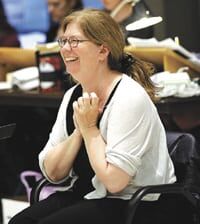
“I truly love this show in a deep way. I love the beautiful little world it creates. It’s funny, but profoundly romantic. It has one foot in this supernatural world — a woman who’s a snake, you know, and can do magic, yet on the other hand she runs a pharmacy with her mortal husband,” Zimmerman says during a rehearsal break.
The director is enthusiastic and also intrigued by the female buddies, White Snake and Green Snake, as model heroines for little girls. “I fantasize that they might say ‘Do you want to be white snake or green snake?’ White snake is the beautiful, romantic leading lady figure, but green snake is this tough, funny tomboy who’s energetic and so impulsive. They are such a great team.”
The play began development at the Oregon Shakespeare Festival during the summer of 2012. As is her process, Zimmerman begins with no script, imagines the world of the play with her designers, gathers her cast, and they begin reading the source material together. Between rehearsals, Zimmerman writes the script. After Oregon, she then mounted the play at Berkeley Rep in California, now here at the McCarter, with the next stop scheduled at her “home theater,” the Goodman in Chicago.
Different casts have been part of the productions, but there have not been substantial revisions in the text. However, she adds, “New people always bring a new world, a new personality, a new attack. But I started out thinking, and I’d talk to the cast about it, it’s about not judging by appearances, seeing through the form of something to the true inner self of someone.”
She feels that this is a universal feeling, that we want to be loved for the thing that we know we are. “Lady White Snake is such a virtuous woman. She knows in fact that she’s a snake in disguise and that humans hate snakes.” Zimmerman explains that if the husband knew of her snakeness, he would reject her, so she’s leading a double life. “I think many of us feel that inside we’re snakes. No matter how well we behave or how kind and loving we’re known to be, we have a perception of ourselves that we’re actually snakes, and if someone saw that for real, we would be rejected.”
However, during these last days of working on the play, she feels that it has taken a step beyond this to a kind of Buddhist ideal that there is only one form. “To even discriminate between one form and another is an illusion.”
Ever since her childhood in Nebraska, then in England and France, Zimmerman has marveled in her world of “let’s pretend” and was an avid reader. The progression of her career followed this lead as she went to Northwestern University, first majoring in theater, then continuing to earn a doctorate in performance studies.
Much of her work as writer/director has been adapting literary works for the stage. At McCarter she mounted “The Odyssey” in the fall of 2000, returning in January, 2005, with “The Secret in the Wings,” which grew from old fairy tales, and “Argonautica” in March, 2008. Many of us in the area also saw her Tony Award-winning production of “Metamorphosis” on Broadway (and can have the opportunity to see Rider University’s production running from Wednesday, October 30, through Sunday, November 3).
Both of Zimmerman’s parents were college professors, her father in physics and her mother in literature. Just as she was beginning work on “The White Snake” in Oregon, Zimmerman’s mother died. This was a very difficult time emotionally and she thinks back to her mother’s strong influence on her work. “My mother was a compulsive and constant reader of literature and she lived in that world. Our conversations would be, say, about the brothers Karamazov as if they were our next door neighbors. ‘Would you believe Dmitri would say that?’ We actually gossiped about them.
“And my mother could not remember the names of my friends or teachers, and she called me by my sister’s name half the time. She never told me to put on a sweater when I left the house or any of those things that mothers are supposed to do. She didn’t teach me anything about femininity or dressing up. But at 87 she could remember who married who at the end of Trollope’s ‘Barchester Chronicles’ — and why. That went in me in the deepest way. I always had one foot in the reality of books, and I want to make it manifest in three dimensions of a story.
“That’s my compulsion. That’s what staging is about — getting to live in that world which is an alternate world and yet informs and demonstrates how to live in this world. It’s a kind of a roadmap to understanding our emotions and human nature, why things happen the way they do and that they can’t be explained. I know that my drive toward that is possibly even stronger than hers. I take it to wanting to live three dimensionally in alternate worlds.”
Maybe this explains how Zimmerman juggles so many projects. She was commissioned by Disney to mount a production of Kipling’s “The Jungle Book,” admitting that the rumor is true — Disney gave her carte blanche in developing the piece. She’s been moving back and forth between “The Jungle Book” and “The White Snake.” However, she says, “’The Jungle Book’ was in the deep background when I was working on this. It was still in the conceiving and preproduction design research. That goes on hold when you go into production with something else. Then I was back to it.”
After its origin in Chicago, “The Jungle Book” is now in Boston at the Huntington Theater. “It opened on Thursday and I started here on Tuesday.” Will it move on to Broadway? She says that she’s not being coy when she says that she doesn’t know. She does know that her production process is different from what Disney is used to and that perhaps they are puzzled as how to proceed. She says, “It hasn’t taken the years and years and millions and millions it has taken in the past for them to develop things. It’s just this wild and wooly little handmade thing. The Disney touch on ‘The Jungle Book’ was extremely light.” However, she says she’s certainly glad to be back in a rehearsal room with just herself and the cast and not so many curious and interested observers. “I got letters from students all over saying they were doing their dissertation on Disney theatrical productions, ‘I’d like to observe.’ How could you say no to that?”
Talk about juggling projects: Zimmerman has also been a professor at Northwestern University in the School of Communication for 20 years. She laughs and admits, “My teaching has a little bit gone to the dogs. I’ve never taken a year off, but I did clear the decks a bit for ‘The Jungle Book.’” This means having just a few students for “field studies.”
She is also taking her Metropolitan Opera production of “Lucia di Lammermoor” to La Scala in Milan — then a remounting of her production of “La Sonnambula” at the Met.
When the McCarter production is over, Zimmerman will take a break for a few weeks and retreat with her dog to her home in Maine. But in many ways she remains the girl in Nebraska and races out the door into the summer to play kick-the-can and ignore her mother’s call to come in. “I think all people in the theater are living in that special place where they just keep on playing.”
She then reminds me that the word ‘play’ is both a verb and a noun and says “After all, theater is just pretending.”
The White Snake, McCarter Theater, 91 University Place, Princeton. Through Sunday, November 3. $20 to $80.
A “relaxed” performance of “The White Snake,” designed for families with children on the autistic spectrum having learning disabilities, and other sensory and communication disorders or a learning disability, is set for Wednesday, October 23, 7 p.m. All tickets $15. 609-258-2787 or www.mccarter.org.