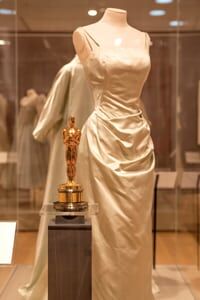
The trip to Doylestown, Pennsylvania, and the James A. Michener Museum — with its spectacular permanent collection of paintings by “Pennsylvania Impressionists” — has rarely been more rewarding than this season, thanks to the museum’s two new exhibitions: “From Philadelphia to Monaco: Grace Kelly Beyond the Icon” through Sunday, January 26, and “Local Mill Makes Good: Celebrating 75 years of American Theater at the Bucks County Playhouse,” through Sunday, March 2.
The story of Grace Kelly is part of American mythology, as it can be viewed on large and small screens, which makes it doubtful she will ever elude “icon” status. The understated style that belied her public reputation as a “clothes horse” for the world’s top fashion designers is practically within reach at the “From Philadelphia to Monaco” exhibit, which includes about 40 of her dresses arrayed on mannequins recalling her average, though very trim build. That style, and her nearly flawless beauty, remains an inspiration to young women today, and to red-blooded males throughout the world.
Kristina Haugland, curator of costume and textiles at the Philadelphia Museum of Art, points out that the wedding dress worn by the Duchess of Cambridge (nee Kate Middleton) during her wedding to England’s Prince William in 2011 was similar to that worn by Grace Kelly when she married Prince Rainier of Monaco in 1956. Helen Rose designed Kelly’s wedding dress. Rose, was a costume designer for MGM and 20th Century Fox during the big-budget heyday of those large Hollywood movie studios.
“It’s a more ‘covered’ look, designed to let her beauty shine through,” says Haugland of Kelly’s wedding dress. “It remains a sterling example of bridal elegance.” Haugland says that Grace Kelly’s wedding dress, which the actress gave to the Philadelphia Museum of Art shortly after her wedding, has not been shown publicly since an exhibit to mark the 50th anniversary of the event in 2006. She says the dress is very fragile after having been on display regularly before modern conservation techniques became known and before the Museum of Art had air conditioning installed.
“She really wasn’t a clothes horse,” says Haugland. “Grace Kelly really epitomized the style of the 1950s and 1960s. She set such an understated look and was an example for young women at that time. She loved her old clothes. She sent trunks and trunks of her clothes to Monaco, which is why they survive today.” For this exhibit, which was housed in Montreal’s McCord Museum before arriving in Doylestown, all 41 gowns and outfits were provided by the Grimaldi Forum, Grimaldi being the name of the royal family of Monaco. “The dresses were selected because they represented different stages of her career and life,” Haugland says.
The exhibit includes fragments from daily life that are anachronistic, given today’s largely digitized human interactions. There are several handwritten notes, some expressing friendly affection for the new Princess Grace, from Queen Elizabeth II, Prince Phillip, Prince Charles, Mrs. Clementine Churchill, along with others from a later era sent by Princess Diana, Queen Silvia of Sweden, and Queen Beatrix of the Netherlands.
A visitor to this part of the exhibit might be forgiven for wondering what might be lost, given that today these missives would likely be transmitted via text message.
The exhibit created its own protocol-laden buzz on the evening of October 26, during a black-tie gala dinner that attracted Prince Albert of Monaco, about 50 Kelly family members who still live in Philadelphia and Bucks County, and Pennsylvania First Lady Susan Corbett, not to mention embassy and consular dignitaries from Washington and New York.
There is a connection between the Grace Kelly exhibit and another Michener exhibit, “Local Mill Makes Good: Celebrating 75 years of American Theater at the Bucks County Playhouse.” Grace Kelly appeared on stage at the Bucks County Playhouse (BCP) in 1949 in a production of “The Torchbearers,” just as she was embarking on her brief, though memorable, career as an actress on the stage and in television and film. “The Torchbearers” is a comedy written by her uncle, the Pulitzer Prize-winning playwright, George Kelly.
The Michener exhibit commemorating the historic theater has little on the play or Grace Kelly’s participation in it among the many posters, photographs, and other memorabilia that bring life to the exhibit. There is one photo of her on stage in the play, but no newspaper reviews survive and the name of the photographer is unknown.
But you don’t have to be a Grace Kelly fan to appreciate the playhouse’s reputation. The BCP has long been a landmark on the “Straw hat circuit” of summer stock theaters, which once famously extended from New England to New York and Philadelphia and even into the Midwest. In fact, those of a certain age who grew up in the Philadelphia metro area may remember piling into school buses for field trips to the theater for performances of “A Midsummer night’s Dream,” or “Romeo and Juliet.”
The Bucks County Playhouse began in 1939, as, legend has it, an enterprise of George S. Kaufman, Moss Hart, and Oscar Hammerstein III, who comprise a Mount Rushmore of American theater and who happened to live in Bucks County before they became interested in getting a local stage up and running. But according to David Leopold, who curated the exhibit for the Michener Museum, that legend has as many holes in it as the old theater’s fire curtain. The credit belongs to a man named Henry Chapin, who wanted to start a community playhouse just as the New Hope Mills building became available.
The exhibit has dozens of posters and other theater ephemera to capture the attention and imagination of theater lovers, and others interested in one of the area’s most cherished cultural institutions. There are a few rows of old seats from the playhouse arrayed in front of a screen that plays a film feature on a continuous loop following an ingenue who one day is helping with scenery at the playhouse and then next finds herself with an important acting role on stage. There is a cameo by George S. Kaufman, who had bought a ticket and then asks to meet the young lady after the final curtain.
There are many photos of actors who appeared in Bucks County Playhouse performances along with posters showing how “Barefoot in the Park and “The Odd Couple” were among several Neil Simon plays that were launched at the theater. There is one original Al Hirschfeld drawing and at least two copies of vintage New York Times pages where his famous line drawings depict the scene outside the playhouse and a performance when — at the outbreak of World War II — the company’s operation moved to the old Bellevue Stratford Hotel in Philadelphia.
The exhibit consists of sections devoted to “Players, Producers, and Productions,” with a fourth section focused on the “Rebirth” of the playhouse, after extensive renovations to the building were completed last year. As with any exhibit dealing with the theater, whimsy is honored, in this case with a parking meter borrowed from the New Hope Department of Public Works. Anyone who has visited New Hope knows perhaps all too well, that parking is at an extreme premium, meter infractions are taken very seriously, and fines are extracted without mercy.
There is a replica of a dressing table and a “gypsy robe” hangs nearby. The robe, a theater tradition that outsiders likely do not know much about, is a garment that is treated as a good luck charm by cast members, especially in the chorus of a musical. Small trinkets and other memorabilia from the show are sewn into it before it is passed on to another show or sent to Actors’ Equity, or, sometimes, the theater collection at Lincoln Center for safekeeping.
There are other parts of this exhibit that bring it and the history of the playhouse to life. As the theater prepared to reopen last year after its extensive renovations, Robert Beck, the noted Lambertville artist, painted several views of the Playhouse, several of which are in the exhibit depicting renovation work at various stages, culminating in a “Dress Rehearsal.” There are also works in the exhibit by Edward Willis Redfield and Louis Ney, both firmly in the fold of Pennsylvania Impressionists.
The story of the Playhouse needed a rewrite in recent years, and the Michener Museum considered it as the subject of an exhibit. “For several years, the subject would come up about doing an exhibition on the playhouse,” Leopold says. Fortunes started looking up for the playhouse when the Bridge Street Foundation got involved. Then Monaco approached the museum about the Grace Kelly exhibit.
“The place was totally run down.” Leopold says of conditions backstage. “When they went in 2010 or 2011 and saw what condition it was in, nobody wanted anything to do with it. The fortunes of New Hope and the arts are intimately connected with the Playhouse.”
With the extensive renovations, the playhouse is looking at producing new works, as it originally did. This past June, a new play “Mothers and Sons,” by Terrence McNally — who has won numerous New York Drama Desk, Obie and Tony Awards, and a Pulitzer Prize — premiered at the Playhouse and will open on Broadway in the spring, according to Playbill.com.
“I really believe we’re in a second golden age of the Playhouse,” says Leopold.
From Philadelphia to Monaco: Grace Kelly Beyond the Icon. Through Sunday, January 26.
Local Mill Makes Good: Celebrating 75 years of American Theater at the Bucks County Playhouse. Through Sunday, March 2.
James A. Michener Art Museum, 138 South Pine Street, Doylestown. Monday, Tuesdays, Wednesdays, and Friday, 10 a.m. to 5 p.m., Thursdays 10 a.m. to 8 p.m., Saturday 10 a.m. to 5 p.m., and Sunday noon to 5 p.m. $8 to $18. www.michenerartmuseum.org or 215-340-9800.