Opera. Jazz. Cabaret. Musical theater. Chamber music. Classical and Broadway pops. Baroque music with and without chorus. A quicksilver, genre-defying trio. This year’s Princeton Festival is an impressive reinvention with many gears and flywheels.
But there’s magic in that machine. Thanks to a merger with the Princeton Symphony Orchestra in 2021, Princeton will again resonate with music, with a panoply of performances from June 10 through 25. This is the first time the festival will be presented as the premier summer arts program of the PSO. The series will include pre-concert talks, library events, and a poetry workshop.
The new season is cause for celebration, following as it does two years with a heavy emphasis on virtual fare, due to the coronavirus pandemic. In 2020, only weeks after COVID-19 began its spread across New Jersey, the festival pivoted to present a mix of new and archival material in an online format. Last year, it dipped a toe into returning to live, in-person musicmaking, with limited, socially distanced audiences treated to “Opera by Twilight” concerts, presented outdoors at Morven Museum & Garden. Even so, because of continuing safety concerns, most of the performances were, once again, conveyed via internet streaming.
This year will be more of a return to form, yet in many ways the experience will be entirely new. The association with Morven will continue, though freshly reimagined, with a full roster of musical events, presented in two venues, a stone’s throw from the Princeton Battle Monument.
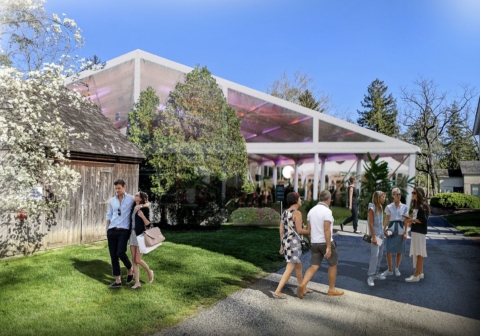
Unlike in previous years, when everything took place at different locations scattered across Princeton, and largely indoors, this year’s offerings will be more centralized. Many of them will be presented in a specially constructed, state-of-the-art, clear-span (no poles, no obstructed views), open-sided, 10,000-square-foot performance tent on the grounds of historic Morven Museum, at 55 Stockton Street (Route 206), with additional Baroque concerts held across the road, at Trinity Episcopal Church, at 33 Mercer Street.
“The world’s gone through a pause, and things are opening up, and it’s an opportunity to do something new and different,” says Marc Uys, executive director of the Princeton Symphony Orchestra. “It gives us a chance to really reset what the festival is, and where it is, without that being a commentary on its past. The festival has a proud history of major accomplishments. But this is a convenient time in the history of the world to begin a new era.
“I think the things that are really going to set this apart from what festival goers of the past years will know, of course, is the location and the fact that it’s outdoors. And making the decision to do that has also shaped also what the programming is.”
Having most of the events in one venue, of course, presents its own challenges. “There are some logistical constraints in presenting a different event every night,” Uys says. “A lot of time is needed in a space to prepare for a performance. The space will be active every day from 7 in the morning until midnight. It’s a very different kind of undertaking from how the festival was constructed in the past, where multiple venues were used, and that kind of production challenge didn’t exist.
“On a programmatic level, what we’re really trying to do is to maintain those things that the festival has been well known for — of course, opera has been an essential part of the programming — but also to continue to expand beyond opera, and not just adding peripheral events, but developing a balanced performing arts festival.”
Naturally, the Princeton Symphony Orchestra will be well represented. Rossen Milanov, the orchestra’s music director — and now the Princeton Festival music director — adds, “That was important to us, because we wanted to celebrate this merger of these two organizations. We have the orchestra front and center in the opening concert, and then of course featured in the operas, and also closing the festival with two concerts on stage. We have that available to us as a result of the merger. We now have this resident orchestra.
“This is an incredible opportunity to reach completely new audiences that we normally don’t reach during our winter programs. The fact that it happens during the month of June, the fact that it happens in a unique venue, and the fact that it has these extremely diverse offerings is a completely new area for us. So this is really exciting, to use the Princeton Symphony as a kind of umbrella organization, and to bring that intimacy and closeness to the artistic act under this performance tent.”
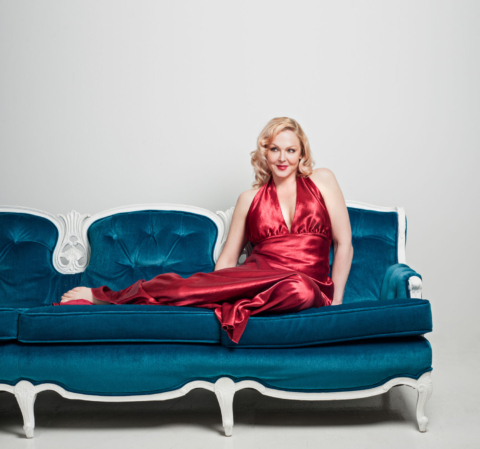
Milanov will conduct the orchestra on the festival’s opening night (Friday, June 10, at 7:30 p.m.), when vocalist Storm Large will perform Kurt Weill’s “The Seven Deadly Sins.” This “sung ballet” was Weill’s final collaboration with Bertolt Brecht, with whom he had worked on “The Three-Penny Opera” (with its breakaway hit, “Mack the Knife”). Large, a versatile performer, shot to prominence thanks to television appearances on “Rock Star: Supernova” and “America’s Got Talent.” The second half of the program will be devoted to Rodion Shchedrin’s striking “Carmen Suite,” settings of famous themes from Bizet’s opera for strings and percussion.
Commentator Rob Kapilow will bring his popular radio show, “What Makes It Great?” to the tent (Monday, June, 13 at 7 p.m.), as he explores Franz Schubert’s string quartet “Death and the Maiden.” Kapilow will deconstruct key passages with live musical illustrations to reveal what makes the music so extraordinary. The evening will conclude with a complete performance of the work by the Signum Quartet. This event is presented in partnership with WWFM The Classical Network, and will be broadcast live at 89.1 FM and wwfm.org.
Creating a completely different vibe will be Alyssa Giannetti and Jason Forbach, who will pay tribute to musical theater legend Stephen Sondheim, in a cabaret-style presentation with Matthew Stephens at the piano (Wednesday, June 15, at 7 p.m.).
Across the street, the Baroque ensemble The Sebastians will present works by Johann Sebastian Bach, George Frideric Handel, Antonio Vivaldi, Giuseppe Antonio Brescianello, and Johann Georg Pisendel (at Trinity Episcopal Church on Thursday, June 16, at 7 p.m.).
Then back at Morven, lending further variety, will be a duo of trios. The protean Time for Three will blur boundaries between classical, Americana, and modern pop (Tuesday, June 21, at 7 p.m.), and pianist, composer, and Juilliard graduate Aaron Diehl will explore early jazz with his trio (on Wednesday, June 22, at 7 p.m.).
No one could have anticipated in June 2019, the festival’s 15th season, the challenges that lay ahead. The mounting of fully staged opera, the wellspring and always a mainstay of the series, would go out, albeit temporarily, on a high note, with a superb production of John Adams’ “Nixon in China” at McCarter Theater. The performances also proved to be the swan song of former executive and founding artistic director Richard Tang Yuk. In September, 2020, Tang Yuk, who had been with the festival from its inception, decided it was time for a change.
During the period of transition that followed, Gregory Geehern, who had been the festival’s associate conductor and assistant to the artistic director, was promoted to acting artistic director.
Geehern was recruited by Tang Yuk while still a doctoral student at Indiana University, to act as chorus master for the festival’s production of “The Flying Dutchman” in 2013. He was invited to return for “Porgy and Bess” in 2014. This required that he spend much of the year leading up to the festival teaching in Indiana during the day, and then doing festival work in the evening and into the night. He assisted in coordinating auditions, listening to singers, negotiating contracts, and planning out the trajectory of concerts. “I like to joke that I worked remotely before it was cool,” Geehern says.
In 2017 the board invited him to work for the Princeton Festival full-time. So he packed his bags and made the move to New Jersey. With the PSO merger, Geehern is now festival director, and fully-staged opera returns.
This year’s offerings will include no less than three operas, including Benjamin Britten’s “Albert Herring” (Friday and Sunday, June 17 and 19, at 7 p.m.) and a double-bill of Derrick Wang’s “Scalia/Ginsburg” and Wolfgang Amadeus Mozart’s “The Impresario” (Saturdays, June 11 and 18, and Sunday, June 12, at 7 p.m.).
“Scalia/Ginsburg” is a charming conceit about the relationship of U.S. Supreme Court justices Antonin Scalia and Ruth Bader Ginsburg, often divided in their interpretations of the law, but always united in friendship, especially over their mutual love of opera. The work received the imprimatur of both justices, who provided forewords for Wang’s published libretto. Ginsburg described it as “a dream come true.”
Mozart’s “The Impresario,” a parody on the vanity of singers, was written at the peak of the composer’s creative powers. It was given its premiere in 1786, the same year as “The Marriage of Figaro” and, on imperial command of Joseph II, was presented as a contest piece, in direct competition with an opera by Antonio Salieri that was presented at the other end of the room.
The Princeton Festival production will be the very definition of meta, with the sets designed to suggest the backstage hilarity of Mozart’s opera, with its squabbling divas, actually transpiring behind-the-scenes in preparation for a performance of “Scalia/Ginsburg.”
“Albert Herring,” on the other hand, is a full-length, springtime comedy of innocence and experience, with a shy and reluctant young man unexpectedly elected “May King” on the merit of his unusual virtue. The pianist Sviatoslav Richter described Britten’s lark as “the greatest comic opera of the century.”
Milanov will conduct the Princeton performances of “Albert Herring.” The double bill of “The Impresario” and “Scalia/Ginsburg” will be conducted by Geehern.
All three operas will be presented in English, with accompanying titles. The translation of “The Impresario” was done by award-winning lyricist Dory Previn. Synopses of the operas will be included in the programs that will be distributed at the performances and are also posted now on the Princeton Festival website.
Back to Trinity, Geehern will lead the Festival Chorus, appearing with The Sebastians, in performances of a Bach cantata and a Handel Chandos Anthem (Thursday, June 23, at 7 p.m.).
As a grand finale, the festival’s concluding weekend will consist of two pops concerts presented in the performance tent. Sierra Boggess, star of “Phantom of the Opera” and “The Little Mermaid,” will join the orchestra for an evening of Broadway pops (Friday, June 24, at 7 p.m.).
Then Milanov will conduct a program of concert favorites and familiar melodies, with PSO Assistant Conductor Kenneth Bean leading musicians of the Youth Orchestra of Central Jersey in a selection from Antonin Dvorak’s “New World” Symphony, in a special family pops concert (Saturday, June 25, at 7 p.m.). Musical activities for young people will be offered beginning two hours before the concert, including an instrument building station and a percussion “petting zoo.”
Individual programs will dictate the seating arrangements, to lend a distinctive, more intimate atmosphere to Morven jazz and cabaret “club” nights.
Drinks will be provided from an on-site bar, which will open one hour before all events presented under the tent. Tickets to the jazz (Aaron Diehl) and cabaret (Sondheim) concerts will include “light fare,” with beverages available from the bar. The grounds are also ideal for pre-concert picnicking.
Pre-concert talks will be held in Morven’s Stockton Education Center and, prior to the Baroque concerts, at Trinity Episcopal Church. These talks are free and open to the public.
Julian Grant, a composer of some 20 operas himself, will bring his personal experiences to bear when sharing insights into “The Impresario” and “Scalia/Ginsburg” (Saturday, June 11, at 5 p.m.).
Schubert scholar Charles Fisk of Wellesley College will talk about the composer’s later years, with an emphasis on the final quartets (Tuesday, June 14, at 5 p.m.).
Musician and early music specialist John Burkhalter will explore the variety and styles of Baroque music (at Trinity Episcopal Church, Thursday, June 16, at 6 p.m.).
Timothy Urban of Mason Gross School of the Arts and Westminster Choir College will take a look “Under the Hood of Albert Herring” (Friday and Sunday, June 17 and 19, 5 p.m.).
Jacqueline Horner-Kwiatek, formerly of the vocal ensemble Anonymous 4, will discuss the challenges and rewards of singing Bach and Handel (at Trinity Episcopal Church, Thursday, June 23, at 6 p.m.).
Also, an artists’ round-table on “Albert Herring” will be held at Princeton Public Library (Thursday, June 2, at 7 p.m.). Panelists will include Milanov, Geehern, stage director Richard Gammon, and select cast members. Princeton Festival Guild member and Princeton Symphony Orchestra trustee Marcia Bossart will moderate.
In addition, Nicole Homer will lead a poetry workshop at the Stockton Education Center, at which writers of all ages will receive critique and coaching on their original works inspired by “Scalia/Ginsburg” (Saturday, June 18, at 12:30 p.m.), also free with registration. This will be followed by a live poetry reading (at 3 p.m.).
One “virtual” aspect of the festival remains: the finals of an international piano competition for young artists, ages 6 and above, which will be livestreamed on the Princeton Festival website (Monday, June 20, at 3 p.m.).
Founded in 2004, the Princeton Festival has established a strong profile as a multi-faceted, summer performing arts series, and a destination for audiences from throughout the Mid-Atlantic region and beyond. It has built a reputation for artistic excellence, and for cultivating the number and variety of its offerings.
The festival also promotes life-long learning in the arts, through performance opportunities for children and young people in the piano competition and emerging professionals in principal and supporting roles in opera and musical theater. It enjoys long-standing partnerships with public libraries, local churches, and community centers, where it offers a series of free educational lectures to a wide and diverse community.
It is particularly renowned for the exceptional range and quality of its operatic offerings, which have embraced works by Mozart and Puccini, Handel and Stravinsky, Gershwin and Sondheim, and John Adams and Benjamin Britten.
For their receptivity and flexibility Uys can’t say enough to express his gratitude to the venues that have made this year’s festival possible.
“Morven have been wonderful and accommodating from the early days of the pandemic, when they literally took us in off the street to do some outdoor concerts at the pool house. We were eyeing out the whole property and thinking what more can we do over here and how can we utilize this amazing location next to downtown. It’s been an interesting last six months for all of us as we planned this. We had a kind of a concept, but as we’ve gone along its grown and we’ve discovered that we need more time, so the time commitment for Morven has grown. They’ve been very flexible and accommodating with that.
“Trinity has also been incredibly generous to us. We couldn’t do what we’re doing at Morven without Trinity as a kind of support venue for a lot of our rehearsals and our office space that we’ll have during the festival. Of course, we’re also grateful for the absolutely beautiful venue for the baroque concerts. We really imagine that as being part of our festival campus, so that now and in the future when there are things that really should be indoors, for whatever reason, that’s a wonderful place to do it.”
“I think everyone is excited for what this can be, and we’re all excited to see it come to fruition, and then to get a better idea of what we can do in future years.”
For more information on the Princeton Festival and a complete schedule, visit princetonsymphony.org/festival.