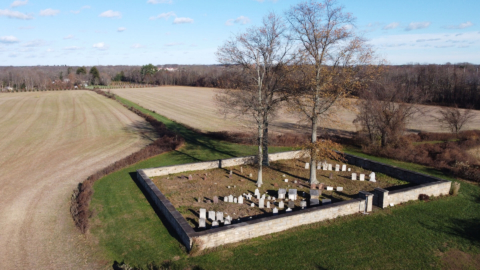
The Schenck-Covenhoven Cemetery sits about 2,000 feet north of the Route 1-Washington Road traffic circle. Listed as “eligible” for the National Register of Historic Places, it’s one of New Jersey’s oldest surviving colonial burial grounds. It holds West Windsor founders, early colonial settlers, and likely Revolutionary soldiers. However, it has deteriorated after being abandoned generations ago. The Historical Society of West Windsor plans to rehabilitate it in the years ahead but needs support from the community. This is its history and our vision.
Current Conditions. The cemetery features around 130 gravestones, representing between 80-100 burials from the 1730s and ’40s to 1941. Most graves face east-to-west, whereas the surrounding fieldstone wall parallels Route 1 and Washington Road. Its oldest legible gravestone at the time of this writing displays a date of 1746 (for “M. I.” — individual unknown), and with one exception, burials ceased by the 1890s. Families are generally buried together, and there are several family clusters scattered throughout.
Although surrounded by Princeton University’s “West Windsor Meadows Neighborhood” campus, opened in 2024, the cemetery is a legally separate “orphaned” plot not owned by any entity. For generations, it served the nearby 18th century neighborhood of Penns Neck (itself currently centered on Washington Road, east of Route 1).
The stones vary in size and material. Many are professionally carved, but some were amateur-made. Some are still legible, but many others are eroded or even broken, toppled, tilted, or sunk below ground. The perimeter wall, too, shows signs of aging. Yet, the University periodically manages the weeds, and most importantly, most graves are identified with specific individuals, thanks to various surveys since the 1880s.
Colonial Roots. In 1693, William Penn — Pennsylvania’s founder — purchased more than 6,500 acres here, northwest of present-day Penn Lyle Road. He and his sons kept it as an investment property for decades but never lived here. In 1737 they sold it to two Dutchmen from Monmouth County: Garret Schenck and John Van Couwenhoven. In that year, the term “Penns Neck” began to appear in writing in reference to this vast territory.
John and Garret divided the land into multiple large estates amongst their children, who settled here. Over several decades, these colonists established the “Penns Neck” neighborhood and replaced native forests and meadows with vast farms stretching across the horizon.
They built this family burial ground sometime between 1737 and 1746. The gravestones reveal many surnames: Covenhoven, Cruser, Dye, Hight, Martin, Oppie, Rowland, Schenck, Slayback, Smith, Stout, Van Dyke, and Voorhees.
From the early 1800s onward, cemetery ownership passed through the Schencks, ending in 1849 with Clarissa Schenck. However, in 1877, a group of neighbors incorporated the “Penns Neck Cemetery Association” to ensure its upkeep. One of its founding members, Eliza Schenck, had the perimeter fieldstone wall built in 1876. Two years later, Clarissa formally deeded the burial ground to the Association.
Abandonment & Maintenance. Although the association’s articles of incorporation provided for annual elections, all of its original trustees died by the 1930s, and there were so few successors that it dissolved around then. They never deeded the cemetery to anyone else, so the burial ground was thereafter permanently an “orphan” with no legal owner or caretaker. Over several decades, it became overgrown with saplings and weeds, and its stones eroded and broke, as it was physically isolated from, and increasingly forgotten by, the neighborhood that had created it all those generations prior.
In the 1940s, Princeton University bought the farmland around — but not including — the cemetery. Although a few restoration efforts occurred in the 1960s and ’70s, the burial ground itself was largely uncared for until 1993, when the Princeton Baptist Church of Penns Neck assumed stewardship. Four years later, the cemetery was listed as eligible for the National Register of Historic Places. The church cared for it to a greater extent than had been done in decades, including recently restoring a portion of the wall. However, they were limited by funding, so there is much more left to do.
Very recently, Princeton University opened a new campus in the surrounding land, replacing fields of crops with athletic facilities, a parking garage, student housing, and more. Now, the orphaned cemetery persists, seemingly out of place in its new context. However, it is in fact right at home — as one of New Jersey’s oldest surviving colonial burial grounds, a historic jewel of West Windsor, and deserving of recognition, preservation, and respect from all.
Our Vision. Late last year, the Historical Society of West Windsor — a small, all-volunteer nonprofit — began discussing the cemetery’s preservation. After extensive coordination with attorneys, restoration experts, the university, and the Princeton Baptist Church, we assumed stewardship in 2025. We have multiple long-term goals:
1. Gravestone Repair: Especially the many broken, tilting, or flaking, stones that require professional care.
2. Wall Repair: Fixing mortar/stones and intruding vegetation.
3. Tree Care: Removing an overhanging dead tree and assessing the health of the other two in partnership with the University.
4. Landscaping: Weeding, leveling, and possible lighting.
5. Programming: Historic markers, archaeology, research, tours, etc.
However, this project will be very expensive and laborious and, again, we’re a small, 100 percent unpaid volunteer nonprofit, limited by how much funds and volunteers we have.
So, how can you help? By donating or volunteering. It’s going to take a community effort to restore one of our most historic sites for generations to come. To learn more about this project, and how you can help, visit: www.westwindsorhistory.com/pncem.html.
The West Windsor Historical Society is an all-volunteer community nonprofit dedicated to documenting and promoting West Windsor’s rich history. If you like what we do, please consider volunteering or donating. To learn more, visit: westwindsorhistory.com.