Dominique Morisseau, in her three-play Detroit cycle, illustrates the changes in the Motor City, particularly the change from thriving industrial giant to unremittingly decaying shell, by shrewdly and effectively depicting how those societal shifts affect the everyday person trying to get by and survive in peace. Or at least in dignity.
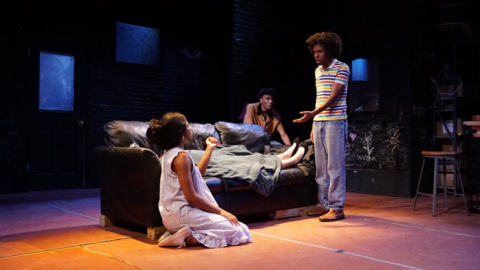
Her play, “Detroit ’67,” at Princeton Summer Theater through Sunday, July 31, concentrates on the Poindexter family and their immediate milieu.
Amid general upheaval in their hometown, the Poindexters — a sister, Michelle (Nyah Anderson), and brother, Lank (Gabriel Generally) — must deal with a crucial personal change, the loss of an influential father who, with his late wife, fostered a tight, loving unit whose underlying closeness Morisseau makes apparent by having the siblings discuss memories and mementoes as well as by repeating the father’s charge to the practical “Chelle” that she exercise some rein on her impulsive brother.
The parents’ legacy includes a house Michelle turns into a latter-day speakeasy by holding nightly parties that include dancing to Motown sounds Lank mixes on his brand new 8-Track — it is 1967 — and drinks by the glass that Chelle and an unexpected boarder, Caroline (Hayley Krey), mix at the explicit-labelled cash bar.
The operation sounds shady, and being unlicensed is illegal, but Morisseau makes it clear such party houses are a tradition in Detroit’s Black community and that Chelle and Lank are being honest and entrepreneurial, making of their new-found assets what they can in a city that doesn’t hold out much opportunity to them.
Subplots abound, such as Caroline being white, attractive to Lank, and sort of a fugitive from the law, and Lank wanting to advance from throwing parties to having his own bar and dance club on his neighborhood’s lively 12th Street.
The Poindexters don’t live in a vacuum. They receive daily visits from Bunny (Sheleah Harris), a neighborhood gossip who makes her living as a freelance concierge touting night spots and other attractions to people she surmises are looking to find them, and from Sly (Camron Chapple), a long-time family friend who is Lank’s partner in his club scheme and who has a crush on Chelle.
The bigger intrusion on the Poindexters’ lives is what’s happening in Detroit, a city that in 1967 is laden with unrest that on the surface (and in stark reality) leads to decline but also, says Morisseau, to opportunity for people willing to stick out the troubled times and forge some stake towards their future.
While the parties the Poindexters throw are fun-filled and peaceful, their neighborhood, including 12th Street, is being burnt to the ground, both by rioters and the police who are fighting the constant fracas with random, often indiscriminate arrests that include beatings, unnecessary jailing, and destruction of property they consider to be at the root of the trouble.
Morisseau presents a wide, vivid world in detail. “Detroit ‘67” provides a broad view of all that is going on and how it marks the beginning of a new reality for Detroit. Morisseau’s genius is in showing the order Chelle and Lank, as well as Bunny, Sly, and Caroline, are trying to establish in their individual ways amid the chaos.
They have to live among everything around them. That is their choice, but they also choose to live well if their immediate surrounding will let them.
Anike Sonuga’s production for Princeton Summer Theater focuses, as is appropriate, on what happens in the Poindexter home, totally realized in another outstanding and informative set by Jeffrey Van Velsor.
We hear sirens, see occasional flames or red and blue flashers from police cruisers, and are treated, especially in late scenes, to a loud, booming noise that works more like an effect than a realistic or practical background sound, but mostly we learn of the uproar outside by reports from people entering the Poindexter home or, more pointed, from the wounds characters receive when they venture out or the blood stains on their clothing.
Violence and chaos are always in the background, but the Poindexters have more to discuss than Detroit self-destructing. They need to plan their immediate and future needs, some of which are changed by outside developments, and they need to keep the warmth between them going even when it’s challenged by the riots or Chelle’s disapproval of Lank’s choices.
Morisseau’s complexities are discernible through Sonuga’s production, which keeps you involved and rooting for the best each of the characters can expect because Sonuga and company are so direct in their approach. Their push is towards clarity and reality, but it’s sometimes at the expense of intensity and edge.
Nyah Anderson anchors a cast that gives all of the characters definition and a spirit that drives you to like them even when you fear for their decisions, as the pragmatic, intuitive Chelle does.
Anderson registers so many of Chelle’s traits, from the hard-nosed businesswoman who is going to make the most of her parties to the maternal woman who not only takes pride in her son, away from Detroit to study at Tuskegee University. Yet, she also cares for her brother, Sly, and even Caroline.
We see Detroit from every character’s point of view, ranging from Bunny’s fearless woman about town to Lank’s dreams and Chelle’s planning, but it is Chelle, with her combination of doubt and hope, her ability to calculate adversity and advance to the next step, and her dogged belief something positive can come from the chaos, who garners our attention and affection. Anderson makes that happen with the quiet simplicity of her performance.
The general simplicity Sonuga imposes may not be enough to show the full scope of ‘Detroit ’67.”
Nothing is missing. All facets are noted, and Sonuga makes sure you know all Morisseau intends to impart. Her solid production would be stronger if there was more underlying subtlety and a deeper, more unrelenting mood of tension was established.
Affecting though this production of “Detroit ’67” is, it lacks fine points and shifting emotional levels that would raise it from sufficient to special.
Sheleah Harris is a wonderful Bunny who leavens every scene she’s in and mixes a carefree nature that registers as genuine with signs that Bunny knows how the world works and how to make it work for her. She also comes through as a friend and sounding board when Chelle needs one.
Gabriel Generally is a mercurial Lank, mischievous to the point of being silly one moment, determined and committed the next. Camron Chapple exudes charm as Sly. Hayley Krey provides perfect balance to Anderson with her straightforward yet nuanced performance as Caroline.
Two points make me wonder. One is why Sonuga had Anderson and Generally speak in almost a whisper in the final scene. The other is why Morisseau thinks it’s odd that Caroline knows all about Motown music when she lives in Detroit and, in 1967, every teen from Seattle to Miami, white, Black, or otherwise, knew The Temptations, Four Tops, Marvin Gaye, Smokey Robinson, and Gladys Knight.
Detroit ’67, Princeton Summer Theatre, Hamilton Murray Theatre, Princeton University, through Sunday, July 31. Thursday through Saturday, 8 p.m., and Saturday and Sunday, 2 p.m. $29.50 to $34.50. 732-997-0205 or www.princetonsummertheater.org.