Both in general and in terms of musical theater, the Princeton Festival was eclectic, touching on various genres and types of music and featuring a panoply of large works and small.
The event produced by the Princeton Symphony Orchestra presented a variety of musical programs at Morven Museum & Garden and Trinity Church in Princeton from June 9 through 25.
Theater being my métier, I saw a contrasting trio of performances — “Broadway’s Next Hit Musical,” “The Barber of Seville,” and “I Am Harvey Milk.”
The first took audience suggestions for song titles, fished from a bowl filled pre-show, and improvised a new tune, allegedly from a new musical, around it. The second, of course, is Rossini’s classic opera. The third is an oratorio by Broadway composer Andrew Lippa (“The Addams Family,” “The Wild Party”) for a men’s chorus, vocalists, and orchestra, about slain gay rights pioneer and San Francisco City Supervisor Harvey Milk.
All were worthy outings. While it’s difficult, unless you’re Irving Berlin, to come up with a passable song on the spot, the “Next Hit Musical” ensemble did it consistently. “The Barber of Seville,” conducted Rossen Milanov and directed by James Marvel, was a sprightly affair that involved physical comedy and gymnastic choreography that turned the “stand and deliver” approach to opera on its ears and left it there. “I Am Harvey Milk” has a lush score, conducted by Lippa, and offers glimpses of moments in Harvey Milk’s life rather than giving a chronological history or attempting a full biography.
What impressed most was the skill of variety of the performers. “Broadway’s Next Hit Musical” is a piece designed to travel and as easily play one-nighters as a long run. “The Barber of Seville” and “I Am Harvey Milk” are produced by the Princeton Festival, each to take the stage and mere three times then disappear. Given the ephemeral lifespan of these productions, it was remarkable to see the quality of detail, precision, and design aspects that went into each show and how well-rehearsed they were.
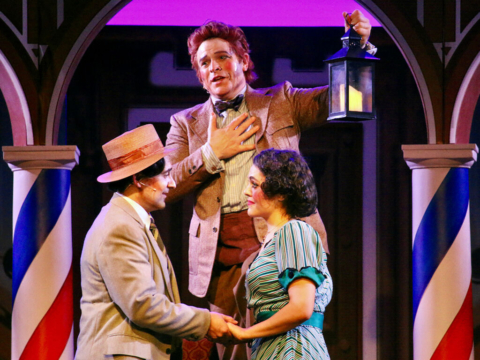
Marvel’s “The Barber of Seville” was a relentless romp that had characters and chorus members bustling about the stage in ways that would have daunted and stymied opera casts of the past. The pace added to the comic nature of the piece and made me all the more awestruck about how much attention was given to theatrical details other than voice. Kaitlyn Costello Fain, who played Dr. Bartolo’s housekeeper, Berta, not only sang her arias with silky mezzo aplomb but spent time between numbers doing a gymnastic display that was as breathtaking as it was exciting. In fact, it was worth pondering how Costello Fain could endure such a workout, serial cartwheels and all, and emerge singing so clearly and strongly.
It was clear this “Barber of Seville” was going to stress comedy from the moment one entered the spacious tent on Morven grounds that served as the Festival’s primary performance space. As is usual today, there was no curtain, so when you looked at the Blair Mielnik’s wittily kicky set, the first thing you saw was a structure the columns of which were painted like barber poles, red, white, and blue in diagonal stripes. Mielnik’s scene painters even made the stripes seems cylindrical. Then, to suggest the dustiness of Southern Spain, Mielnik had a village views painted in a a pale, muted color palette that gave them a shade of Braque painting, at first glance later corrected, a cubist effect, too.
This is a set built for fun, and Marvel and his cast provided it. As Milanov brought out the cheery aspects of Rossini’s score, Marvel coached his cast to be triple threats. Andrew Garland’s Figaro was as many places in one scene as his character’s famous opening largo suggest. Kelly Guerra, already known to be fine singer and actress from her work last year in the Festival’s “Scalia/Ginsburg” showed she had natural comic gifts. Steven Condy as Bartolo and Eric Delagrange as Basilio showed they were game for Marvel’s hijinks. Cody Müller, another alumnus from “Scalia,” added to the impression he made last year by including well-timed physical comedy is all three of his role. Tenor Nicholas Nestorak was not as physically flexible as his castmates, but he used his costumes and verbal joking to earn his share of laughs.
Marvel might have indulged in some overkill. But “The Barber of Seville” is, at heart, a farce, so the excess of stage business, including a lambada, could be forgiven. I would have liked, though, fewer pratfalls and more attention to making the romance at the center of “Barber” to foment.
The voices were marvelous. Guerra has a pure, full soprano and a knack for finding the right emphasis in each phrase she sings. I have a feeling people who saw her at the last two Princeton Festivals will be boasting of the experience when Guerra becomes a star.
Nicholas Nestorak is another whose voice is smooth. Serenading suits him.
Vocally and theatrically, Andrew Garland was a perfect Figaro, always with a look of resourceful mischief on his face and suppleness in his deep baritone.
Steven Condy’s subtlety as Bartolo made him more comic than the performers who acted out more. Condy played Bartolo as no fool, which gave his portrayal more texture. Eric Delagrange fell into form as Don Basilio, strong of voice and able to wring to laugh.
“Broadway’s Next Hit Musical” was played for laughs. Rob Schiffman included oodles of puns and one-liners in his opening monologue and introduction to segments. The musicals he and his crew created were meant to tickle audiences more than warm them.
The currency here was quickness, the aim to dazzle the audience with how clever you can be making while generally making up a song on the spot.
Audiences put song titles in a hit, and performers picked them randomly and presented a tune alleged to be the hit song from a hit musical. (My entry, “Ways I Miss You” was read out as an interesting choice, but I declined to stand and claim it.)
Five songs competed for a “Phony” Award, the winner of which had a full musical built around his or her improvisations. This means “Broadway’s Next Hit Musical” is a different show every time. The winning song in Princeton was “Love Under the Washington Crossing Monument.”
Heidi Gleichauf, who picked the song, did not know when Washington’s Crossing Took Place.” Lynn Schiffman, working with her, had to say, “I think it was in 1776” when Gleichauf mentioned 400 years ago. No matter. Gleichauf atoned for her ignorance of history with a rousing tune, no mean feat for a song title she said “just trips off the tongue,” and included a bit in which she, standing like Leutze’s George Washington in a boat, begins to row.
“Broadway’s Next New Musical” could be less scattered, less precious, and less self-confidently political. (Audiences, as Schiffman found out and commented on, may not agree with you.) In general, though, it provided a good time.
Andrew Lippa endows “I Am Harvey Milk” with a full and beautiful score it was a pleasure to hear. Actors, particularly pre-teen Benjamin Pajak, did a fine job in singing it and giving volume to Lippa’s impressionist look at who Harvey Milk was, what he stood for, why he stood for it, and how he died.
The weak link to the oratorio is the lyrics, also by Lippa. They are direct and simplistic in ways that have become the bane of music theater lyrics in the 21st century. Ideas and emotions aren’t expressed with imagery and poety. They are baldly stated. Lippa’s point may be that Harvey Milk liked to get to the point and forgo fanciness. I, though, became bored with them. They almost became anthems.
The lack of subtlety or verbal artistry extends sometimes Lippa’s book. Harvey Milk being called the verboten “f”-word used about gays has no power when it is led up to ways that are expected and have little finesse. Lippa’s piece is 10-years-old, but I think its writing, not its music, needs work.
Pajak as young Milk, Adam Kantor as the adult Milk, and Scarlett Strallen as Milk’s difficult mother all sang well. Stacey Stevenson, an activist and non-actress, created some of the oratorio’s more stirring moments reading the word of famous anti-gay figures such as Anita Bryant and Milk assassin Dan White.
The Princeton Festival’s Male Chorus was excellent, especially five who came forward to do a dance scene.
For more information about the Princeton Festival and the yet to be announced schedule for 2024, visit princetonsymphony.org.