Joni Mitchell was really onto something when she wrote the song “Woodstock,” particularly the words, “we are stardust.”
It’s the concept that we are all from and of the stars, made of the same stuff, that basically we are all one.
Yet, society and especially 21st century American culture, wants to divide us into good and bad, smart and dumb, productive and unproductive, etc. These divisions, and the undercurrent of competition, keep us separate, and especially keep us from self-integration — from a deeper understanding of ourselves.
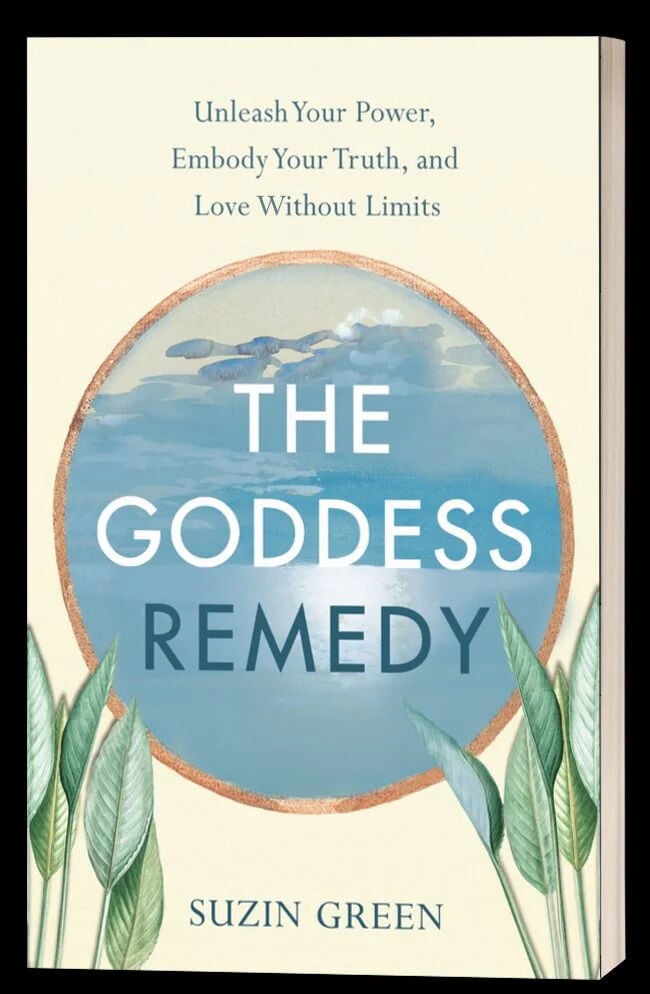
Longtime musician, healer, and psychologist Suzin Green takes the idea of oneness and runs with it in her new book “The Goddess Remedy” (She Writes Press, 2026).
Drawing on decades as a musician, writer, meditation teacher, and therapist, Princeton resident Green illuminates how the goddess paradigm offers a revolutionary approach to healing our most painful divides: doing versus being, mind versus body, and masculine versus feminine — divisions that keep us out of balance and disconnected from ourselves and the world.
Weaving myth with memoir, yogic philosophy, poetry, and soul-centered psychology, “The Goddess Remedy” is both a practical handbook and manifesto of love. Green provides tangible tools for anxiety relief and trauma recovery while simultaneously charting a path of sacred activism, shadow work, and self-care.
“The Goddess Remedy” will be released on January 20, available in book stores and online. The initial launch party is private, but a public book event is planned for Sunday, February 22, at 4 p.m. Princeton Makes in the Princeton Shopping Center.
“My book is an interesting cross — part memoir, part sociopolitical analysis, part wisdom philosophy, and a self-help component; it spans many different genres and is really one of a kind,” Green says.
“These ideas have been kicking around since the ’90s, but I had so much other work, I was focused on my music and my private practice,” she says. “But this book really wanted to be written. Back in 2019, I thought to myself, ‘if I don’t put everything [else] on the back burner, I’ll be too old to get this done.’”
So, Green put her musical life and private practice on hold and sat down to write. Then came the COVID pandemic and lockdown. In its aftermath, there seemed to be an upsurge in symptoms of a sick society — poverty and illness, crime, war, political infighting and violence, etc.
That’s when the author knew she was on the right track.
“I’d been thinking about these ideas for a long time and worried that they were no longer relevant, then the politics exploded in our faces,” Green says. “I had thought that patriarchy was yesterday’s news, and now it’s on everybody’s mind.”
“It’s a system that ranks thinking over feeling, man over woman, doing over being,” she explains. “There’s nothing wrong with thinking or doing, but it needs to be grounded and balanced with its other half – the ‘doing’ masculine needs to balance with the ‘being’ feminine.”
This division is wreaking havoc on our culture, on the ecology and survival of the planet, and on everyone’s mental health, Green suggests.
“(When we) split off from the feminine, from simply ‘being,’ we end up with a system that’s lost in its own mind and feels alienated,” Green says. “The key is to integrate with its inner core. The current (way of life) wants to conquer more, control more, own more, rather than just ‘cleaning our own house’ and nurturing our own systems.”
Perhaps the biggest takeaway from “The Goddess Remedy” is the myth that we’re separate from one another — isolated individuals strapped in a zero-sum game based on survival of the fittest. When we step through this veil, we realize we’re part of something much greater.
“We’ve been tricked into believing we have to be more, do more, strive after that elusive more, which no matter how close we get to it always eludes us,” Green writes. “This is a lie. When we slow ourselves down, pushing back against the compulsion to do more, be more, strive more, we discover a simple truth: that even in all our wounding and muddle, we are enough. And that rather than seeking outside ourselves for the everything we think is there, what we really need to do is turn within and listen.”
However, this is not to say that “The Goddess Remedy” suggests we all retreat from the world. On the contrary, “The world very much needs us,” Green says. “It needs us awake, it needs us engaged. It needs us understanding that the answers to the great longings of life are not outside of us, and have never been.”
Green’s book shows how the goddess lives within everyone, regardless of gender identification. In the pages of the book, we discover four essential archetypes of the goddess that are gateways into all the best within us.
The author reflects that when she first started thinking about the goddess, it was in the ’70s, during second wave feminism, when one of the threads of the movement was awakening to the goddess.
“I always had a mystical leaning, and it was revelatory to discover the feminine faces of the divine, learning about the goddesses, about how thousands of years of life on earth had been suppressed, had been covered over by what came next,” she says.
“At first ‘the goddess’ was just for women, an image or motif that we could use to build our empowerment,” Green says. “But this isn’t about just women awakening to a metaphor that helps us feel better, it’s about a world culture that needs to repair the split.”
For example, the book notes a certain kind of “patriarchy living in your mind,” and makes suggestions on how to recognize how thousands of years of conditioning show up as self-doubt, people-pleasing, and the exhausting split between constantly “doing” instead of just going with the flow and
“being.”
“I’m being a little tongue-in-cheek when I say we aren’t really ‘human beings,’ we’re ‘human doings,’” she says. “Our ‘doing’ function is masculine and our ‘being’ function is feminine. And the ‘human doings’ are really making a mess. It’s a simple way to understand the book.”
Our patriarchal/critical mind oppresses us and wants to make us feel badly about ourselves, keep ourselves stuck, trapped and addicted.
“It’s about acquiring more and more and more – houses, money, drugs, etc.,” Green says. “And when we do acquire the shiny new objects, we only want more.”
“That inner longing is never satisfied,” she says. “So we’re awakening the inner goddess, balancing, and what is released is the true, wise masculine that’s been trapped for thousands of years.”
The book is laid out in three major sections. Part one unpacks the idea of the split between masculine and feminine and how it is causing chaos in society and our collective psychology.
Part two breaks down the archetypes of the goddess, suggests how these can be blueprints for all of us, and explains how to work with them to be aware of our inner being.
Part three is about integration, where we learn how the feminine and masculine can work together. Green has created six practices, simple acts that can guide readers on the pathway to healing and awareness.
“That’s my hope for readers is that by the end of the book the reader finds this profound integration, finds ways that we can be real masters in our own lives,” Green says.
Despite the title and references to a handful of female goddesses — Kali, Saraswati, Lakshmi, and Kuan Yin — “The Goddess Remedy” is not just for women.
“I wrote it for everyone, but it might be more important for men,” Green says. “We hear so much about young men are having such a hard time. They’ve been forced into this isolation from their ‘healthy’ masculinity.”
“We want our young men to be masculine, but we want to masculinity to be wise, not driven by fear and alienation, but rather driven by wisdom and clarity and compassion,” she adds.
The author is a writer, musician, therapist, and meditation teacher known for her embodied wisdom and ability to guide others into profound stillness. An influential voice in the American yoga and kirtan movement, she is also mom to Coby Green-Rifkin, director of communications and marketing at Rutgers (New Brunswick) Graduate School of Education.
“We are all one” and “when you compete, you only compete with yourself” may be part of the old hippie ideal, but they’re not such bad philosophical concepts, on reflection.
“I’m a Baby Boomer, and I know that Millennials and Zoomers sometimes hold us in contempt, but the values we brought in were great, and I still believe we are all one,” Green says. “I still believe in love, and I’m not going down without a fight.”
The Goddess Remedy by Suzin Green, will be available in stores and online January 20. www.thegoddessremedy.com.
Suzin Green on the Web: www.suzingreen.com.