The New Jersey State Museum’s recently opened exhibition, “Beyond the Tangible,” features 26 non-objective abstract works by 22 American artists. The works were created from the late 1930s to recent times and are part of the museum’s fine arts collection.
“A number of the works included in this exhibition haven’t been on view in some time, and we’re pleased to have this opportunity to share them with the public again,” says exhibition curator and NJSM Executive Director Margaret O’Reilly.
According to museum materials, “Non-objective abstraction is a form of art lacking identifiable landscapes, objects, or people. Line, shape, color, and texture take center stage in this art form.”
“The artists have created these works purely for aesthetics. Some employ this form of abstraction as their sole method of expression, while others use a variety of styles to create their works. Each work invites the viewer to engage in a visual dialogue and perceive beyond the tangible.”
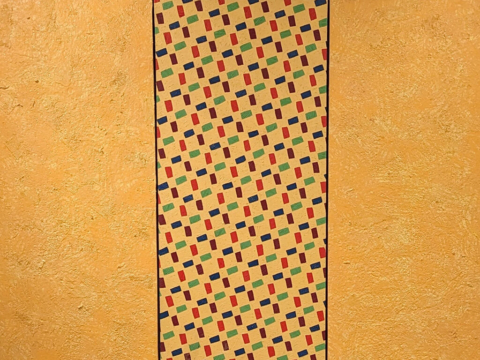
The work “Soot Camp” by James Little offers a peek into the exhibition and an indication of the value of the NJSM’s contemporary art collection.
Former fines arts curator Alison Weld writes in “Art by African Americans in the collection of the New Jersey State Museum”:
James Little, the third of seven children, was born to Rogers and Annie Simmons Little of Memphis, Tennessee. Little attended the Memphis Academy of Art, where he majored in painting, studying with Ted Faiers, Burton Callicott, Veda Reed, and David Rocha, whom he credits as significant teachers. In 1975 he left Memphis for the graduate school of New York State’s Syracuse University, where he was a fellow in African-American Studies. In his last year there, he achieved the honor of becoming a Marion Jones Scholar. After graduate school, he moved to New York City, where he currently lives. The son of a construction worker and a cook, he was introduced to the craft of art by drawing “paint by number” imagery and by mixing plaster, concrete, and foodstuffs while helping his parents. He began to paint at age eight, copying from European masters. At times he used illustrations as source materials.
The majesty of nature is and has been important to Little, who is an abstract painter. “Soot Camp” (1980), which was created using levels, stencils, frottage, scrottage, and the admixture of water and oil, also refers to textile design and is thus grounded in craft. On many Little begins by empirically mixing his paint to achieve the right color and hue. “Soot-Camp,” which also brings to mind the off pastels of the 1950s, whether in the “Necco” wafers or commercial tiles used in the home, is also imbued with an idiosyncratic quality visible in its pockmarked, moonlike surface and the odd color.
His philosophy and aesthetics professor, Dr. Jameson M. Jones, also left an indelible mark. Little’s paintings of the late 1980s were symbolic and sacred circles. Little strives to achieve a tactility and objectivity, reflecting the architecture of New York City, its manhole covers and steel plates, and ultimately, its physicality. He responds and works on each canvas until it “breathes its own air.” To achieve the unique surfaces of his paintings, he blends oil with water, using a kitchen blender. He sees color as a reflection of mood types and his surface as the substance of character and intuition. Kenneth Noland, Alma Thomas, Max Ernst, and Francis Picabia, as well as Dubuffet’s Art Brut and Piet Mondrian, have affected Little.
“Soot-Camp,” which symmetrically frames a pattern reminiscent of fabric cut along the bias, results from Little’s fascination with the mundane details of New York City’s environment. The work may be seen as a grid of endlessly repeated crosses. Little also believes that Gospel, Blues, Jazz, Rhythm and Blues, as well as Abstract pattern Expressionism have been formidable factors in his development as an artist.
“Beyond the Tangible” is on view through August 27. The New Jersey State Museum, 209 West State Street, Trenton. Tuesday through Sunday, 9 a.m. to 4:45 p.m. Free.
For additional information, visit www.statemuseum.nj.gov.