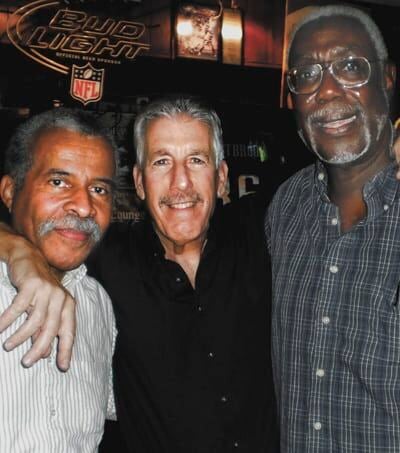
It is likely that Bob Smith’s lack of formal training on the guitar is a big part of what makes the sound of Bob Smith’s Organ Trio unique, something that area jazz fans can hear this weekend at the Candlelight lounge and later in the month at Cafe Amici Milano, both in Trenton.
The Trenton-based Smith was raised by his mother, Annie Smith, in Swainsboro, Georgia, on a farm that produced cotton, tobacco, and peanuts. That was several years before the family joined the migration to the north.
Although he did not know his father, he knew how to play the guitar as a five-year-old, says Smith, adding that he never took lessons but learned by watching his grandfather and his guitar-playing uncles.
Shortly after arriving in the Princeton-Trenton area in 1957-’58, Smith went into a musical instrument store one day to inquire about taking formal lessons. “The guy listened to me play for a few minutes and then told me, ‘If I gave you lessons, it would be like you learned all over again, because you doing everything backwards.’ ”
So with his singing uncles and with other ensembles, “I learned to play by ear,” he says, noting he still cannot read very much music.
Being raised in rural Georgia, it seems natural that he became aware of blues, gospel, and of course country music via the radio. But he did not really learn about jazz until he came up north, after high school, to join relatives in Princeton.
Combine Smith’s gospel and blues-flavored guitar stylings with Tommy Pass’ [Passarella’s] tasteful and occasionally eccentric Hammond B-3 organ treatments, and you have soul-jazz trio that can lock into a groove tighter than a pitbull on a mailman’s leg.
Since the untimely 2005 death of their longtime drummer, Newt Stewart, the duo has been more than ably backed up by drummer Tommy Burrows. But for special gigs at Amici Milano in the Chambersburg section of Trenton, the duo is joined by drummer Lenny Pucciatti.
Just where is Swainsboro, Georgia?
“It’s not near anywhere,” Smith laughs and says, “It’s way out in the middle. I came up here in 1956 after high school looking for a job, because my mother and uncles lived in Princeton.” Smith found musical work right away, accompanying his uncles in their gospel singing quartet, but one day he was outside playing his guitar and someone in the neighborhood who knew some things about jazz and blues heard him play.
“This guy came up, he’d heard me playing, and he said, ‘I want to start a band. Do you want to join?’ He didn’t know me, but he knew my uncles. We did one rehearsal and got the job in Jamesburg, at a place called Hubby’s Inn. We ended up playing there for like, three months on Friday and Saturdays,” Smith says. While that was going on they nailed down another gig in another once-small central New Jersey town, the borough of South River, where the newly formed group played at the Thunderbird Inn.
“We came back to Hubby’s for a time, and then finally we played in Trenton,” he recalls, noting he was in his late teens. It was 1958 that he began playing professionally in earnest. By 1960, after he had turned 21, he was playing the Harlem Club in Trenton (later known as the 302 Club) with a saxophone, bass, and drums. Smith always sang when tunes required it, and he still does.
“One Saturday night I heard a big commotion in there. This guy is bringing in a Hammond B-3 organ, but he was just there to sit in; his name was Richard Corbin. He said to me, ‘A friend of mine has a job up in New Brunswick, a place called Nessie’s. It’s a Friday-Saturday-Sunday job; they already have an organ up there. So that was my start in jazz.”
Smith credits Corbin and well known saxophonist (and the trio’s special guest at Amici’s on Tuesday, January 21) Tommy Gryce with giving him his basic jazz education, extending Smith’s already accomplished blues playing.
If it hadn’t been for his grandfather’s guitar, which was around the house when he was growing up, Smith says he is not sure if he would have ever shown an interest in music.
After a hitch with the Army band in Korea in 1965 Smith returned to his day job — shipping supervisor for the former Princeton-based D Van Nostrand publishing company — and continued to pursue his music as an avocation on weekend nights. Today he continues mixing his music jobs with his part-time employment with Princeton Delivery Company.
Hanging around Trenton in the 1960s, he got to know Philadelphia-raised organist Jimmy McGriff, a friendly man who left his day job as a policeman in Philly for a life on the road, playing the blues behind his Hammond B-3 organ. If any organist was synonymous with Trenton, to be sure, it was McGriff, who got his feet wet in Trenton clubs.
“When McGriff first started out here in Trenton it was at a place called Club Parkview. I used to go down there and sit in with him, and at that time, [fellow Hammond B-3 organist] Charlie Earland was playing sax with him. We hit it off and did a lot of Jimmy Smith tunes. [Jimmy Smith is usually thought of as the pioneer king among Hammond B-3 players.] They were ready to go on the road, but I wouldn’t go on the road with them. Jimmy McGriff used to tell people, ‘I really like the way Bob plays, but he won’t go on the road,’ Smith says, who preferred the security of his job.
His marriage to well known area vocalist Barbara Trent may have also been a factor. The couple — now separated — has two children, Scott Trent and Guy Smith.
The Bob Smith Organ Trio has just one album out, in CD format, “Beautiful Friendship,” which showcases the drum stylings of Stewart. “Newt was how we all got together,” Says Smith. “Pass and I had worked together, but Newt was a drummer who lived up in Princeton. He had a lot of private jobs, and he would use different people to play. Tom Pass and I never worked with Newt until one day he called us to play a private job, and the three of us just hit it off. It felt so good, the three of us playing together.”
Smith’s friend, fellow area guitarist Dick Gratton, wound up with two jobs one weekend and asked them if they wanted to take one of his jobs at the Newtown Pub, just across the river. That job lasted for months, and the three of them knew they had something special as a trio.
“One night somebody came up and asked me, ‘What’s the name of your group,’ and before I had a chance to answer, they both chimed in, ‘the Bob Smith Trio.’ “
“If Tom Pass got a job it was his trio; if Newt Stewart got the gig, it was the Newt Stewart Trio,” Smith added, noting it took both he and Pass many months to recover — musically, spiritually, and emotionally — from Stewart’s death.
“We were thinking about recording another album when Newt passed away. It was such a shock when he died. We didn’t just play clubs together. We hung out together when we weren’t working,” Smith says, “(Stewart) just went to sleep one night and didn’t wake up.”
The repertoire for the Bob Smith Organ Trio includes a few of the band’s originals, but mostly it dips heavily into the catalogs of recordings by other great Hammond B-3 masters: Smith, McGriff, Charles “The Mighty Burner” Earland, Rhoda Scott, Richard ‘Groove’ Holmes, and Don Patterson. Tunes include familiar fare to even casual fans of blues-based jazz: “Georgia on My Mind,” “Every Day I Have the Blues,” “Beautiful Friendship,” and Stevie Wonder’s “More Today Than Yesterday.”
Reached Christmas week at his vacation home in South Carolina, organist Tom Pass — raised on Bert Street, on the border of Chambersburg, right next to St. Francis Medical Center — says that he became involved with music from the time he was eight and credited “some very fine instructors” at Trenton Central High School. After he graduated from Trenton State College, Passarella returned to Trenton Central as band director and worked his way up to supervisor for fine and performing arts for the Trenton School district. He retired in 1999.
“I started with accordion at age eight, and it’s just a natural transition to organ from there. Accordion was an acoustic synthesizer, and you didn’t need electricity to play it,” Pass says, “With accordion you play left hand bass, and with the organ you play left hand bass.”
Pass picked up a small spinet organ in 1971 and his first gig was playing at Lanzi’s Lounge on Liberty Street.
“I played there on weekends when they would have pop groups. I played pop music until 1978 or 1980, and then made a transition back into jazz after I met Bob Smith in 1982 at a gig. I knew of him and knew who he was. We’ve been working together pretty much ever since then.”
Playing the old classic Hammond B-3 organ is not for the faint of heart. Just ask players around the Shore or in other parts of the state of who had hernia operations from lifting and moving the massive instrument and related Leslie speakers. As Bernardsville-based John Ginty — who’s accompanied Citizen Cope and the Dixie Chicks on their world tours says, “it’s a 425 pound commitment.”
“It’s a financial commitment to purchase one and I also had to buy a van,” Pass explains. Once the Bob Smith Organ Trio began working together in earnest in the early 80s, “we carried that organ up and down stairs and steps and hauled it over bars to get it into places to play until the early 1990s.” At that point, he put the organ away and bought a more portable Hammond B-3 clone, still made by Hammond, but weighing in at only 35 pounds.
Pass says his main influence on Hammond B-3 was another organist who came out of Philly, Don Patterson. Pass’ home record collection includes all of Patterson’s recordings and at least another 80 or 90 recordings by other Hammond B-3 players.
“You didn’t take lessons on Hammond B-3 back in those days; you had to learn by listening to records,” Pass says. Pressed about high points of his time with the Bob Smith Organ Trio, Pass says they would have to include a show in 2001 or 2002 in tribute to McGriff at the Trenton Jazz Festival. McGriff, in declining health, was able to attend the concert.
“Another time I was on stage with Wild Bill Davis opening for Count Basie at Trenton Central High School, but really, through the years, Bob and I have worked with some very fine players. Great local players like Richie Cole and Clifford Adams often come and sit in with us.”
After all, it is the unique sound that makes music sing.
The Bob Smith Organ Trio, Candlelight Lounge, 24 Passaic Street, Trenton, Saturday, January 11, 3:30 to 7:30 p.m., 609-695-9612.
Top Shelf Lounge, 5564 Market Street, Philadelphia, Saturday, January 18, 4 to 8 p.m. (musicians invited to sit in), 215-748-4245.
Amici Milano (with special guest Trenton’s Tommy Gryce), 600 Chestnut Avenue, Trenton, Tuesday, January 21, 8 to 11 p.m., and continuing every other Tuesday.