In Brian DePalma’s satirical 1970 movie, “Hi, Mom!,” the directors inserts a long black-and-white scene in which a white Greenwich Village audience attends a play called “Be Black, Baby” in which they are put in black face, made to eat soul food, and insulted before being driven out of the theater.
Of course, in keeping with the satire, the white audience loves the show, lavishly praising its experience while a black actor mutters, “They didn’t get it at all.”
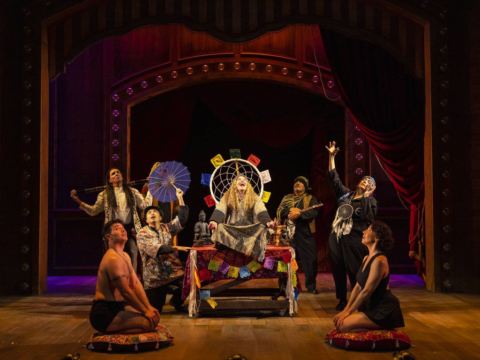
“Between Two Knees,” a work written in ensemble by The 1491s and at Princeton’s McCarter Theatre through Sunday, February 12, is filled with satire. Much of the show is done in vaudeville style, including a hilarious opening in which the cast walks individually on stage, each imitating a stereotypical image of a Native American that you might see in a movie or some other portrayal. (Irving Berlin’s “I’m An Indian, Too” from “Annie Get Your Gun” plays in the background following this scene.) Another scene, equally funny, depicts Rachel Crowl as a modern shaman purporting to conduct, as advertised, “an authentic Indian wedding ceremony.”
“Between Two Knees” has several purposes and takes several different tones during its two acts. It is most successful when it settles on comic sketches that lampoon popular images of Native Americans, as described above or as exemplified by the constant presence of the former Cleveland Indians logo that peeps out, triangle eyes and forehead only, from the top of the fake proscenium The 1491s use to frame their bits.
The show is also effective when it depicts domestic scenes that involve an indigenous American family but can just as pointedly refer to any family throughout the world.
Amid the broad comedy and exaggerated melodrama come segments that are more serious and more disturbing.
Though narrator and general master of ceremonies, Larry (Justin Gauthier) remains lighthearted through most of his patter, at times sounding as if there’s a giggle in his voice, some of what he says is serious and meant to be taken seriously.
Satire or the idea that “Between the Knees” is primarily a lark that puts poignant information in a digestibly comic form go out the window during these passages.
For instance, Larry in a joking voice says he wants the white people in the McCarter audience to feel guilty because of some of what they see and learn during “Between Two Knees.” Towards the end of the show, the guilt is practically demanded, assuming a moral high ground has been established, and one, in decency, can only acquiesce to what is being bidden, i.e. feeling guilt.
Hence my reference to “Hi, Mom!” at the beginning. One group, perhaps from turnabout being fair play, is being ridiculed and denigrated by another group. The change in direction from the group that usually takes the walloping and the designated group of “privilege” doesn’t matter. Wrong is wrong. Any idea that disdain can be reversed and should be accepted in good sportsmanship (or because of alleged just desert) is a double standard, the kind that is prevalent in woke 21st century thinking.
Matters take a deep and ugly turn towards the end of the second act when a ditty that begins lightly but is clearly sincere, says “So Long, White People” and celebrates, with intention, the elimination of Caucasians from American soil and, by extension, the world.
Members of the McCarter audience are asked to learn the doggerel lyrics, neither thoughtful or profound, and wave their arms, as Larry directs, as the “So Long, White People” chant continues for several verses.
I did not wave my arm. Nor did I sing along. The song was too lame for me to participate even if I agreed with the sentiment.
Larry goes one to posit a world without capitalism and other bêtes noires of the progressives. He is entitled to his opinion. It is clear why the ensemble calls itself The 1491s, even before Larry explains it. What he and the 1491s are not entitled to do is to assume agreement with its point of view, let alone celebration or actions one does not find in his or her best interest.
Turnabout is not fair play. It’s only turnabout, and it’s as unfair as it was before the turning.
On radio once, I was asked what I thought of Vice President-elect Mike Pence being booed as he entered a Broadway performance of “Hamilton.” I asked the host what the same audience would do if a different segment of the audience booed Nancy Pelosi. Booing either is wrong. The trendy and popular might win cheers from the political of one side or another. It doesn’t make an act or an attitude correct.
“Between Two Knees” was marred by its wandering from the satirical and clever to making a statement about guilt and applauding the extermination of an ethnic group. I can hear Gauther and his fellow 1491s echoing DePalma’s black actor and saying, “This guy didn’t get it.”
I did get it. I can praise what works. I will point out the nefarious, especially since it is a double standard and would never be tolerated in reverse. “So Long, White People” and the idea that someone can stipulate another’s guilt is enough for me not to recommend this show in spite of the standing ovation it received from the McCarter audience on opening night.
This is a shame because “Between Two Knees” contains some fine moments. In essence, it follows a family from December 29, 1890, the day of the Wounded Knee Massacre in South Dakota and 1973, when Wounded Knee is used as a protest site to gather Native Americans seeking civil rights.
“So Long, White People” stems from an 1890 scene. A woman who thinks she is uninjured and is calming an infant is her arms is shown to be mortally wounded, as are 3,000 of her kinsmen. As she gives her child to two others to be raised, she prays all white people be subsumed in a hole and removed from the land. The song is sung when this prayer allegedly is answered. (“Between Two Knees” doesn’t get the historical facts about Wounded Knee entirely right, but the important fact, that a generally peaceful encampment was attacked, is sadly true and suffices for the purposes of the show.)
The child becomes an archetype of sorts. He is taken into a Native American family that stands for generations of families — Wotko Long, Jennifer Bobiwash, Derek Garza, Shaun Taylor-Corbett, and especially Shyla Lefner all excellent in their roles as the family goes from old Western America to the modern era.
Several scenes become poignant as the archetypical family raises a legion of foundlings and adopted children that, as the story continues, turn out to be actual grandchildren and great-grandchildren of the woman who loses her life at Wounded Knee. As time goes on, traditions in clothing, lifestyle, and allegiance shifts from indigenous to becoming more America. Perhaps the most touching scene in “Between Two Knees” is when William Wolf, living in 1941, declares his eagerness to join the U.S. Army following the attack on Pearl Harbor (announced by Gauthier’s Larry playing FDR).
William, in this scene, is as Yankee Doodly as any recruit, but it is a single line of his that grabs the heart, a line in which he says he must fight the oppression in Europe and Asia so similar to that his ancestors faced.
In scenes like this and several others, “Between Two Knees” elicits due sympathy and empathy. History is often the tale of people going too far and skewing facts to satisfy themselves. When “Between Two Knees” stays on a genuinely satirical or matter-of-fact course, it has definite merit. When it strays towards the agitprop and assumes agreement, makes demands, or denigrates, it is as bad as any 1940s movie depicting Native Americans as villains.
Between Two Knees, McCarter Theatre, 91 University Place, Princeton. Through Sunday, February 12, Tuesday through Thursday, 7:30 p.m., Friday and Saturday, 8 p.m., and Saturday and Sunday, 2 p.m. $25 to $60. 609-258-2787 or www.mccarter.org.