“A Christmas Carol” more than earns its place with ballet’s “Nutcracker,” music’s “The Messiah,” and film’s “It’s a Wonderful Life” on the Mount Rushmore of winter holiday staples.
In five decades of theatergoing, I have seen hundreds of “Christmas Carols,” from musicals to opulent extravaganzas to one-person shows, including one by Charles Dickens’ great-great grandson, Gerald Charles Dickens.
The best of them, and even the second echelon, never fail to move me. As well as I know the story and details of Ebenezer Scrooge’s transition from bitter tightwad misanthrope to magnanimous patron of the community, the tale Dickens created is chocked with enough texture, melodrama, humor, and humanity to entertain time after time.
Princeton’s McCarter Theatre Company understands the value and attraction of “A Christmas Carol.” Productions, ranging from the simple to the grand, have been a tradition of the theater since Nagel Jackson’s stewardship in the 1970s and ’80s.
This year’s rendition, adapted from Dickens and directed by Lauren Keating, is in the middle of the pack in terms of grandeur and theatricality, but it ranks with the best of the productions from Emily Mann’s era in conveying the drama, redemption, and celebration of Scrooge’s journey from miser to benefactor.
Keating’s script and staging emphasize the high points in Dickens’ story. Important moments seem to be accompanied by theatrical exclamation points as if Keating wanted to make sure the audience noticed and noted the crucial bits from the general run of the story.
This calling of attention to key lines doesn’t mar or harm Keating’s production as much as it changes its smoothness. The extra wink, nod, or stress on a particular word makes its seem as if this production is bent on telling a story with a moral instead of letting the moral emerge naturally as the play goes on.
Dee Pelletier, an excellent Scrooge, is particularly acid as she delivers her character’s more familiar lines, Scrooge’s trademarks. They register well enough, but they seem forced and engineered to unfailingly hit home instead of sounding natural and of the moment.
The cavil, again, is minor, but as Pelletier’s performance proceeds from its hammered beginning, the actor makes it clear she can accomplish a lot with wit and subtlety, which would have been preferred to emphasis that borders on exaggeration or a means to make sure the audience gets what is obvious whether one knows “A Christmas Carol” or not.
Pelletier and Keating are at their best in vignettes shared by the spirits of Christmas past, present, and future, whose serial visits are foretold to Scrooge by the ghost of Jacob Marley. These sequences show Scrooge’s metamorphosis in progress. They make his path towards sociability more gradual and evolving, as opposed to being sudden or a last-minute revelation.
Rather than remaining a benign, studying observer of the scenes the various spirits reveal, Pelletier’s Scrooge responds emotionally and viscerally to visions that range from nostalgic and sentimental to worrisome and foreboding.
As direct and deliberate as Pelletier is in early scenes that establish Scrooge as a self-centered curmudgeon is how free she becomes in expressing eagerness, enthusiasm, or concern as, via the spirits, Scrooge relives his hardscrabble childhood, glimpses his once-promising future that included romance and mirth, feels again a disappointing love, reacts to overhearing people’s unkind opinions of him, and realizes the likelihood of stark, unthinkable fates for two of the characters.
When Scrooge sees his sister, Fan (Alesiandra Nikezi) or one-time fiancée, Belle (Legna Cedillo) for the first time in decades, Pelletier’s responses are movingly palpable, even more than when she first sees Scrooge’s younger self.
You see the memory of emotion spring to Pelletier’s face and posture. Genuine joy and happiness register there. The same occurs when the merriment of the Fezziwig party during Scrooge’s early apprenticeship and a visit to Scrooge’s nephew Fred’s lively, festive home are shown to him.
Pelletier’s Scrooge longs to jump into the reel his younger self (Matt Monaco, who also plays Fred) is doing with his Fezziwig colleagues. He can’t resist participating in singing or play a guessing game with the cheerful guests at Fred’s. On both occasions, he gives in to his bubbly will.
It adds texture to see the younger, inner Scrooge who recognizes and can share in fun and who can add sociable, buoyant living to his meager existence counting money and eating gruel.
Pelletier is equally adept at showing Scrooge’s empathy towards the Cratchit family (Kenneth DeAbrew, Gisela Chipe, Sam Roman, Charlotte Ward Taylor, Zuraiya Holliman-York, and Yoyo Huang) and concern about the death of a man whose will go unmourned with his goods pilfered before he is removed from his bed.
The vision sequences are where Keating’s production shines. Their smartness, mixed with the appropriate jolliness or despondency, goes right to the heart of Scrooge’s adventure, naturally creating the moral instead of stressing it.
Pelletier lets you see Scrooge considering all he witnesses. The reformation of Scrooge’s thoughts and social nature take place throughout Keating’s “A Christmas Carol,” and not just in the ending passages.
The cast in general contributed to the warm feeling this production brings. Gisela Chipe stands out particularly as a cultured, no-nonsense Margaret Cratchit. Legna Cedillo is a kind, understanding Belle who shows how much she longs for Ebenezer to be even partially a man who whom she could share, as opposed to spend, life.
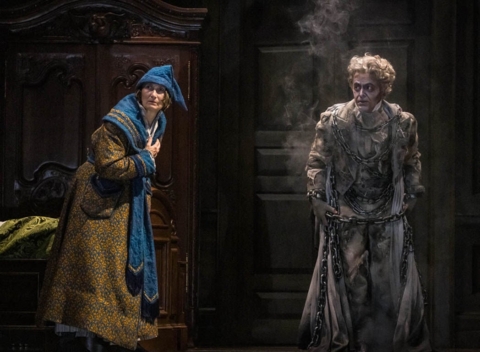
One impressive Keating bolstering to Dickens is showing how influential Jacob Marley (Grayson DeJesus) is to Scrooge’s decision-making. DeJesus is firm and dominant in demanding Scrooge’s laser focus on business and only business. He turns Marley from a functional character to a critical one.
Polly Lee is a funny Mrs. Dilber who captures the subservience of an employee and shrewdness of a woman with business to conduct. Keating takes Old Jo, the pawn shop owner, out of his seedy storefront into the streets of London, where Vilma Silva makes the character and his pushcart a rich part of the London landscape and makes Jo a telling contrast to Scrooge.
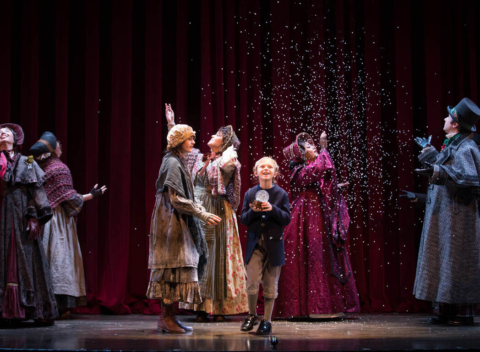
Daniel Ostling’s sets for Scrooge’s office, Fezziwig’s store, Fred’s parlor, and the Cratchits’ lodging are both efficient and telling, giving the perfect tone to each location. It was nice to see the shaded background of St. Paul’s that looks like a throwback to earlier McCarter “Christmas Carol” sets.
Linda Cho’s costumes are a Victorian fashion show that pays attention to class and character. Palmer Hefferan is an asset as composer and sound designer. Paul M. Kilsdonk’s lighting provided mood, especially during the vision sequences and the moment of Scrooge’s emergence as a joyful man.
A Christmas Carol, McCarter Theatre, 91 University Place, Princeton. Through Saturday, December 24, Tuesday through Saturday, 7:30 p.m., Saturday, December 17, 2 p.m. (with ASL interpretation), Sunday, December 18, 1 p.m. (with audio described and open caption) and 5:30 p.m., Friday, December 22, noon, and on Christmas Eve, Saturday, December 24, noon and 4 p.m. $25 to $80. 609-258-2787 or www.mcarter.org.