It is as redundant as it is an understatement to call Mary Zimmerman’s theatrical compositions magical and mystical. They certainly appeal to those, including myself, who are willing to enter into their dreamily conceived esthetic and to unconditionally accept the worlds that she creates. Like it or not, they have their own but very specific definitions of naturalism and normalcy.
Having slithered gainfully about for a year during its evolution (with earlier productions at the Oregon Shakespeare Festival and Berkeley Rep), “The White Snake” is now at McCarter Theater. Derived from an ancient Chinese fable in which humans and demons co-exist, consort, and contrive to find happiness, Zimmerman’s creation is not only great fun but also a theatrical treasure to be enjoyed by the whole family.
Even as McCarter audiences recall such memorable Zimmerman forays into myths, fairy tales, fables, and legends, as “The Odyssey” (2000), “The Secret in the Wings” (2005), and “Argonautika” (2008), they are also undoubtedly aware of her fantastical 2002 Tony Award-winning homage to Ovid, “Metamorphoses.” As evidenced by this ravishing production written and directed by Zimmerman, “The White Snake” is likely to be placed high on the list of favorites, as it is already on mine.
Zimmerman has acknowledged taking what has appealed most to her from the various versions of “The White Snake” that has presumably evolved over centuries beginning in 981 CE. In her version, a narrator who pops in and out of the play keeps us informed when we move from one version to another. The most popularly and prominently known version is Feng Menglong’s novella, “Madame White Forever Confined Under Thunder Peak Pagoda” written in 1624. As a moral fable cum fairy tale, it is as famous in China as is “Cinderella” in the Western world.
As I have previously been transfixed by all of Zimmerman’s imaginative and sometimes fearsome flights of fancy, let me just submit that her charming adaptation takes a wonderfully light-hearted approach to the story and its digressions that are wrapped in philosophical conjecture, misguided religiosity, and existential inquiries.
If they are essential and inherent elements in the various versions, be assured that it has acquired a witty and often good-humored text as well as a company of talented performers, many doubling in their roles, who make every minute a pleasure.
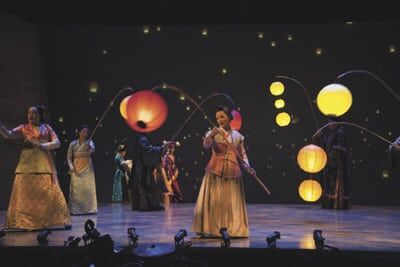
This is also a visually stunning production in which a steady breeze of whimsically deployed and artfully designed fabrics, textures, and objects arrest the eye even as our ears prick up to the clever lines that keep us amused and laughing. Although the embroidery plays an essential role (as it always does in a Zimmerman dreamscape), we are quickly involved in the complex and delightfully convoluted story, the plight of its endearing characters.
The story concerns the adventures of two snakes who feel that it is time to descend into the world of mortals after spending centuries studying, meditating, and mastering the art of transformation, i.e. shape-shifting in their spiritual mountain retreat. The White Snake (Amy Kim Waschke) is beautiful and determined. Her friend and companion The Green Snake (Tanya Thai McBride) is eager and impetuous and remains a faithful accomplice to The White Snake. Together they put into motion a plan for White Snake to seduce and marry Xu Xian (Jon Norman Schneider), the handsome young man she has fallen in love with at first sight.
Flattered by the attentions of the White Snake, Xu responds, and their future looks bright. With her amazing ability to cure people of their ills, they open a pharmacy. Yes, it’s funny. But life for them gets problematic when an evil and demagogic abbot (Matt DeCaro) with the powers of a sorcerer figures out the deception and conspires to ruin the lives of the lovers by telling Xu of his wife’s true nature.
Along with her talent as a writer/adaptor and director, Zimmerman is also renowned for her ability to create stage pictures that are hauntingly beautiful. This is accomplished with the concerted efforts of her design team. One cannot look at Daniel Ostling’s cunningly plain and tilted settings as enhanced by Shawn Sagady’s delicately patterned projections without feeling that they should be framed for posterity. Even as you take in the splendor of Mara Blumenfeld’s exquisite Chinese costumes as bathed in T.J. Gerckens’ atmospheric lighting, you also see how carefully they are an integral component of Zimmerman’s world. If I may add one caveat, it is that the play right now has a number of endings when one would suffice.
The fantastical story, essentially a parable with Buddhist underpinnings, is, however, augmented with many lovely visuals. These include colorful parasols, glowing paper lanterns, cascading ribbons as rain, and a huge billowing silk sheet that becomes a river that will serve in an earth-shaking war between the opposing spirits of the air and the sea. A great white heron with its spreading wings and a stag spirit are impressive guardians of a secret grove, but just as awesome is the fleet of dragon boats that come floating by during a festival. This gives an opportunity for the play’s three musicians to hit their stride. Original songs, music, and sound composed by Andre Pluess add a stirring exotic flavor throughout that is as much about the transformative power of love as it is about the transformative potential of theater in the hands of an artist.
The White Snake, McCarter Theater, 91 University Place, Princeton. Sunday, November 3. $20 to $83.50. 609-258-2787 or www.mccarter.org.
Parking can be a problem near McCarter because of the major construction going on. Consult the McCarter web site for instructions for the best and nearest parking.