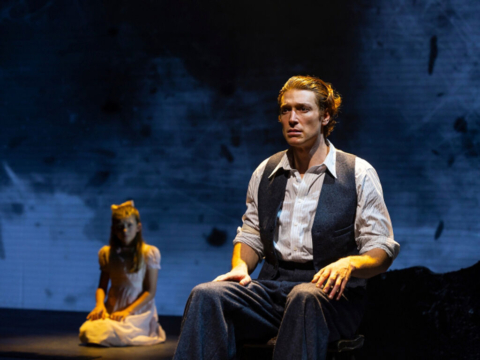
Poignancy is built into “The Pianist,” Emily Mann’s theatrical translation of keyboard virtuoso Wladyslaw Szpilman’s autobiographical account of his survival as a Jew who avoided transport to a World War II death camp but had to endure the deprivations and depredations of Nazi occupation as he hid, scrounged, starved, froze, and negotiated his way through a hostile and threatening Poland.
Mann and Szpilman tread on some familiar territory. “The Pianist,” at New Brunswick’s George Street Playhouse through October 22, contains de rigueur scenes of Nazi abuse, callousness, and disregard for human life, especially if that human is Jewish. We see or hear about Hitler’s approach into Poland, listen to characters dismiss the leader’s anti-Semitic dicta as a political phase they will ride out being Poles above all, and witness brutality on several levels. Mann’s artistry as author and director and “The Pianist’s” combination of assured effectiveness and harrowing depth make that territory fresh and imbue it with the humanity the Nazis are dedicated to erasing.
“The Pianist” employs the known but makes it to personal to Szpilman and his family to movingly transcend the recognizable. As Mann’s play focuses on Szpilman and his struggle to cope, persevere, and survive, it transcends further to evolve into a work that encompasses the pity and terror of tragedy while incorporating the hope and mettle of the human spirit. Far from being automatic, the poignancy in “The Pianist” is earned, palpable, and ultimately triumphant. The play and production are gems.
Several factors contribute to “The Pianist’s” success and theatrical power. One is Emily Mann being a master of juxtaposition, keying into the varying attitudes of a family while suggesting, then showing, the menace approaching, moving from that family to the general threat to Jewish Poles and eventually to Wladyslaw’s individual ordeal, and shrewdly, deftly alternating scenes of unconscionable horror with moments of pure human goodness. Another is the performance of Daniel Donskoy, a European star well-known enough in Germany to compete in and win its rendition of “The Masked Singer,” whose intensity matches that of the play and whose virtuosity with language, expression, and even musicianship makes him a formidable Szpilman, able to dazzle with wit one moment and arrest an audience with empathy in another. “The Pianist” marks Donskoy’s American debut.
Finding small, quick instances that go beyond their stage time to illustrate fear, shock, and distress on one hand and selfless benevolence on the other is one of Mann’s most potent tools. Tension enough is caused by the Szpilman family waiting in a Warsaw railyard for what we know is their journey to extinction when Mann succinctly adds to the awfulness by having a boy shot on the spot, gun to his temple, for not doffing his cap to a German soldier.
In classic fashion, Mann does not show us the boy’s killing. It is reported by the onlooking Szpilmans yet has all the impact as if we witnessed it.
Mann makes subtleties speak volumes. A desperate Wladyslaw, losing hope and demoralized by the number of former colleagues and friends that may not denounce him but won’t help, receives a warm, enthusiastic invitation to another musician’s home. Critical aid comes from the least likely of sources. Workmen miming the removal of the Szpilman’s furniture, culminating with the Bechstein piano that has sustained the family in several ways, is felt in the pit of one’s stomach. The wails of a woman who has sacrificed a child dismay and irritate simultaneously. In an edgy situation, Wladyslaw is asked to prove his claim to concert proficiency by playing a piano. Both the character and the versatile Daniel Donskoy rise to the occasion.
Throughout, with a minor cavil or two, some because of necessary exposition, “The Pianist” is a gripping work that activates the intellect and profoundly touches the heart. The piece grows as it proceeds. Its last sequence, showing Wladyslaw alone and fighting to stay alive, more because of biological needs, food and warmth, than Nazi threat, disturbs and breaks the heart, especially as acted by the remarkable Donskoy. George Street artistic director David Saint mentioned in a curtain speech that “The Pianist” is being considered for Broadway. With a tweak here and there, it’s ready. It’s ready without tweaks.
Daniel Donskoy is one of those performers whose range might be incalculable. He can be as nonchalant as he is intense, as brave as he is frightened, as angry as he is cowed and make it all register fully with appropriate theatrical effect.
He finds the Goldilocks spot in every aspect of his performance as Szpilman. Even moments of high emotion rate the passion Donskoy exudes. The best part is each nuance seems natural, integral to the character and situation of Wladyslaw Szpilman. There are no histrionics or grand moments, only a man living through a period of extreme angst and fear tempered by receiving rare instances of kindness.
Donskoy fighting to retain Wladyslaw’s optimism while showing the exhaustion of fading hope is a masterful thing to behold. Seeing the ease Wladyslaw has with his family and contrasting it with his ambivalence at being spared their fate, his decision to survive for them, and his disillusion leavened by an occasional stroke of fortune demonstrates the depth and scope Donskoy can give a character.
In several scenes where there is no visible piano, Donskoy and castmate Charlotte Ewing mime the fingering of known pieces. They are exact in this. Later, in a pivotal scene, Wladyslaw has to play the piano. This time, Donskoy plays for real, and it’s enchanting within “The Pianist” and to the audience experiencing this added talent.
Tina Benko plays a number of characters, all with definition, and all with an intensity that rivets you to her and the purpose of her scenes. Benko’s first entrance moves the emotional temperature of “The Pianist” up a notch. It follows some the exposition I mentioned and provides texture needed at that moment. Whether a distressed mother, a sympathetic colleague of Wladyslaw’s, or one more who persecutes Wladyslaw, Benko makes mark on the play and production.
Robert David Grant also makes his two major supporting roles pay, especially as he seems to build a special rapport with Donskoy. Their exchanges make you forget either is acting. Paul Spera, as Wladyslaw’s fiery brother, Henryk, bring excitement to family scenes. Jordan Lage is strong in his myriad roles.
Now for a tough part. All of the performances in “The Pianist” are solid and worthy, but some family scenes at the top seem a tad pat, not because of dialogue but because of an exaggerated sweetness among the Szpilmans. They are said to be cultured people, all musicians and artists, even the sister who opts to be a lawyer. Mann makes a point about the splendor of 1933 Warsaw through them.
The tweak I hint at when mentioning a Broadway transfer is giving each family member more heft. They sometimes seem like functionaries rather than rounded people. Their attitudes and what they say is important. They provide background and give Wladyslaw a motive to persist. They just need more individual dimension. Claire Beckman, Austin Pendleton, Georgia Warner, and Arielle Goldman can obviously muster.
The design work in “The Pianist” is uniformly excellent. Beowulf Boritt’s set is perfect in its versatility and enhanced by S. Katy Tucker’s projections, Linda Cho’s costumes suit character and period, Japhy Weiderman’s lighting establishes moods and conditions, and Mark Bennett and Charles Coe admirably key their sound design to all situations and are especially wonderful in the musical passages. Iris Hond’s original music is exceptional, creating tone while fitting into the genres in Szpilman’s repertoire.
The Pianist, George Street Playhouse, Arthur Laurents Theatre, New Brunswick Performing Arts Center, 11 Livingston Avenue, New Brunswick. Through Sunday, October 22. Showtimes are 8 p.m. Wednesday through Saturday and 2 p.m. Thursday, Saturday, and Sunday. $25 to $70. www.georgestreetplayhouse.org or 732-246-7717.