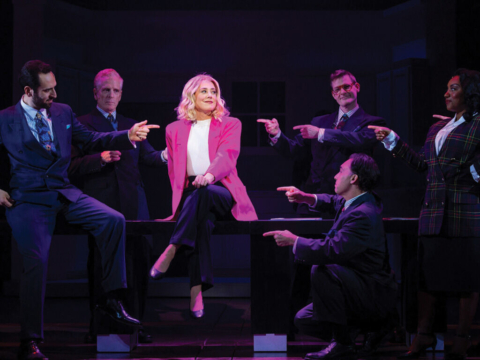
Anchored by a sterling performance by Erika Henningsen, lively production numbers, and a refreshingly varied score by AnnMarie Milazzo, “Joy: The Musical,” having its world premiere at New Brunswick’s George Street Playhouse through December 30, is a bright entertainment with some heart to it.
While the show, with a book by Ken Davenport and music and lyrics by Milazzo, needs some tweaking in the first act and a more convincing closing sequence, it has the makings of a popular hit because its focal character, inventor and marketing genius Joy Mangano, at work developing new products and appearing on HSN and other TV shopping networks to this minute, is someone you constantly like and root to be the winning figure she becomes.
Davenport and Milazzo are also shrewd in emphasizing what the real-life Mangano says interests her the most: being motivated by and working with family to attain success.
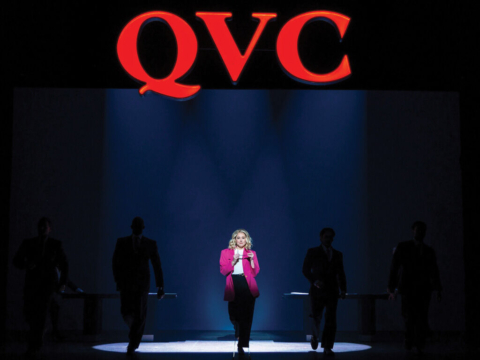
Of course, Joy’s persistence and tenacity comes through as well, and there’s a wonderfully witty number about TV’s first department store, QVC, but the personal, family-rooted part of Davenport’s script stays in front of all the technical, professional, and legal bits, and that concentration elevates “Joy” from being one more success saga to a story that is primarily about people and what it takes to support and live with a borderline eccentric group that includes two divorced couples and a child residing under one roof.
Davenport and Milazzo don’t only tell you the “what” of Joy’s journey; they explain why she strived so hard and for whom.
The pluses in this show, and Casey Hushion’s brisk yet warm production, aided by Joshua Bergasse’s stage-filling and clever choreography, are many, and they add up to a good time in which the audience can’t help but share and revel in a family’s stabilization and one person’s hard-won victory.
Before “Joy” moves on to other venues, there are few sections of the script, mostly in the first act, to which Davenport should attend before he has a piece that is ready for Broadway.
To tell Joy Mangano’s entire story would take more time than a standard musical would allow. Davenport and Milazzo concentrate on aspects of the story that differ from the ones David O. Russell did in the 2015 movie, also called “Joy.”
Given the welter of material, some elements of Joy’s path to entrepreneurial royalty have to be elided, altered for convenience, or eliminated.
The eliminated parts do not matter at George Street. Only one thing seems missing, and that’s in the second act. The altered makes sense. For instance, Joy Mangano has three children. “Joy: The Musical” shows only one, which is enough to show a child’s place in Joy’s thinking and motivation.
It’s the elisions that get in the way sometimes. Though entertaining, some scenes fly by. Several of these scenes need more time to breathe and need to reveal more about what Joy is thinking and doing.
A case in point is the sequence in which Joy conceives and creates the item that will catapult her to become the idol of inventors and marketers everywhere, a self-wringing mop with a washable head, known widely as the Miracle Mop.
Davenport and Milazzo do a good job of showing how Joy gets inspirations. An opening number, about how Joy sees shapes and gleans how to construct a useful object, is telling and the right place to begin. Throughout the show, Joy peruses sketches or reads ledgers and remarks, “Who’d have thought it would be so simple?” showing how well she perceives and assimilates details.
Details, though, seem to be sorely lacking in several first-act scenes. Times moves too quickly, so fast you don’t get a sense of how much elapsed between, say, conception and completion. In the scene in which Joy makes her mop, the process seems as miraculous as the item’s eventual name.
Joy goes to a garage, cuts come fabric, staples this, saws that, sews something, and voilà! The finished prototype appears.
There are other scenes that require more space, more breathing room. Right now, “Joy: The Musical” comes in at about two hours. Davenport, Milazzo, and Hushion can afford to add some time to the first act to take it from being entertaining, a good and proper start for any theater piece, to having the same heft and involvement as the much more carefully measured and much more textured second act.
Brevity may be the style today. I can’t count how many plays I refer to as “another 90-minute wonder.” In “Joy’s” case, style needs to be defied. Seeing Joy solve more problems in making her invention a reality, having some of the calamities caused by Joy trusting her family in business arrangements, giving a little more time to Joy worrying about how to support a family that seems to lean totally on her, can provide the weight the first act lacks. Davenport, in particular, needs to make a work that is fun into one that also has more meaning.
That said, he, Milazzo, Hushion, and Bergasse offer a lot to see and revel in with numbers such as “Welcome To My World,” “I Got People,” and the QVC number, “We Sell Stories.”
One little cavil about those and other numbers, my usual bugaboo, sound design. As is constant in theater today, the sound is too hot to hear the lyrics. Given that Milazzo’s lyrics are way above average for today, we need to know better what each character is singing and not just settle for the gist.
The second act of “Joy” relaxes the pace and takes more time to enrich the story. The only part that needs some work in the triumphant end. Joy’s biggest obstacle, the one that can scuttle all of her success, is a lawsuit and counter lawsuit about who owns the molds to her mop. In real life, Joy wins that case by demonstrating to the judge the process by which she made the mop, something the plaintiff cannot do. In “Joy: The Musical,” the judge is won over by an 11-o’clock number, “Have You Ever Felt That?” which is great on its own but makes no sense as a legal argument. Joy needs to sing that song, then say, “I will show you why this mop is mine,” demonstrate her mastery, and then wait for the verdict. Again, Davenport has settled for shorthand that hurts rather than enhances his show.
Casey Hushion’s loveable direction and a unanimously triple-threat cast that comes though in every way, makes George Street’s production fun while making you fall in love with as varied a crew as you’ll find in any story.
Erika Henningsen, as Joy, is aces, four of them. From the beginning, Henningsen defines Joy as a dynamo who needs to change gears in order to achieve stability, security, and peace among a headstrong, undisciplined clan that includes her divorced parents, ex-husband, and wise child.
Henningsen is sharp in showing Joy’s thought processes, pinpointing the moment Joy knows her family’s situation must change with the onus on her to do it, and Joy’s maturity as a mother, daughter, wife, inventor, and businesswoman. While distinctly showing Joy’s evolution, she also turns in a slam-bang performance as an actress, singer, and dancer. Henningsen’s is as a complete a performance as you can find, which is another reason to give the first act some space. Henningsen will know how to fill it.
Vicki Lewis adds to her reputation as a top-notch character actress as Joy’s selfish, doubting mother, who shows heart in a wonderful second-act number, “Mother’s Daughter.” Stephen DeRosa is all optimistic high spirits as Joy’s father. Sami Bray conveys a child’s needs and wisdom as Christie. Pomme Koch leads a canny, funny chorus in QVC scenes. Badia Farha saves the day and wins hearts as Joy’s QVC producer. Trent Saunders is able to retain sympathy as Joy’s wayward ex-husband. John Hickock makes the most of his sly villain’s song, “Little Lady.”
As always, Anna Louizos provides handsome and perfectly detailed sets. Tina McCartney’s costumes suit characters to a T.
Joy: The Musical, George Street Playhouse, New Brunswick Performing Arts Center, 11 Livingston Avenue, New Brunswick. Through Friday, December 30, Tuesday through Saturday, 8 p.m., and Wednesday, Thursday, and Saturday, 2 p.m. $25 to $85. 732-246-7717 or www.georgestreetplayhouse.org.