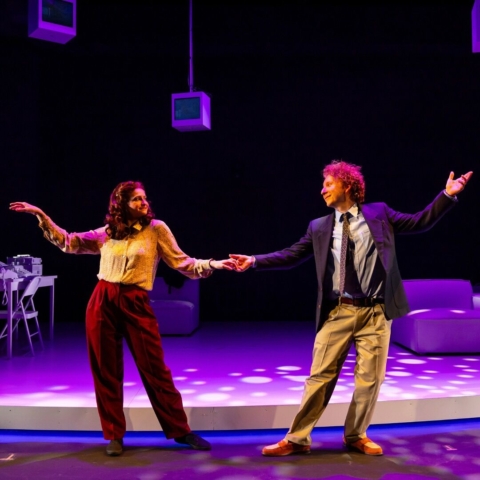
Hilarious, heartwarming, and intelligent, “Gene & Gilda,” Cary Gitter’s efficiently enlightening look at the eight years star actors Gene Wilder and Gilda Radner spent together, is refreshingly different from most theatrical profiles of the famous. The show’s run at George Street Playhouse in New Brunswick continues through December 22.
It’s not that Gitter writes as if Mr. Wilder and Ms. Radner were unknown, and he was introducing them to you. It’s that he’s able to blend celebrity, and even incorporate classic bits and characters from the performers’ repertoire, with depth and dimension that reinforces why movie and television audiences loved Wilder and Radner and, best of all, humanizes them.
“Gene & Gilda” lets you see Wilder and Radner in multiple ways that illuminate them as individuals while showing why they thrive as a couple. Jonathan Randell Silver and Jordan Kai Burnett are as charming and deft as Gitter’s material. They resemble without mimicking their characters. They sharply maintain the “human first” aspect I mentioned. Yet both can seamlessly slip into a moment (or more) of “Saturday Night Live’s” Roseanne Rosannadanna or “The Producers’s” Leo Bloom and convey the defining eccentricities of what is, after all, their characters while rendering them moving, real, people who are congenitally, compulsively creative but who, in the long run, are just Gene and Gilda whose public attention needs to tempered with privacy, affection, and the peaks and valleys of real life.
Gitter, Silver, Burnett, and their canny director Joe Brancato provide a moving and satisfying gamut that winningly and tastefully travels from Wilder and Radner’s obsessive but choppy beginning on the set of a 1982 movie, “Hanky Panky,” to the inevitable dealing with Ms. Radner’s death at age 42 (about the life span of Judy Holliday and Ernie Kovacs, who share her comic flair and uniqueness). Gitter’s greatest gift to his audience, and to writing, is never dwelling on any particular moment or happenstance, including Ms. Radner’s suffering and passing, and yet creating the impression all was covered in full by the sequences he chooses to depict, scenes rife with clever and radiating suggestion and implication.
In an engaging but economical 80 minutes, Gitter leads us to understand what who Gene Wilder and Gilda Radner were as people and as a couple that was completely, devotedly in love. No wonder the first thing you see while you’re waiting for “Gene & Gilda” to begin is Christian Fleming’s bright white stage with a half dozen small television monitors suspended each saying “Gene & Gilda” in script and encased in a heart reminiscent of the familiar “I Love Lucy” logo.
At first, I was worried about how Gitter was approaching his story. Lights come up, and you see Silver, as Wilder, walking to a director’s chair positioned stage left. Gene is about to do a live television interview, an exercise he usually shuns, and is upset when the moderator asks about Gilda’s recent death.
“That’s off limits,” Wilder says. “We agreed not to talk about that.”
The fear, I’m sure you gleaned, is that Gitter will turn his play into a series of reflections triggered by Wilder’s memory and perspective.
Joyfully I report that first impression did not follow through. The Wilder interview serves as a framework for segueing to specific passages and allows Wilder to explain some of his neuroses and proclivities, but for the most part, the “then this happened” format I dreaded at first sight did not impinge on Gitter’s play, On the contrary, it neatly served it. (Relief!)
A fulfilling part of “Gene & Gilda” is Gitter’s adroit juxtaposition of Wilder and Radner as themselves and as they appeared and appealed to audiences.
Gitter gleefully suspends reality to let Jonathan Randell Silver enact Wilder’s classic scene from “The Producers” in which Leo goes into a tizzy at Max Bialystock’s tirade about cowardice. Giving a bit of context to Wilder’s reaction to a tough time, Gitter brilliantly has Silver go through Leo’s entire routine, beginning from when he announces himself “hysterical” to Gilda attempting to snap him out of his tantrum by slapping his face — “I’m in pain. I’m hysterical, and I’m in pain” — to Gilda throwing water on his face — “I’m wet! I’m hysterical, I’m in pain, and I’m wet!”
Silver and Burnett execute the scene like masters, Wilder, Zero. Mostel, Matthew Broderick, and Nathan Lane would be proud at how the pair followed in their footsteps.
Then Gitter incorporates Leo’s security blanket by having Gene rely repeatedly on his “security handkerchief,” which he allegedly always carries with him. He may have a different handkerchief in his suit jacket’s breast pocket, but he can summon his security hankie at will. To his credit, Gitter also finds a way, in a realistic moment, to have Gilda capitalize on Wilder’s square cloth of comfort.
While Silver aces some of Wilder’s notable screen moments, Jordan Kai Burnett is given a veritable field day in a thrilling scene in which she, in the context of planning a second one-woman show for Broadway, runs through all of Gilda’s beloved “Saturday Night Live” inventions in a brisk, bravura three minutes.
All the catch phrases, such as Roseanne Roseannadanna’s “It’s always something” or Emily Litella’s “Never mind,” are heard as Burnett jumps on an ottoman like Judy Miller doing her bed-bouncing gymnastics or Baba Wawa enters to deliver some headline.
The sequence is breathtaking, Burnett blithely and decisively presenting one Radner character for three seconds before moving to the next for another few seconds, then jumping up and down Judy-like for four seconds before Emily or Baba enters to attempt order.
The gambit is so good, “Saturday Night Live” should invite Burnett to come and do it on national TV. Perhaps “SNL” will when “Gene & Gilda” fulfills a not very secretive aspiration and winds up off-Broadway, if not on Broadway.
Joe Brancato’s direction is so perfect, it’s almost undetectable. Silver and Burnett move through Gitter’s work as if what they’re doing is unscripted and organic to them. When the characters discuss some troubling or marvelous aspect of their marriage, it’s as if you’re a fly on the wall of the Wilder-Radner home and witnessing daily life in progress.
That daily life includes fun and shared adventures in Wilder’s favorite spot, the French Riviera. It also involves discussions about what makes each of the celebrities click — their need to work and be creative, their acceptance of each other’s quirks, and their undeniable love.
If Brancato is perfect, Jonathan Randell Silver and Jordan Kai Burnett border on casting Nirvana. What texture they provide while entertaining grandly and making every laugh line and character peccadillo comes across flawlessly.
Jordan Kai Burnett is a living wonder. She captures all that made Gilda Radner one of a kind while relaxing from the performer and showing a woman with extreme confidence in her gifts. She also conveys Gilda’s disappointment when she thinks those gifts are not being optimally used by producers and casting directors.
Burnett also lets you see Gilda as the driver in her and Gene’s relationship. It is Gilda who moves matters forward romantically and in terms of career. It is Gilda who appreciates and makes Gene see the creative spark they share.
To return to a theme, Burnett makes Gilda Radner ineluctably human. You see the performer, but more you see the woman that informs her, the irrepressible mind that can bring Emily Litella and Roseanne Roseannadannas to vivid life. (We even get to see Burnett in Roseanne’s wig and costume for one sequence.)
Jonathan Randell Silver — Gene Wilder’s real name was Silverman — treads a more subtle line but finds a surefire way to convey all of Gene Wilder’s tics and fetishes, some reflecting film characters as much as the actual man, while capturing the dignity, poise, and quiet that was also part of the man.
The smaller traits, such as Wilder needing some “alone time” and vacations from Radner, are key to Silver drawing a complete portrait of a complex man who, unlike Gilda, was not always happy to be that complex.
Both Burnett and Silver have special moments that tie them indelibly to their characters and Gitter’s play. There is constant kismet in their performances, even when Gene and Gilda’s symbiosis is not shown presentationally, as when Burnett and Silver do the couple’s dance from 1984’s “The Woman in Red.”
Whether in employing versatile chairs that can turn into sofas or other surfaces or devising a series of projections that comment on what we’re seeing on stage, Christian Fleming’s set works as smoothly as any of the varied elements that make Brancato’s production flow.
Gregory Gale nails the flamboyance of Gilda’s wardrobe while capturing the gentlemanly elegance of Gene’s. Max Silverman’s sound design is subtle, but it enhances many scenes, especially when Burnett is performing Gilda’s tour de force. José Santiago’s lighting knows when to let the stark white of the set contrast with the moodier serious or dramatic moments.
Gene & Gilda, George Street Playhouse, New Brunswick Performing Arts Center, 11 Livingston Avenue, New Brunswick. Through Sunday, December 22. Showtimes are 7:30 p.m. Wednesday through Saturday and 2 p.m. Thursday, Saturday, and Sunday. $65 to $90. www.georgestreetplayhouse.org or 732-246-7717.