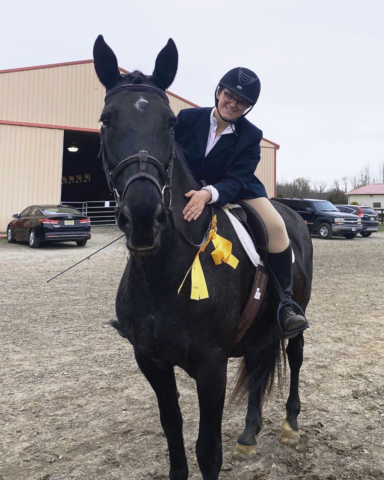
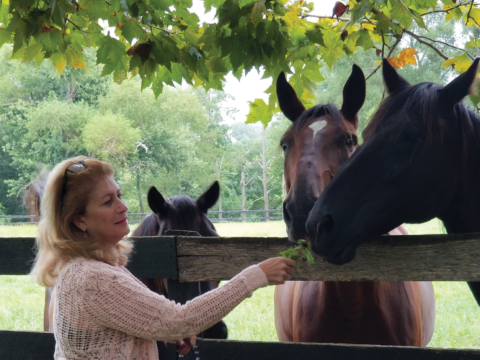
If you have ever watched a harness racing event at the Meadowlands or elsewhere, you’ve witnessed the speed and determination of standardbred horses pulling their driver in a sulky. But what happens after their racing years? Retired standardbreds, known for their eagerness to please, are sold and often worked beyond their abilities. When they are no longer able to work, these versatile animals are likely to be sold for slaughter.
Nicolette Smith, herd manager for the Cream Ridge-based Standardbred Retirement Foundation (SRF), says, “We give these horses a second chance” through programs such as Adopt a Horse.
The standardbred is an American breed that traces its roots to the English thoroughbred Messenger, brought to the United States in 1788. All standardbreds descend from his great-grandson, Hambletonian 10. Crossbreeding standardbreds with Morgan horses, prized for their speed, friendliness, and strength, further improved the breed.
The term “standardbred” refers to the requirement that a horse run a two minute and 30 second mile to qualify for the breed’s registry, first established in 1879 as the National Association of Trotting Horse Breeders, now the United States Trotting Association. Their racing speeds can range from 25 to 35 miles per hour.
These horses have many abilities beyond racing, says Smith. “Standardbreds are able to bring so much to people. They are definitely the toughest breed of horse I have ever met. No matter what you ask of them they will do it, or at least try to, even if they don’t understand or they are hurting. They are also incredibly smart, comical, and wonderful family horses.”
“When it comes to children, standardbreds have an almost sixth sense about them. You can watch them transform into an entirely different horse. The one that may not have the best ground manners will stand as still as a statue as a toddler runs around, under, or behind them. The child that’s learning to ride may be on one of the fastest trotters on the track, but you’ll watch them barely go faster than a walk no matter how hard the child kicks. It’s so special to see the connection these horses have with the little ones.”
Smith has a lifetime of equine experience. She says, “I’m almost positive (that) growing up I spent more time at the barn than my actual home. I have photos of myself as a toddler on trail rides with my mom; I went on pony rides whenever I would have an opportunity; and I had countless Breyer model horses.” She began riding lessons when she was five and participated in 4-H, showing at local fairs and the Central Jersey Horseman’s Association in Freehold. She now rides and teaches at Laurita Equestrian Center in New Egypt.
Smith dreamed of being an equine veterinarian, but she says, “There was nobody really ‘horse-related’ in my family. My mom was a realtor and ran financial companies and my dad was a printer by trade. When it came time for college I chose the safe route, studying business management and marketing. I had to work to put myself through college, so in my junior year of high school I started working in a financial office from 3 p.m. to 9 p.m., in summer, working from 9 a.m. to 9 p.m. I stayed there for six miserable years, working in the world of finances and being cooped up in a cubicle for up to 10 hours a day.”
When Smith found an opening at SRF, she says, “I jumped,” and, in the three years since, “My equine medical knowledge and abilities have grown exponentially.” Reflecting on her work, Smith says, “Having adopters find their heart horse is always gratifying, but two experiences definitely stand out the most to me.
“One night we were getting a shipment of horses directly from the kill pen (for slaughter). Before (standardbred) Seymour Sam was even unloaded, you could just smell infection coming from the trailer. Sammy had a nasty hip injury. I went twice a day, seven days a week for several months to treat and hand walk him. At first, he hated me and I couldn’t blame him. It was not pleasant for either of us.”
In the end, Sammy’s standardbred intelligence and positive attitude came to light. “Sammy learned that the quicker we got through everything, the faster he would get cookies, walks, and grooming. His personality became hilarious and he turned into a giant goof. Sammy eventually became sound enough to start under saddle. I helped him find the perfect home in Ohio where he is loved, spoiled, and even ridden with his forever family.”
Smith also recounts last fall’s “journey of Bill’s Iscape, an adorable gelding horse with a cute dished face and near perfect heart-shaped star on his head. He was very skinny, incredibly nervous, and fearful of people. He wanted to trust so badly but was too afraid. Over time, he learned he could and became the sweetest, most gentle horse on the farm.”
When adopters came to SRF looking for a lesson horse, Smith says, “I watched Bill pick his family. They walked up to him, and he actually shook his hoof with the one daughter. I have received photos of Bill toting around toddlers like he’s done it his whole life and decorated with balloons for a rider’s birthday. Bill is genuinely smiling in every photo. He is now healthy, loved by so many, spoiled, and the sparkle has returned to his eyes. The family even came back to adopt another standardbred because of how happy they are with Bill. To watch him go from this fearful, defeated horse to a wonderful lesson horse and breed ambassador is amazing.”
Some of Smith’s experiences at SRF have been daunting. “These horses come to us in conditions that just make you question humanity: emaciated and a lot of times with extensive emotional and physical trauma; so badly foundered, sick, or weak you just give them the extra love and care they deserve and let them lay their head across your lap while you apologize to them for all the people that have let them down in their lives.”
Smith tells of “one of the hardest things for me to see. Vic was a gorgeous, massive gelding that had likely been in a car versus buggy accident and was dropped off to the kill pen when his owners likely didn’t want to invest the money or time into helping him. Vic was completely defeated and held his head down to the ground. All of his bones were visible. He had infection coming from his nose and eyes; his temperature was 104; and he was incredibly weak. His abdomen was swollen, and he had harness burns on his stifles (knees) and chest. Worse, he had a very obvious leg injury, left untreated. I cleaned his leg and gave him pain medications, fresh hay, and a mash of feed. I remember getting in my truck and just sitting there crying for some time, trying to wrap my head around how people could treat an animal so horribly and not have any remorse or repercussion.”
Smith became an SRF adopter herself when she bought her own Standardbred, Buckeye Warden. “I took him because his behavior wasn’t the best and he had several issues. He lives happily at the farm where I board. He’s still full of sass, spunk, and his stallion tendencies, but he is a lovable clown who loves to play tag and hide and seek. He will always have a forever home with me.”
Smith also bought a Friesian/thoroughbred/standardbred mare from an auction in New Jersey. She says, “She was an Amish plow horse in Indiana. I retrained her to the saddle myself. She has been my biggest challenge personally, trying to rehabilitate her from years of neglect and abuse. She is still nervous but trusts me entirely. She’s named Louisa after the Lord Huron song (“Good for nothing…I’m just waitin’ to die…”); so fitting of everything surrounding the circumstances in which I found her.”
Many of the horses rescued by SRF attain equine fame. Smith says, “Some recently starred in the latest ‘Little Women’ movie; one recently competed in show jumping at the U.S. Pony Club Finals in Kentucky; and many are in mounted police units from New York and Newark to Miami.” Other standardbreds live out their lives in therapeutic or traditional riding programs but always, Smith adds, “as comical companions and, most of all, devoted friends.”
SRF also provides lifelong homes for standardbreds who have sustained catastrophic racing injuries. The organization has about 270 of these companion horses. According to SRF, “Although horse racing is a multi-billion dollar business, the standardbred racing industry has made no provisions to support these grand horses when their racing careers come to an end.” All standardbreds are retired from racing when they reach age 15.
In addition, SRF rescues retired standardbreds tagged for shipment to slaughter in Canada and Mexico; most are sick or injured from overwork. Through volunteer posts on the Save Our Standardbreds from Slaughter (SOSS) Facebook page and SRF, more than 3,000 horses have been rescued since 2017.
Judith Bokman and Paula Campbell joined forces to create SRF in 1989. Bokman’s husband, Stephen, is an equine veterinarian in Millstone Township and Campbell’s husband, John, is a Canadian Hall of Fame Standardbred driver, now retired. SRF is the largest organization facilitating standardbred adoptions, sponsorships, and fostering in the country and currently cares for roughly 500 standardbreds.
SRF does not own a farm but pays for boarding at some 35 locations throughout the United States. Donations are vital to the organization and provide 80 percent of its funding. For example, for approximately $350 per month, sponsors can cover expenses for a companion horse that can no longer be ridden. Foster owners also can provide care and a good farm home to an adoptable horse until a permanent home is found.
Additional income comes from fundraising events, such as casino nights and golf outings, provide 12 percent of SRF’s budget; money from harness racing organizations and grants bring in nearly 4 percent; and shopping from the SRF website also helps the organization with expenses.
There are also non-monetary ways to help, including “volunteering at the Cream Ridge farm or for special events and promoting the organization by sharing Facebook posts, liking social media pages, and being breed ambassadors,” says Smith, adding, “Standardbreds are often overlooked yet have so much potential.”
Standardbred Retirement Foundation, 42 Arneytown-Hornerstown Road, Cream Ridge. 609-738-3255 or www.adoptahorse.org.