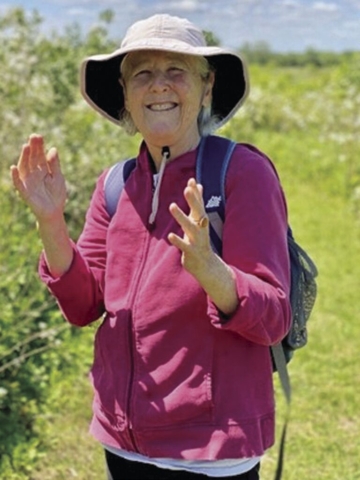
In the spring of 2020, eco-artist Susan Hoenig joined forces with members of the Friends of Princeton Open Space who were restoring 18 acres of forest at the Billie Johnson Mountain Lakes Nature Preserve.
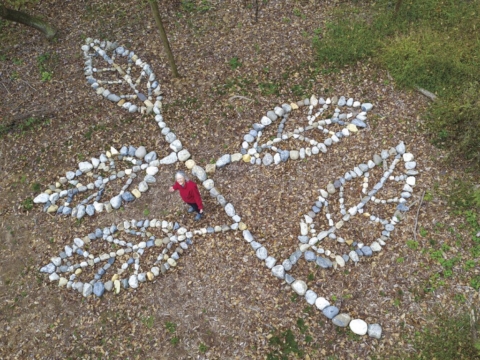
Hoenig created two ecological leaf sculptures along the preserve trails: a white oak, close to a foot bridge not far from the lake house, and an American chestnut, close to saplings that had been planted by the Friends. She hopes that when people see the sculpture, they will discover a connection between the art work, the trees they represent, and the restoration project.
On a local level, the goal of the Friends’ project is to reintroduce the American chestnut tree to the preserve, which will contribute to a larger effort to bring the tree back to the forests of the U.S. The tree had been abundant in the eastern forests until it was attacked by an Asian fungus beginning in the early 1900s.
Today, the tree is considered functionally extinct, but efforts made by groups like the Friends could change that. Of the eight saplings they planted, they hope at least two will survive, and, as native American plants, they will contribute to the ecosystem by providing food for birds, insects, and many forms of wildlife. Hoenig, who visited the planting site this month, said the drought had taken a toll on the young trees but they were still standing.
Hoenig says her enthusiasm for the project was inspired by a desire to share her art in a natural setting. “The sculptures become a way of focusing attention on the landscape,” she says.
To prepare for the sculpture, Hoenig collected river stones of different sizes and colors, which were donated by the Belle Mead Co-Op. Following a rendering she had created, Hoenig and volunteers placed the stones on the ground forming a pattern of the stem and leaves.
“This idea of creating an ecological art project for people is to create awareness of the beauty and value of the trees. It’s not simply an art object placed on a pedestal. It’s an art piece that points to everything around it,” she says in a short documentary about the project (view it at www.fopos.org/artistinresidence).
The leaf sculpture project at Princeton is the second one Hoenig has completed in the area. In 2016 she created 11 sculptures in the forest of Graeber Woods in Griggstown. Placed alongside 96 acres of trails, the sculptures are eight to 35 feet in diameter and are situated beneath the trees they represent.
Hoenig has been committed to ecological art for several years, but she says, her experience working as a volunteer assistant at the Featherbed Lane Bird Banding Station in Hopewell was pivotal. Having worked at the station since 2006, she has enjoyed in-depth conversations with master bander and conservation award winner Hannah Suthers, who runs the station.
Many of the conversations with Suthers and other volunteers, including biologists and botanists, centered on climate and plant and animal life cycles. The group was especially concerned with the negative impacts on forests caused by global warming and related issues like droughts, fires, and powerful storms.
“The fate of birds and humans is deeply connected to our ecosystem,” says Hoenig, who reflects her sentiment in many paintings leading up to and after her work at the banding station.
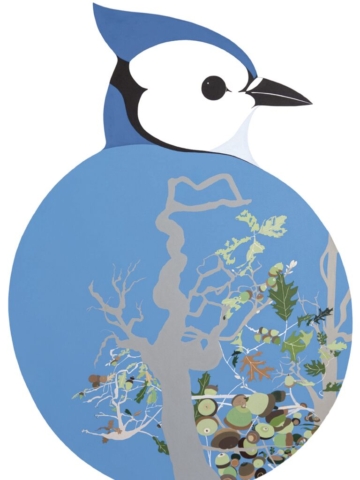
A painting titled “Mast Year” depicts a blue jay with a collection of acorns painted within its rounded body. A mast year occurs every few years when oak trees produce quantities of nuts, Hoenig explains. The lives of many animals and birds depend on these acorns, and global warming could have a negative effect on this cycle.
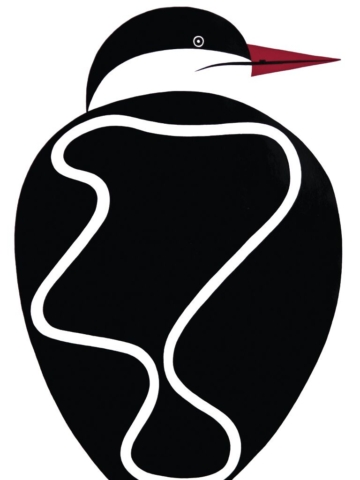
Another painting, “Migratory Route of the Arctic Tern,” shows a migratory route outlined on a tern’s rounded back. “I often paint within a circular, rounded, cosmic space,” says Hoenig, adding that her work is influenced by Gaston Bachelard’s book: “The Poetics of Space.”
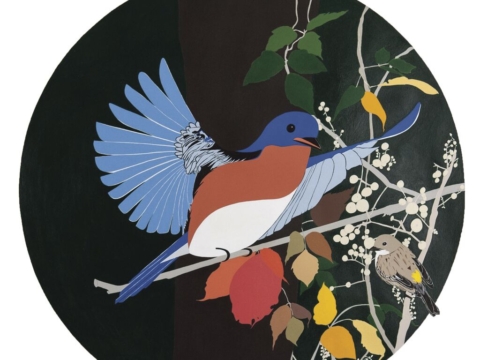
And in “Painting Poison Ivy,” two birds are eating cream white berries produced by the plant in late summer. While poison ivy is loathed by humans, it is sought after by many birds as an important source of nourishment.
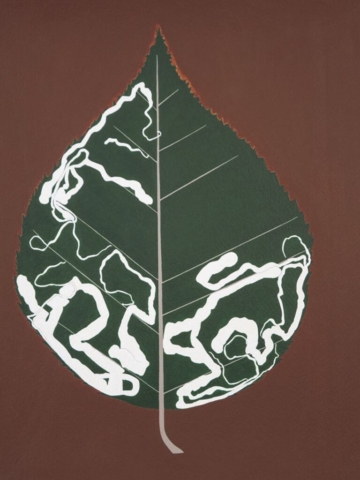
In a series of leaf miner paintings, Hoenig shows the patterns created by the “miners,” the larvae that dwell in the layer between the leaf’s upper and lower epidermis.
Leaf mining occurs when moths, sawflies, beetles, or other insects make a cut in a leaf where they lay their eggs, Hoenig says. Under the protective cover of the plant, the larva eats and tunnels its way through the plant, creating a pattern on the leaf. At the right level of maturity, it emerges from the mine and continues maturing in the soil below, often overwintering. It is rare for miners to significantly affect the health of the plants.
Hoenig has long been fascinated with cicadas and their contribution to healthy forests. Cicadas aerate the soil, and once they die, their bodies supply an important source of nitrogen for the soil, says Hoenig. In turn, the trees support the cicadas, who live off roots during their underground nymph phases. Once they emerge, they depend on branches and twigs to lay their eggs. After strong storms, uprooted trees provide habitats for cicadas.
In addition to being in the ongoing group exhibition “Thrive” at the Historic Walnford House in Upper Freehold, Hoenig created a series of 10 paintings titled “Uprooted Trees, Magicicadas, and Climate Change,” which was funded by the Puffin Foundation. Her paintings will be on view this September at Princeton Public Library, and paintings from this collection were shown in a program titled “Cicada Data,” featuring research by Princeton High School students, which opened at the school’s Numina Gallery this past April.
Hoenig says her love for both the natural world and art and her desire to make a positive contribution to society go back to her childhood in the Cambridge area of Massachusetts. Both of her parents were holocaust survivors who escaped to England in the late 1930s where they lived during the war years. They emigrated to America in 1949 where her father became a physics researcher at MIT. Her mother established herself as a ceramic artist and teacher.
Hoenig pursued her love for art at Bennington College in Vermont and earned her masters of fine arts at the University of Iowa. In the course of her studies, she learned about the Italian American architect Paolo Soleri, who is known for creating artwork and objects using natural materials. She was especially intrigued with his process of creating living spaces by digging out huge forms from the earth, then pouring in homemade concrete, and when dry, inverting the forms.
In the summer of 1979, Hoenig traveled to Arizona to work at the Soleri-inspired Arcosanti, an experimental town in the desert mesa. Influenced by her experience there, Hoenig began moving much of her artistic work from framed wall art to real spaces, such as the trails where her leaf sculptures can be found today.
Hoenig, who loves connecting with people, teaches at the Art Council of Princeton in its Out-Reach programs and is a frequent guest speaker at several venues in the greater Princeton area.
She has given several walking tours of her leaf sculptures and plans to resume the tours in the near future. Hoenig says it is her desire “to connect earth and art to make visible the relationship between habitat, plant, and animal life.”
To check upcoming tours, visit the Friends of Princeton Open Space website at www.fopos.org/events-programs.
For more on Hoenig’s leaf sculptures at the Billie Johnson Mountain Lakes Preserve, Princeton, go to www.fopos.org/artistinresidence.
For more on the artist, including her sculptures at Graeber Woods, visit www.susanhoenig.com.
Editor’s note: In addition to expressing herself through images, Susan Hoenig also uses language — as demonstrated in the following poem:
Queen of the Night’s Aria
The ‘Queen of the Night’s Aria’ permeated the forest.
Palette in hand, I painted hues of greens, pinks, oranges and bright reds.
The colorful leaves shone brightly between the sun and the moon.
In a quickening moment, at the highest note, I finished the hairy vines climbing toward the light.
I painted berries green, as if in a dream.
They turned white, then cream-white.
They were ready.
The magic flute announced completion.
The birds came at once to feast.
I touched up leaves brownish yellow.
Then winter came and all the berries were gone, in the forest of poetry.