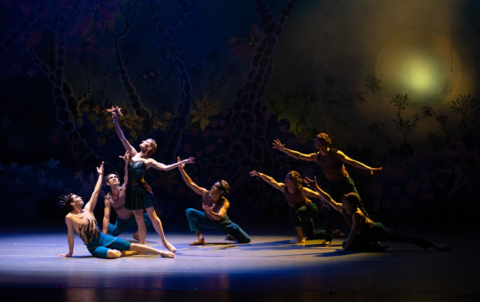
A principal dancer with American Ballet Theatre from 1997 to 2012, the Pennsylvania-born Ethan Stiefel set the hearts of a whole generation of tween-age ballet geeks throbbing with his portrayal of the motorcycle-riding ballet bad boy in the 2001 cult dance film “Center Stage.” Today, Stiefel is the artistic director of New Jersey’s American Repertory Ballet. To provide that sturdy little company a major new ballet, tailor-made to its talents, he choreographed the ever-so-pretty, 65-minute “A Midsummer Night’s Dream,” which premiered last weekend at New Brunswick Performing Arts Center.
Stiefel has set himself up for comparison to the two greatest neo-classical choreographers of the last century, George Balanchine and Frederick Ashton, as each created a well-known and beloved dance adaptation of the 1595 Shakespeare comedy. Balanchine’s two-act “A Midsummer Night’s Dream” — which premiered in 1962 with Edward Villella as Oberon, King of the Fairies, and the trailblazing African-American classical dancer Arthur Mitchell as his mischievous assistant, Puck — is regularly performed by New York City Ballet during its spring seasons at Lincoln Center. And Ashton’s one-act “The Dream,” created for England’s Royal Ballet in 1964, is performed frequently by ABT.
Comparatively, Stiefel’s work is less strictly classical, its movement vocabulary extending beyond the ballet lexicon to include large doses of pantomime, slapstick, folk, social, and popular dance steps, as well as acrobatics and clowning. Not only is Stiefel’s playful concoction highly entertaining, but the choreography consistently supports the drama.
The pastoral play tells the tale of two mis-matched mortal couples undergoing a transformative adventure in a fantastical forest inhabited by Oberon (here a female, heading a tribe of elves) and Titania (Queen of the Fairies), who feud over possession of a changeling. The magical creatures — whose movements are small, quick, precise, and twinkling — are choreographically distinguished from the mortals, who embrace vernacular movement genres, and render classical vocabulary with big, sweeping, lyrical flow.
Stiefel’s choreography prioritizes story-telling and refrains from gratuitous displays of wowing technique. And exercising such restraint could not have been easy for Stiefel, as the role of Oberon (at the matinee performance I saw on April 2) was rendered by his wife, ARB’s artistic associate, Gillian Murphy.
An ABT principal since 2002, Murphy is a world-class ballerina known for her powerhouse technique. While her presence brought an added sheen to the proceedings, Murphy never dominated the stage. Rather, she worked snugly within the team of ARB dancers portraying the ballet’s four leading roles. Sure, from time to time, as she danced with the others, one’s eye was drawn to the brilliance of her splaying legs in a jump or her dazzling footwork. Yet mostly, she blended in graciously, while her star quality elevated everyone’s performance — most notably in an exquisitely choreographed happy-ending sequence in which the four magical creatures cavort harmoniously center-stage, flanked in front and back by the finally-properly-matched mortal couples, who soar through the space with romantic runs and overhead lifts.
While Stiefel’s “Dream” choreography may not rise to the level of ingenuity demonstrated by Balanchine and Ashton, ARB’s production is as ravishing as any other version. Scenic designer Howard Jones’s enticing floral backdrop, sparklingly lit by Joseph Walls, instantly transports viewers into an enchantingly beautiful dream world. And Janessa Cornell Urwin’s costumes add luxuriously to the ballet’s visual extravagance.
Also enhancing is the live musical accompaniment proffered by the Princeton Symphony Orchestra, under the baton of Kenneth Bean. The ballet’s traditional Mendelssohn score is here supplemented by Erich Korngold’s music for Max Reinhardt’s 1935 “A Midsummer Night’s Dream” film. Long forgotten, the Korngold score was specifically unearthed from a California basement for this production.
And a big bravo is due to the show’s standout dancers, who all revealed a flair for comedy. As Puck, Aldeir Monteiro combined athleticism, innocence, and spriteliness as he drove the mixed-up goings-on with amusing authority. Erikka Reinstierna-Cates shone as the mortal Elena, imbuing her physical comedy with the precision and beauty of a ballet-trained mover. And as Bottom, the mortal who gets turned into an ass, Seth Koffler won the day with his hip hop-flavored donkey kicks and well-timed vaudevillian antics.
American Repertory Ballet returns to the New Brunswick Performing Arts Center on June 3 with “Movin’ + Groovin,’” a program of three world premiere dance works. www.arballet.org.