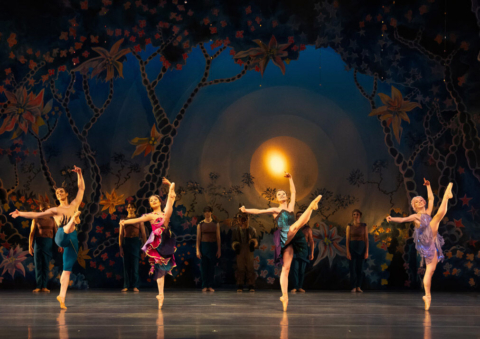
Dancing better than ever, American Repertory Ballet brought its amusing, hour-long “A Midsummer Night’s Dream” to New Brunswick Performing Arts Center, May 10 through 12. Based on the eponymous Shakespearean comedy, and choreographed by company artistic director Ethan Stiefel, the guaranteed-to-please-everyone ballet employs an array of classical, vernacular, and clowning movements to tell its tale of an argument between the ruler of the elves, Oberon (here presented as female), and Titania, leader of the fairies. While all ends peacefully, along the way, mistakes made by Oberon’s sidekick, Puck, involving a love-spell-casting flower, create hilarious havoc among two couples of mortal lovers, and between Titania and Bottom, a man who turns into a donkey.
When I saw the ballet’s 2022 premiere (reviewed in these pages, April 6, 2022), I was struck by the clarity and efficiency with which Stiefel’s choreography conveys the narrative details, emotions, humor, and larger themes of the drama. This time around, I noticed that, along with its crystalline storytelling, it’s also a delightfully “dance-y” ballet — featuring lots of pure movement passages that display the solo dancers’ fine classical technique and the stellar synchronization characteristic of the troupe’s ensemble work. Moreover, the beauty alone of the ballet’s production elements — Howard C. Jones’s magical fairy-tale forest setting, Joseph Walls’s transporting lighting, and Janessa Cornell Urwin’s alluring costumes — makes for a rewarding aesthetic experience.
The ballet’s enchanting musical accompaniment supplements Felix Mendelssohn’s 19th-century score with music composed by Erich Wolfgang Korngold for a 1935 film of “A Midsummer Night’s Dream.” (The movie starred James Cagney, as Puck!) While the score was played live (by the Princeton Symphony Orchestra) at the 2022 premiere, the ballet is now performed to a well-balanced recording that, to my great delight, was not amplified to the distorting levels often heard in other dance venues (such as Newark’s New Jersey Performing Arts Center and New York’s Joyce Theater).
And as I’ve grown used to watching ARB perform their afternoon shows to small crowds, I was also delighted that the matinee performance I attended on May 11 played to a nearly sold-out audience. Dance company directors nationwide always claim that it’s much easier to sell tickets to full-evening story ballets than to fill a house for mixed bills. Fortunately for ARB, Stiefel has an affinity for accessible storytelling and harbors a gifted roster of actor-dancers on whom he can create.
Because conflict and character spark every good story, Stiefel’s “Dream” grabs us from the get-go as it pits the fierce, knife-sharp dancing of Annie Johnson (as Oberon) against the inviting, lyrical movements of Nanako Yamamoto (as Titania) to kick off their battle over a Changeling, danced by Lily Krisko, whose dazzling footwork mark her character as a desirable prize indeed. Within just seconds of meeting the mortal couples we sympathize and completely understand their issues.
As genuine soulmates, Clara Pevel and Leandro Olcese show their limitless love through soaring leaps, thrilling lifts, and exquisite classical partnering. Then, as the aggressive pursuer of a disinterested partner, Madison Elizabeth Egyud steals the show’s comic honors with her brilliantly timed, slapstick maneuvers, performed with Tiziano Cerrato, in a riotous depiction of a twosome sorely in need of a dose of romantic magic.
In other versions of this story ballet, Bottom emerges as the chief comic character, and his duet with Titania is typically the laugh-out-loud highlight of the show. Company apprentice Tomoya Suzuki gives an endearing, spot-on portrayal of the uneducated Bottom’s innocence and shock as mischievous elves transform him into a donkey, and later as he traumatically recalls his “donkey-dom” in a side-splitting solo turn. However, the Bottom-Titania scene falls flat. In the ballet’s only choreographic misfire, Stiefel tries to find the humor physically, in the design of intentionally awkward positions. But the comedy here must be character-generated as it lies in the juxtaposition of motivations. What’s funny is the idea that Titania is enamored with an ass, while the donkey is driven by bodily satisfactions — eating, tickling, moving rhythmically. Those feelings need to be more convincingly expressed in order to make us laugh authentically, as we do throughout the rest of the ballet.
American Repertory Ballet’s next performance is “Interwoven,” a collaboration with the Princeton Symphony Orchestra as part of the annual Princeton Festival on Saturday, June 15, at Morven Museum & Garden. More information: www.arballet.org.