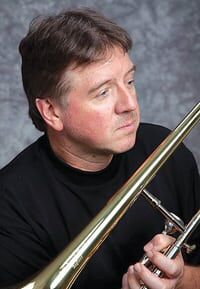
It’s likely that internationally recognized jazz trombonist Conrad Herwig’s peripatetic existence in his youth — the only child of a career Army officer father — contributed greatly to his multi-cultural approach to teaching jazz to college kids.
Herwig is the director of the Jazz Studies Program at Rutgers University for the last three years and director of the 17-piece Rutgers Jazz Ensemble for the last five years. He has played with nearly everyone — from Cuban trumpeter and arranger Mario Bauza and pianist Eddie Palmieri, giants in Latin jazz, to traditional jazz saxophonist and band leader Joe Henderson and singer Frank Sinatra. Herwig spent nearly a decade on the road with Sinatra’s orchestra, touring the world as the featured trombone. Sinatra, incidentally, claimed that he patterned his phrasing from trombonist and bandleader Tommy Dorsey.
Audiences can hear Herwig’s artistry when he leads the Rutgers Jazz Ensemble with “A Tribute to Wayne Shorter” — featuring acclaimed tenor saxophonist Craig Handy — on Monday, December 9, at 7:30 p.m., at Nicholas Music Center at the Mason Gross School for the Arts in New Brunswick. He is also set to perform with jazz artist and composer Anthony Branker on Sunday, December 15, at the Arts Council of Princeton.
Born in Oklahoma, Herwig grew up mostly in Hawaii. “My Dad was an Army officer, so we moved around a lot when I was a kid,” he explains one night in a telephone interview from the dressing room at lower Manhattan’s Blue Note club, where he was performing with Dominican-raised piano phenom Michel Camilo.
He began to learn the trombone as an eight-year-old while living in Leavenworth, Kansas, “but I was in the seventh grade when we moved to Honolulu. There I was able to be around [trombonist James] Trummy Young, who worked with Louis Armstrong and Jimmie Lunceford.”
“Believe it or not, there was a vibrant scene (in Hawaii) in the ’70s,” he says. “There were a lot of jazz musicians hanging around Hawaii in those days, and lot of bands coming through on their way to the Far East would stop over in Honolulu.”
While Herwig’s mother played flute and his father sang in the church choir, neither pursued music as a vocation. But, he says, “Both my parents were very much into the arts and they encouraged me to pursue whatever I wanted to pursue. They took me to concerts, Count Basie and Trummy Young and others in Honolulu, for years.”
That encouragement and support followed him into school. “Just for the record, I went to a comprehensive high school that had an excellent music program. One of my school mates there was Barack Obama. We used to ride the bus together and play basketball,” he says.
Other family members also participated in introducing him to the beauty and complexity of jazz. “I was lucky that I had two different uncles — one from my mom’s side, one from my father’s side — who were both big jazz fans. My one uncle lived in Chicago, and at some point, he just laid his record collection on me: I had Miles, I had Coltrane, I had Ahmad Jamal, I had J.J. Johnson, and I was a 12-year-old kid,” he says. He listened to radio voraciously, staying up until midnight to hear “Professor Bop” on a local station.
From Hawaii, Herwig attended North Texas State University in Denton, did some playing with pianist Red Garland, and joined Clark Terry’s big band (which also included saxophonist Branford Marsalis) and toured. That was followed by a BA in Afro-Cuban ethnomusicology from Goddard College in Vermont, and then, after a move to New York City, a master’s in jazz studies from Queens College. “Once I’d moved to New York City, things snowballed from there, and I was working so much with so many people; my graduate degree ended up working out fine,” he says.
Herwig, who lives now in Franklin Township with his wife Maria and two golfing sons, completed many international tours with Terry’s big band and has played with the big bands of Buddy Rich and Toshiko Akiyoshi before being drawn in to lower Manhattan’s Latin jazz scene. There he befriended Bauza and Palmieri and began exploring the percussive and melodic wonders of Latin and Afro-Cuban jazz.
“I got into arranging and doing Afro-Caribbean or Latin jazz versions of jazz classics like the Latin Side of John Coltrane, Wayne Shorter, and Herbie Hancock. That all came about through performing with Eddie Palmieri and trying to find a fusion of the classic jazz music we all love so much with salsa and Latin jazz rhythms,” he says.
Pressed about recordings that inspired him, either as a trombonist, composer, or arranger, Herwig says his father was a real big band fanatic. “He was always listening to Tommy Dorsey, Benny Goodman, and other big bands. The albums that really turned the corner for me were by J.J. Johnson, Sonny Rollins, and Clifford Brown.” Influences on his approach to trombone performing include Johnson and Brown, as well as “Curtis Fuller, and [Locksley Wellington] Slide Hampton [of East Orange]. Two others were Frank Rosolino and Carl Fontana, who both played with the Stan Kenton big band.”
Herwig recorded his own self-titled debut in the mid-1980s, but it was not released until 1987. Since then, he’s released 22 other albums and been a sideman on recordings by everyone from Sinatra to Palmieri to an album of Mingus classics with Elvis Costello.
Replying to a question on the relationship between blues and jazz and if in fact New York City is still the jazz capital of the world — given all the licenses club owners in Manhattan must procure to run a venue with live music these days — Herwig says, “Blues and jazz are joined at the hip, and that has always been the case. I still feel New York is the center of the jazz world. It’s interesting: though there are still so many jazz musicians that live in this area, now we have to travel more and more to perform outside of New York and even outside the United States. It’s a cliche, but it’s been happening since the ’40s; you get more respect outside of your country than you do in it, you know, ‘the prophet is never respected in his own land,’ or whatever that quote is, and to this day, there’s just an avid audience in Europe and Japan for this music. While New York has consolidated a bit, there are still some great jazz clubs here: the [Village] Vanguard, the Blue Note, the Jazz Standard, and Birdland, These places are among the best in the world. Things are tough all over, what can we say?”
How was it to be on the road with Sinatra for nearly a decade?
“He was among the best bosses I’ve ever had in my life. He demanded and commanded respect for himself, but also for his musicians. He was a true role model. He treated his musicians with dignity; we got paid well and the conditions were great, too,” he says. “He was a king and some people have their own personal demons, but there is dysfunction in everyone’s life on some level. When you went to hear Frank Sinatra, there was a connection he had with his audience, and great artists have that. It was a really great experience for me.”
Given New Brunswick’s proximity to New York, many of the university’s ensemble directors through the years have come straight off the bandstand from New York jazz clubs. That includes trumpeter Michael Phillip Mossman, who was part of the renowned group Out of the Blue, or OTB, and Canadian-raised saxophonist Ralph Bowen, who has carved an admirable niche for himself in the jazz world as a sideman and leader of his own small groups. The same is true for Herwig, who is modest about all of his accomplishments.
Asked about how he fell into his job at Rutgers and his philosophy and teaching approach with some already very talented college kids accepted into Mason Gross School of the Arts’ rigorous jazz studies program, Herwig says he considers himself part of much larger family of jazz people. “We’re colleagues, we’re teaching, and because we all teach improvisation and composition and arranging and private lessons we’re able to direct ensembles. So it just kind of worked out for me; we were just kind of shifting duties a bit. I come from a big band background. I’ve had the blessing of my life of playing with some really great big bands. Hopefully, what I’m able to do is give the students some insight into what it is to play in a big band and make it a cohesive unit.”
From the days when pianist Kenny Barron and guitarist Ted Dunbar were teaching at Rutgers in the late 1970s and early 1980s, the list of alumni from the Rutgers program who have gone on to become names in the jazz world is impressive: trumpeters Terence Blanchard, Sean Jones, and Terrell Stafford, vocalist Jeanie Bryson, drummer Ralph Peterson, and piano players Eli Yamin, Jon Regen, and Misha Piatigorsky are just several.
“We’re preparing our students to follow their dream and be performers, as well as give them the skills to teach if they want to do that, or if they want to work in the music industry in recording studios they can do that as well. We seek to keep the values and tradition of the jazz language, but we’re also trying to emphasize the 21st century skills necessary to survive — and even thrive — in the music industry. I’m a jazz trombone player, but I’ve done all kinds of recording work, I’ve done shows, I’ve done arranging and composing work, and I’ve worked on jingles. When jazz is your hobby, you still have to make a living and put food on the table.”
A Tribute to Wayne Shorter, Nicholas Music Center, 85 George Street, New Brunswick. Monday, December 9, 7:30 p.m. $5 to $15. 732-932-7511 or www.masongross.rutgers.edu.
Forward CD Project, Arts Council of Princeton, 102 Witherspoon Street, Princeton. Sunday, December 15, 3 p.m. Free. www.princeton.edu/~puje.