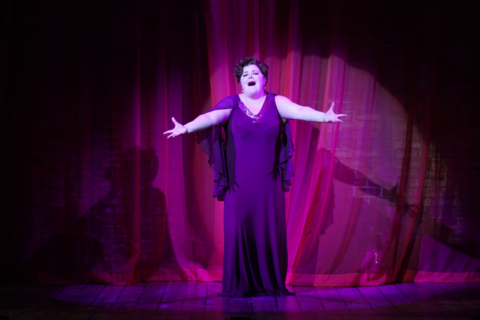
An outstanding rendition of the vintage tune, “There’ll Be Some Changes Made,” shows the potential of the world premiere “Last of the Red Hot Mamas,” at New Hope’s Bucks County Playhouse through Sunday, July 28.
Rheaume Crenshaw, playing Mollie Elkins, once a big star but retired and working as a maid for vaudeville’s ranking queen, Nora Bayes, launches into the Benton Overstreet-Billy Higgins standard and gives it multiple layers of texture that simultaneously suggests nostalgia and commitment to a new beginning.
Crenshaw makes the solo number, performed directly to the house without much production or fanfare, a personal moment that draws the BCP audience closer to both Mollie, as a woman with determination and a sense of purpose, and to Lloyd and Susan Ecker’s show, that entertains throughout but needs more defining, riveting sequences of the kind Crenshaw provides.
“The Last of the Red Hot Mamas” provides a good time as it is, but is cannot move forward, say to off-Broadway or other regional houses, without some changes being made. In particular, it needs more numbers that lift the show beyond simple, and frequently cliched, storytelling and into the assured, arresting place where Crenshaw’s Mollie took it.
Notice that the show is called “The Last of the Red Hot Mamas,” an announcement to anyone who knows anything about theater that it has to be about no one other than the great Sophie Tucker.
And it is!
The Eckers have been fascinated with Sophie Tucker since their first date, more than 50 years ago, as students at Ithaca College where they saw Bette Midler and found special pleasure in jokes she attributed to and performed in Tucker’s style.
Those jokes were written for Midler by Bruce Vilanch, but they had enough Sophie in them to made the Eckers scholars, who have pored over Tucker’s scrapbooks, dozens of them, to learn all they could about her.
Sophie is prominent in “Last of the Red Hot Mamas.” She is purportedly the lead character, but throughout the musical, she is overshadowed by others, not only Elkins but also Bill “Bojangles” Robinson, so much that they take focus and generate more interest than Sophie does.
I kept thinking the show should be called “The First of the Red Hot Mamas” because the most telling, varied, and interesting passages involved Elkins, first as someone who notices Tucker’s talent, next as someone who coaches Sophie on how to get seen, get known, and get recognized for that talent, and last as someone who manages Sophie’s career, including getting her out of scrapes in which Soph’s big mouth and intolerance for fools landed her.
What I’m saying is not meant as a comment on Ryann Redmond, who plays Tucker, or the numbers she’s given.
Redmond does fine. It’s just that Elkins emerges as the better story. As the Eckers, and their co-writer, Harrison David Rivers, write it, Elkins is the one who overcomes a personal and professional situation, uses ingenuity and mettle, takes the stage vividly as both a character and a performer, and wins the audience’s regard while Redmond’s Sophie never gets the chance to establish herself.
The Eckers and Rivers put escalating plot, obstacles to be conquered, and the wisdom to prevail in Elkins’ dramatic arc. Sophie’s course is equally dramatic, but it happens by the numbers. Pitfalls and triumphs are presented baldly, with none of the texture that leavens Elkins’ story and creates curiosity and a rooting factor.
The Eckers know a lot about Sophie Tucker. Their dialogue includes information that tells the BCP audience things they may not know or that deepen her story, but all concerning Tucker happens too quickly or matter-of-factly to register.
Her journey to the alleged top has her singing in her mother’s Hartford saloon, being told she has the pipes if not the looks for Broadway, going to New York and making the rounds of producers’ offices, being spotted by Elkins, and getting directed about what to do next.
The story sounds familiar, right?
Of course it does because it’s the plot of hundreds of plays and movies starring the likes of everyone from Ginger Rogers to Red Skelton. Forget Sophie Tucker. Plug in Esther Blodgett, who as Vicky Lester or whatever name Lady Gaga’s character took, goes from obscurity to fame in four versions of “A Star is Born.”
Sophie Tucker’s tenacity, humor, flying in the face of people who think she’s too fat, ugly, or brash, marketing skills, and big voice are all displayed or mentioned on the BCP stage, but none of it pays.
The scene in which Sophie goes from office to office on Tin Pan Alley, searching for the producer who will see her talent doesn’t pay because “Last of the Red Hot Mamas” doesn’t add anything to it. While Mollie Elkins’ story builds and evolves through the production, Sophie’s starts on one level and stays there.
It’s static and smacks of being seen before.
And before and before and before.
Mollie’s plot line sneaks up on you. Sophie’s is so direct, it becomes comme il faut. Everything just happens. Now she’s doing this. Now she’s doing that. The presentation is all declarative when it needs wiles. It needs charm and enticement.
Most of all, it needs to slow down. Ryann Redmond appears as Sophie, and there’s fireworks, a big voice doing songs we know and love to hear.
But all happens in a vacuum. Sophie’s entrances and numbers have no finesse. Redmond can sing, but never once does she get the chance to sidle into or milk a number. Never once does she get to show who Sophie Tucker, the entertainer known and loved by millions for six decades, is or why she was so popular and so lauded.
The flaw is the progression of the script and in Shea Sulllivan’s direction that gives air and room to numbers Crenshaw does as Molly — Her “After You’ve Gone” is as enthralling as her “There’ll Be Some Changes Made” — but allows no preparation or follow-up to Sophie’s numbers.
“The Last of the Red Hot Mamas’” Sophie gains attention by singing “Shine On Harvest Moon.” Several performers try to sell that song, and it never works. There’s a sense that Redmond’s Sophie is too sudden, there and then gone, for her to reveal what makes Sophie Tucker a star.
It’s a repeating problem that minimizes Tucker’s story while advancing the novelty of Mollie Elkins’ or Bill Robinson’s involvement in Sophie’s early career.
Therein lies the irony. The Eckers have done something different from any show I’ve seen about Sophie Tucker. They confined their story to the 10 years of her career, 1906 to 1913 to be precise. They forewent the usual pattern of one woman playing Sophie looking back on her life as an excuse to sing Tucker’s hits. They introduce Elkins, Bayes, and Robinson. They show how Sophie had to sneak back into vaudeville’s good graces following a verbal faux pas she made on stage.
The problem is everything new seems old again. More thought has to be given to how Sophie’s rise is accomplished, and Redmond, or whomever plays Sophie, has to be given the chance to compete with the actors playing Elkins and Robinson for a spotlight that doesn’t take an audience’s interest in Tucker for granted.
Rheum Crenshaw, you can tell, was the light of Sullivan’s production for BCP. She made Mollie the character of interest and kept you caring for her.
DeWitt Fleming, Jr. provided some lively, and even exhilarating passages as Bojangles Robinson. Tap dancing is usually a delight. Fleming often made it an art.
The dancer who kept catching my eye was Wille Clyde Beaton II. He was often upstage left, but his hoofing in support kept me hoping he’d be part of a dance with Fleming.
Rachel Stern does a great job in two supporting parts. Danny Rutigliano and Jonathan Hadley ace an old vaudeville chestnut. Daniel Lopez is a charmer as Tucker’s partner, Frank Westphal.
Ryann Redmond obviously has the talent to be a wonderful Sophie Tucker. Frankly, I thought she was neglected in the attempt. I always felt as if she was pushed on stage, without build-up, to perform and was never coached, presumably by Sullivan, to get to the next level that would have made her Sophie Tucker.
Stephanie Gibson is often fun as Nora Bayes, but the conception of the character turned me off. It dehumanized Bayes and never showed why she was the toast of New York for almost two decades.
Nate Bertone’s turntable set was like having another character. Jeannette Christensen provided great period costumes and showed wit in dressing some ladies of the evening. The music, as chosen and performed, was a highlight of the show.
The Last of the Red Hot Mamas, Bucks County Playhouse, 70 South Main Street, New Hope, Pennsylvania. Through Sunday, July 28. Showtimes are 7:30 p.m. Wednesday through Saturday and 1:30 p.m. Wednesday, Thursday, Saturday, and Sunday. $32 to $82. www.bcptheater.org or 215-862-2121.