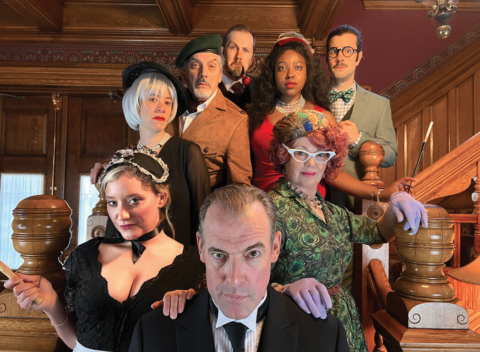
You can hear the thud as Ken Kaissar’s legion of ideas and inventions for “Clue,” the play he’s directed for Bristol Riverside Theatre, constantly fall short of generating the laughs or involvement intended.
Kaissar’s collection of sight gags, sidelong glances, and funny walks have merit in design. You can see the joke he was trying to land and realize its comic possibilities, but somehow this panoply of stage business has no effect.
Perhaps because everything is too planned. Gambits smack of self-consciousness. Instead of occurring naturally with disarming timing, each bit announces itself. A pause before the payoff or characters freezing in place beg for laughs rather than earning them. It’s as if someone is pointing at the various moues, threatening poses, and pratfalls and saying, “Look at this. Isn’t this funny?”
The answer at Bristol is “no.” A more charitable response would be, “It should be. It looks built to be.”
Silence greets most of the gags. Kaissar’s production comes off as slapdash and slapstick instead of tight and zany. It looks as if it is painted by number instead of being allowed to just flow and ease into the hilarity Kaissar’s careful constructions were meant to provide.
The sad part is the engineering is there. The set-up is right in front of you. Then, all halts. The follow-through is more like a tableau than something that turns into a laugh.
Examples: A butler (Ian Merrill Peakes) is about to introduce a country estate’s cook (Krystle N. Adams) to a newly arrived guest. As he turns to point to the cook, the two bump into each other and stay locked at the forehead for about 10 seconds. The choreography is too obvious, and the action is too still. Nothing happens but a set-up that backfires. The cook, when finally introduced is menacingly holding a cleaver as if she is a castaway from a production of “Sweeney Todd.” Should be funny but just looks like shilling for a laugh.
Those two gags die from stillness. Motion is worse. Peakes, though a great break dancer and gymnast, goes into too many gyrations and kicks too many legs and heels as he provides information of various kinds. Because Peakes is talented, that shtick isn’t nearly as bad as when Kaissar has characters go into an assortment of funny walks, sometime high-stepping, sometimes extending legs, sometimes moving at a gallop, sometimes tiptoeing.
Once again, you see these are attempts at humor. The problem is they’re too broad. They’re also too random and undefined. A word I used earlier, “shtick,” gives the general idea.
There are repeating instances when motion works as intended. As sets change rapidly, and cleverly in a way I’ll describe anon, Kaissar has his cast run in place as if they’re fleeing an adversary or have to get to a different room to avert a calamity. These bits are fitting and entertaining.
You can’t blame Kaissar for dreaming up prank after prank for “Clue.” It’s a hard piece to stage. While it purports to be a farcical rendition of the Parker Brothers board game that asks players to figure out which colorfully named suspect killed another player in some room with some weapon, it fails to construct an actual mystery with clues an audience can follow in an effort to solve the crime(s) at hand.
The script by Sandy Rustin based on a screenplay by Jonathan Lynn and including passages by Hunter Foster and Eric Price is a random hodge-podge of puns, double entendre, insult lines, and inside jokes. It is not meant to be serious or mysterious, just madcap in the manner of a screwball comedy.
A director has to flesh out scenes with gags and find a way to make each character individual as well as alternatively charming and sinister.
Twists and turns are sudden and often illogical. Rustin and company seem to have provided directors with a blueprint rather than a finished piece.
Kaissar gets an “A” for effort, but a lower grade for execution. Frankly, I lost interest in the piece early and watched more to catch Kaissar’s nuances or nod approval at individual performances than to see what inanity happened next.
The production is not a total washout. Charles Morgan’s set is a marvel. Some gambits, such as one character using an actual Clue board as a map of the estate where murders take place, are inspired. Several performers — Barbara McCulloh, Carl Wallnau, Owen Corey, and Renee McFillin in particular — find ways to make their character interesting. McCulloh takes early charge, demonstrating nicely how to endow a shallowly drawn character with personality while not going overboard. Corey leads the way in “Clue’s” best sequence, a round-robin of possible endings in which each character in turn is named the pursued murderer and offers his or her alibi to divert attention or get off the hook.
Physical feats aside, Ian Merrill Peakes does well as the butler who serves as a host to the estate’s guests and a guide to the audience. Peakes, like McCulloh and Wallnau, has a way with the wittiest of Rustin and company’s dialogue.
Though hampered by a hideous costume that wanders too severely from the Mamie Eisenhower look that would be appropriate for a play set in the ’50s, Barbara McCulloh is astute at making her character, a U.S. Senator’s wife, eccentric but realistic. Renee McFillin, as a maid and bartender, earned grateful attention as the one performer who lets her character’s quirks filter through a relatively normal demeanor. Krystle N. Adams doesn’t have much to do as the cook but provides fun with a tap dance she does as a Western Union agent, red-tunicked, brass-buttoned uniform and all, delivering a singing telegram.
Carl Wallnau is the right combination of stodgy and obtuse in his part. Michael Padgett conveys the rectitude of his character. Owen Corey works well with some of the excesses assigned to him.
In some ways, Charles Morgan’s set was the star of the production. “Clue,” as most who have played it know, involves figuring out the room in which a crime occurred. Morgan’s scheme keeps several stagehands busy as one “Clue” room slides in and another slides off in constant motion.
Morgan makes it fun to see each room as it appears and provides a second show of sorts as you watch the entrance and exit of the various flats that signify each room.
With the exception of McCulloh’s dowdy dress as Mrs. Peacock, Linda Bee Stockton dresses all in handsome and plausible ’50s attire. Michael Keck’s sound design needs to pay attention to making sure all from the stage is audible, including a radio transmission heard at the top of the play and miking performers so they are intelligible when their back is to the audience. Minjoo Kim’s lighting helped establish whatever mystery “Clue” mustered. Two things that could have been improved upon were the dummies used to represent some corpses after the original actor moved on to a different part and an off-putting sequence that involved the use of recorded dialogue for actors who were represented by on-stage stand-ins while they had to be in place for an entrance from the opposite side of the stage.
Clue, Bristol Riverside Theatre, 120 Radcliffe Street, Bristol, Pennsylvania. Through November 20. Wednesday and Thursday, 7:30 p.m.; Friday and Saturday, 8 p.m.; Wednesday, Thursday, and Saturday, 2 p.m.; and Sunday, 3 p.m. $49 to $56. 215-785-0100 or www.brtstage.org.