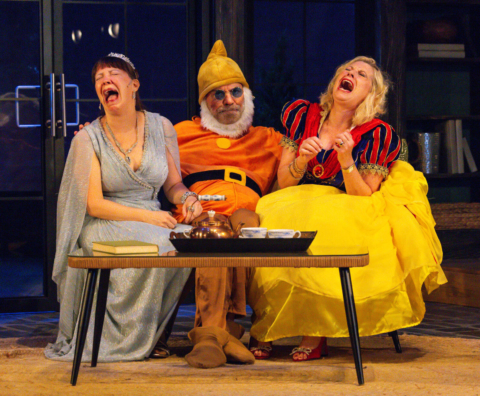
Two scenes in the second act — a telephone call, of which we hear one side of a game-changing conversation, and a tirade that cathartically unleashes a lifetime of complaints, regrets, and private wounds — turn Bristol Riverside Theatre’s production of “Vanya and Sonia and Masha and Spike” from a pleasant but aimless comedy to a moving, textured study of relieved and released unhappiness.
Thank Alan Safier (Vanya) and Amanda Schoonover (Sonia) for making two monologues, one difficult for the silent expression of various mood swings, the other difficult for its length, scope, and emotion, into revealing windows into the lives of two people who lead a genteel but staid and empty existence. Safier and Schoonover propelled Christopher Durang’s witty but light borrowing of elements from Chekhov’s plays into riveting moments that were truly Chekhovian in their ability to be comic and heart-wrenching in one impressive swoop.
Thank director Ken Kaissar for providing Safier and Schoonover the time and pacing that let their indelible passages breathe and bring so much hidden angst so forcefully to the fore. These sequences, each an epiphany, show the artistry of theater while entertaining, elevating Durang’s text to operatic proportion, and honoring Chekhov by exemplifying the humanity and pain he embedded in comic situations and settings.
From the beginning of Kaissar’s production, Safier sets an example of how to approach Durang’s play and its Chekhovian overtones. While nailing both the comedy and emotional range in his character, he presents Vanya as natural and authentic. Yes, there are childish snits and full-out temper tantrums included in Vanya’s generally placid demeanor. Plenty of sarcasm and sweetly spoken verbal daggers, too. But Safier embodies all parts of Vanya in a simple yet complete way that makes his Vanya more realistic than the other characters on Kaissar’s stage. You can picture him going through his daily routines in the pondside Bucks County cottage in which Durang sets his play. He’s quirky but believable.
This makes a big difference in the first act of Bristol’s “Vanya” because Safier, joined by Schoonover and Carla Rose DiPietro as next-door neighbor Nina, keep their parts in balance and let both the spoofed and the serious sides of their characters come through while their castmates overstress comic traits that Durang builds into their roles and relegate their characters into types rather than full-fledged human personalities. They are quirky and even funny but not believable.
That’s the danger of doing a comedy that allows for large portrayals and character eccentricity.
Durang likes to have fun. He’s good at it. He knows how to parody Chekhov while maintaining his own authorial tone and inventing his own comic devices.
He leaves room for actors to go over the top and eke laughs by exaggerating their characters’ mannerisms and peculiarities.
With that permission, there’s such a thing as going too far.
Everyone in Kaissar’s cast shows her or his talent throughout the production, but the first act is marred by going past some limits of even broad comedy. Safier is an expert in judging when enough is enough. Schoonover and DiPietro also have a sense for when to put on the brakes and keep their characters more realistically idiosyncratic than wantonly self-indulgent.
While Safier and Schoonover galvanize the second act, the first act at Bristol seems more like a free-for-all.
Those idiosyncrasies that differentiate a character get in the way of Durang’s play. They keep it and Kaissar’s production from gaining traction or getting its audience interested in the myriad situations and whimsical character traits Durang provides.
“Vanya” seems performed rather presented, engineered for broad laughs rather than a comic piece that works even if one doesn’t recognize all of the Chekhov references and overtones (or in the case of Sonia’s “wild turkey,” Ibsen’s).
Time playing Durang’s piece, which runs to October 5, may correct some of the indulgences. “Vanya’s” first act at Bristol will be more cohesive if that happens.
As mentioned, large eccentric traits are built into Durang’s script. Vanya and Sonia’s housemaid, Cassandra, is, in keeping with her name, a psychic who accurately predicts calamities to come but is never believed. Their sister, Masha, is a famous movie and television star who expects her ego, preferences, whims, moods, and plans to take precedence no matter what the siblings she supports, the stud she sugar mamas, or the pesky Cassandra think or do. The stud, Spike, is one whose developed muscles supersede his IQ and an eye that roves towards anyone who pays attention to his extraordinary physique.
You can see the comic possibilities in all of that. Kaissar, a master at comic stage business, and his cast certainly did. In this case, they need to cut some of the physical comedy down or make it more natural.
Megan McDermott has sterling moments as Cassandra. A scene in which she employs a voodoo doll is spot-on and escalatingly hilarious. Moments in which she shows Cassandra’s independent streak and knack for taking over hit home firmly.
In other sequences, including her entrance, McDermott’s approach to Cassandra is too stock. Its size and cliche suggest more of what someone at a party would do to convey mystery and psychic power. The grandness in which she reveals her presentiments undercut them. This Cassandra is too showy to be believed. It isn’t so much that McDermott is on the wrong track as that she has to judge when to go big and when Cassandra wants to be helpfully informative.
Angela Pierce, as Masha, is supposed to create storms. She is the bread-winner for her siblings, the sole owner of the house where they live, and a bona fide star used to aides running to fulfill her smallest request.
Masha is meant to put Vanya and Sonia’s life quiet life out of kilter, but Pierce is too strong and demanding in the first act. She seems to create Masha from Durang’s pages instead of figuring out how she intersects with Vanya and Sonia.
Pierce’s second act is better. After Vanya’s monologue, she seems to take a different view of her sibling and expresses herself more naturally.
Dante Giannetta was built to play Spike. His years as a body builder certainly show. Posing to show off those muscles is definitely part of Spike’s repertoire.
Giannetta’s approach to Spike is different from any I’d seen the six previous times I’ve seen “Vanya.”
“Different” is fine when it works, and some of the seriousness Giannetta gives Spike is refreshing from the dumb blonde type we usually get.
The trouble at Bristol is Spike becomes unlikeable. Rather than being oblivious to matters that are obvious to others, Giannetta’s Spike comes off as a schemer and user. There’s also a misjudged sequence in which Spike, an actor, re-enacts an audition he did for some vapid TV superhero. Durang’s script says he came in third for the job. In that case, Spike’s performance has to be plausibly good. By making it awful, Giannetta and Kaissar stage the wrong joke.
McDermott, Pierce, and Giannetta would do better with less posturing. A lot of their bits seem self-conscious, a product of trying for a laugh instead of earning it. They push comedy that Durang made inherent.
In the long run, Bristol’s “Vanya and Sonia and Masha and Spike” deserves support because of Schoonover’s funny and touching response to the first dinner invitation she’s received in years and Safier’s tour de force when Vanya spews forth every gripe he’s harbored for decades.
Jason Simms’ set for the production is perfect. It is identifiable as “old Bucks County” while having modern touches and an aspect that convinces it provides a great view of water and nature. Linda B. Stockton’s costumes, especially her costume-party regalia for Masha and Nina, serve every purpose. Cameron Filepas’ lighting provides texture and atmosphere that enhance and comment on the play. Damon Figueras’ sound design is clean and well-pitched.
Vanya and Sonia and Masha and Spike, Bristol Riverside Theatre, 120 Radcliffe Street, Bristol, Pennsylvania. Through Sunday, October 5. Wednesday and Thursday, 7:30 p.m.; Friday and Saturday, 8 p.m.; Wednesday and Saturday, 2 p.m.; Sunday, 3 p.m. $35 to $65. www.brtstage.org or 215-785-0100.