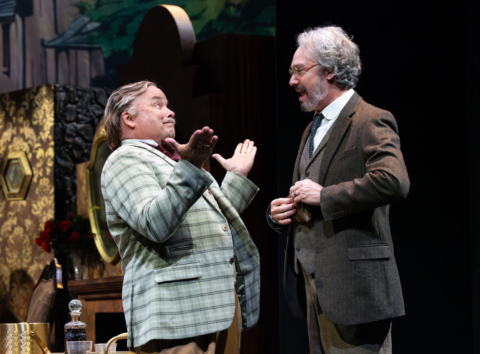
More than three hours in length, and busier at times than a rush hour intersection, Ken Kaissar’s production of “Alibi” at Bristol Riverside Theatre satisfies in a smooth, effortless way because it concentrates on what matters most, the mystery at hand.
Acting might be uneven, the frequent, choreographed realignment of the set may make you mutter, “Too much, hurry up,” and a theatrical device or two might be more distancing than engaging, but Kaissar always keeps you involved and listening for clues to figure out two crimes, a murder and blackmail that coaxes a character to suicide.
The building of suspense and maintaining a deep atmosphere of mystery is important because the trend in recent decades has been to make light of mystery and to concentrate on comedy or eccentric characters. It was pleasing to watch a play that had you calculating and guessing along with the detectives and town gossips to figure out whodunnit.
Bristol’s “Alibi” is a genuine mystery, with all the familiar elements of the genre, including my favorite, the gathering of all the suspects in a room, ending with the criminal culprit being revealed.
Except here there is a twist. All possible felons are assembled, but naming the guilty party is deferred to a later scene that offers more impact and surprise.
It’s worth waiting for. The delayed climax and the desire to hear it is a testament to the canny writing of Amy Kaissar, who adapted Agatha Christie’s novel from the 1920s, ‘The Murder of Roger Ackroyd,” with clarity and the right amount of evidence at the right time to refocus on a complicated case following a tumultuous scene change or odd moment when the acting did not keep up with Mrs. Kaissar’s script.
In general, the Kaissars combine for a success. Christie and her story are well-served. Benjamin Lloyd, Danny Vaccaro, Johnny Fernandez, Lea De Marchi, and Scott Langdon display the wit and intensity in their roles to make up for some weaker portrayals. The musical-chairs set becomes amusing rather than a distraction; a welcomely old-fashioned thrill of mystery and delight in detection is preserved.
In another tribute to the Kaissars’ overall deftness, the three hours and 20 minutes “Alibi” takes to unfold was barely noticed until I looked at the clock in my car as I started for home. Between being involved in the action and enjoying several of the sarcastic retorts Amy Kaissar provide some characters, the time, for me, went by breezily and without any concern whether this play would ever end.
Even in my contentment, there were aspects of Ken Kaissar’s production that made me wonder.
One was that mobile set. Shawn Lewis cleverly designed both large pieces — bookcases, secretaries, curiosity walls — and furniture —desks, sofas, chests — that could be flexibly configured to look like different rooms in different houses. The concept is fun and eventually earns acceptance, but the execution can be cumbersome and not quite as entertaining as I guess was intended. At least 15 minutes of the 3:20 could be shaved if the set moved more simply.
Just as curious was the music played during the set changes. “Alibi” is set in 1935, but the moves were underscored by a tinkly ragtime piano that is associated with an earlier period and doesn’t gibe with the general mood of Mr. Kaissar’s production, guided by the shrewd, at times droll, yet straightforward performances provided by Vaccaro and Lloyd.
Then there’s a theatrical conceit suggested by the play’s title, “Alibi.” Most of the characters, all suspects in the murder, and one or two in the blackmail, give their excuses for not possibly being in the right place or time frame to commit such destructive crimes while standing, usually upstage right, under a bright white light, like one that might be shined during a detective’s grilling in a ’40s potboiler. They also look straight forward and eschew any facial expression or emotion in a manner that seems unnatural.
In a Brechtian way, this offsets the testimony and makes you pay extra attention to it. In another context, it’s off-putting. “Alibi” is set the small “veddy” English village of King’s Abbott, where all hundred or so residents know each other and would respond more directly and conversationally, even to detectives, one they know well, one who comes by request to the fore, asking them where they were, what they saw, and when they saw it on the evening of the murder. I give Ken Kaissar points for having an intriguing idea, but in theatrical effect, it backfires. It interrupts cohesiveness and a certain familiarity between characters that seems crucial to “Alibi,” especially considering its length.
Another time-saver, or different use of time might be trading some narrated scenes, made plausible by the gambit that Vaccaro’s character, a town doctor, is taking notes to write a book about the Ackroyd case and shares some of his insight, for a direct playing of them. Showing instead of telling.
Those cavils are noted because as engaging as “Alibi’ is, it could be stronger if the directness that governs it most of the way was non-stop instead of being paused for scene changes, an odd lighting device, and mostly unneeded narration.
The assets of Amy Kaissar’s script, so well-crafted and designed to bring you into Christie’s mystery, and Ken Kaissar’s staging, tight where it counts, especially in encounters between Lloyd and Vaccaro and Vaccaro and Fernandez, outweigh any criticisms.
Benjamin Lloyd is a local actor you want to see more frequently. His portrayals are always so precise and entertaining. (A “Scapino” he did a decade or so ago for Philadelphia’s Lantern Theater remains among the highlights in regional theater history.)
In Alibi, he plays Christie’s meticulous, perspicacious Belgian sleuth Hercule Poirot with care of which M. Poirot would approve.
Lloyd doesn’t exaggerate Poirot’s famous tics, and Amy Kaissar forgoes having Poirot speak about “little gray cells” in her text, but Lloyd finds droll, subtle ways to make Poirot individual.
In “Alibi,” the famous detective has come to King’s Abbott to retire. He wants to give up investigation and garden what turns out to be a rough patch of land in peace and anonymity.
Those intentions come under the category of fat chance. A niece of the murdered Roger Ackroyd is aware of who Poirot is and that he is attempting an incognito existence in King’s Abbott. She has another character enlist him, and Poirot succumbs to the plea.
Lloyd handles Poirot’s reluctance to return to intrigue as deftly as he disguises the tricks Poirot uses to elicit information. Lloyd emphasizes Poirot’s cleverness as the smartest one in the room while conveying a sense of modesty and comme il faut talent in the character.
It is another smart, amusing-yet-businesslike performance by an actor who has made a habit of giving them.
In contrast, Danny Vaccaro has trod the Bristol stage as much as anyone, but less in recent years. It was a delight to see him return as King’s Abbott’s valued doctor who has to take his medical bag on social calls lest a woman with child suddenly needs his services.
Vaccaro deftly treads a fine line of a man who is stricken by the loss of two of his closest friends, the widow whom blackmail drives to suicide and a fellow leading citizen of King’s Abbott, and one who is excited to be in the thick of solving those crimes and possibly getting a lucrative book deal after using his notes to compose a novel about them.
Vaccaro exemplifies the solid village burger who relishes a change of pace and the chance to use a different kind of ingenuity to diagnose a blight to his community.
Watching Lloyd and Vaccaro collude and spar is a treat, one compounded in scenes Vaccaro has with Johnny Fernandez as the doomed Roger Ackroyd.
Those scenes between Vaccaro and Fernandez galvanize “Alibi” and set it in favorable motion. Fernandez rivets with the strength of his character, especially when he exhibits Ackroyd’s strong will and equally strong attitudes about the people who surround him, especially his family.
Fernandez gives Kaissar’s production depth, especially as he adroitly marks himself as one who is ripe for murder yet is so winning and forthright, you don’t want to see him killed.
Lea De Marchi sets herself apart early when she endows her character, a maid in Ackroyd’s home with an intensity that makes you notice her from within a pack.
Peter Kendall is fine as two distinct characters, one the heir to Roger Ackroyd’s estate, the other a Canadian visitor who makes an untimely visit to Ackroyd’s home.
Another local stalwart, Scott Langdon, exudes menace while speaking common sense as Ackroyd’s secretary. Carl Wallnau provides comic relief in the role of a local detective who is quick to take credit for what Poirot discovers. Beethovan Oden gives gravitas to the production as a reasonable guest at Ackroyd’s home.
“Alibi” was this year’s occasion when Bristol Riverside enlists members of its immediate community to be part of a production. The group did well, particularly Zlatin Ivanov who stood out for his excellent, well-judged performance as one of Ackroyd’s footmen.
Shawn Lewis’ set took on a Rube Goldberg quality as actors schlepped it here, there, and everywhere. Conor Mulligan’s lighting accented key moments that added to both the mystery and Poirot wanting to garden in the unwilling British sun.
Alibi: An Agatha Christie Story, Bristol Riverside Theatre, 120 Radcliffe Street, Bristol, Pennsylvania. Through Sunday, June 15. Showtimes are 7:30 p.m. Wednesday and Thursday, 8 p.m. Friday and Saturday, 2 p.m. Wednesday and Saturday, and 3 p.m. Sunday. $52 to $66. www.brtstage.org or 215-785-0100.