The new summer culture season has arrived with an ominous cloud over it.
Thanks to a cut in the federal funding that supports nonprofits — one of the most common business structures for arts organizations — regional art and culture presenters are facing more challenges to run their businesses than ever before.
And as daunting as the situation seems, it isn’t the end of the world.
I know because I’ve been involved with nonprofits for five decades.
Yep. In addition to having a career as an editor and writer for U.S. 1, I worked for several nonprofit organizations. They ranged from statewide arts education programs to state and nationally known museums to professional theater. For heaven’s sake, I even led the creation of Trenton’s only nonprofit professional theater, Passage Theater.
Although my job gave me a hands-on education in writing grants and interacting with boards, I got more nonprofit know-how by serving as a grant reviewer for the National Endowment for the Arts, New Jersey State Council on the Arts, MidAtlantic Arts, and a few county agencies.
I worked in good times, when the nation had proud bipartisan support to make arts funding available to all communities. And I was an inspired New Jerseyan when I saw Republican Governor Tom Kean strengthen arts funding in the Garden State.
But I also saw the bad times. Think back when U.S. President Ronal Reagan’s Republican administration attacked the National Endowment for the Arts and public institutions for supporting “obscene” art and caused cries for cuts and/or restrictions. And how about the time Democratic Governor Jim McGreevey attempted to eliminate the total budget of the New Jesey State Council on the Arts in order to balance the state budget? Yikes!
And while I was no longer involved with grant writing when COVID arrived, I understood immediately that arts organizations and artists were in trouble and devoted as much ink and space in U.S. 1 as I could to keep them visible.
I also wrote articles on how arts funders were rallying to help organizations to continue into an uncertain future.
Now, just as our state and regional organizations were hoping to be getting back to the business of creating culture, the president of the United States has called for the elimination of all federal support to the nation’s nonprofits. WTF is right!
So, having spent a lifetime involved with the arts in New Jersey and having my share of great moments and crushing blows delivered by ill political winds, I thought I’d share some thoughts with my fellow artists and arts coordinators who are getting ready to deal with this challenging era — one that will change and then change again.
First to staff members. Take care of yourselves. The majority — if not all — of us working in nonprofits are basically idealists who hope to make a better world.
For many of us, our spirit may be summed up by what Franklin D. Roosevelt said at the dedication of the Museum of Modern Art in 1939: “The arts cannot thrive except where men are free to be themselves and to be in charge of the discipline of their own energies and ardors. The conditions for democracy and for art are one and the same.”
However, our idealism sometimes gets translated into thinking that if we work harder, all will be better. And when it doesn’t, well, we just have to work even harder. However, eventually, as I will attest from observing it in myself and my past colleagues, such thinking and behavior can lead to frustration, disappointment, and fatigue.
Contrary to how an idealist usually thinks, the best thing an idealist staff member can do is to take care of one’s physical and mental health.
The latter can be helped by enhancing one’s perspective, realizing that one is not personally responsible for the current situations and making active choices in order to address new problems.
However, staff members also need to understand that even under the best intentions and actions, efforts may fail. Being a byproduct of a culture that has plenty of myths regarding winning and losing, it is easy to blame ourselves if something fails. Yet, as one ancient Chinese text informs, “if the chariot wheel breaks during battle, it is not the fault of the fighter using it.”
The staff should also be mindful of the fiscal health of the organization and entertain new approaches that maintain the organization’s mission and solvency.
Additionally, staff members may have to realize that despite whatever they’re doing, it isn’t going to work and to find a way to survive and continue elsewhere or in another matter.
And finally, during our current politically tense time, the artistic staff also needs to be mindful that the impulse to create strong political statements may be best put in a light of what will serve the collective effort.
Now, here are a few thoughts for board members: Remember that you joined the organization in order to support its mission and the staff who makes that mission a reality.
While the region has committed and thoughtful board members, I also have encountered individuals who think all they need to do is count money and tell the staff what they can do. Therefore, it may be a good time to recall that one of the traditional roles of a board member is to contribute money, get others to contribute money, or get other types of support for the organization.
It is also a good time to remember that the staff is only capable of doing so much and for the board to refrain from developing projects that will result in overburdening them. They may also want to ask the director and staff members what they could best do to help them realize the organization’s mission.
Although my arts funding article on page 7 includes thoughts directed towards funders, municipalities, and communities, some are worth revisiting.
Funding organizations should continue to encourage COVID-era innovations in organizational structures. And if applicable to the fund’s mission, funders could choose to provide general support, rather than a specific category of usage. It is time to allow organizations to use new technology, partnerships, and imagination to create new ways of doing traditional business.
Municipalities need to remember that healthy nonprofit arts organizations are a benefit to the community and explore ways to support and partner with them.
And community and audience members can do several simple things: They can make financial donations, buy tickets, support innovation, and understand that the organizations are facing difficult times.
Finally, all of us can start working toward a better future by becoming politically engaged. After all, former Governor McGreevey’s plan to cut the NJSCA resulted in a new means of state funding that continues today. It also resulted in demonstrating an important lesson: the future is the decisive action of a mass, not a pronouncement. Anything can happen.
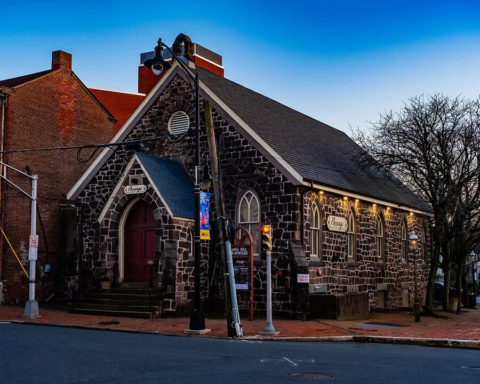
Recently, the above-mentioned Passage Theater celebrated its 40th anniversary with a gala. Being a historic artifact of sorts, I was invited to talk about how a handful of artists decided to create an artist movement and professional theater in downtown Trenton — despite the city’s lack of businesses, financial support, and a prevailing culture of pessimism.
As I spoke, I remembered the formula we employed to make it happen: imagination, a willingness to take risks, a sensible budget, a solid arts vision, and people and organizations willing to open their wallets.
I’m thinking that the general approach may still work. And there may be no better time to start to find out at this beginning of a cloudy summer art season.