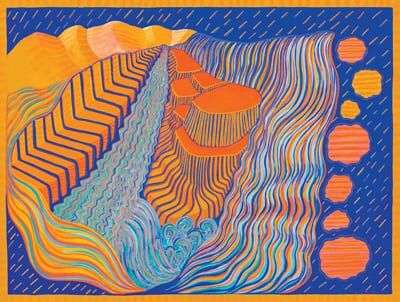
We often ponder these questions: Was there a beginning, and will there be an end? If so, what came before? What will come after? And with space — if you travel out to the end of the universe, what lies beyond?
Looking at the paintings of Ruane Miller makes one think of these questions. Miller seems to see both within and without. Her images pulsate with color and take us to places we recognize but that emanate from the deepest canyons of the artist’s mind. She is unafraid to let go and travel there and is incredibly able to bring that world back to us.
“Inner and outer, human and nature, dream and reality, the intimate and the monumental, the permanent and transitory: dualities intrigue Miller, and she has the confidence to let them be,” writes Lois Fichner-Rathus, professor of art history, in the catalog accompanying “Through the Window of My Mind: Ruane Miller, Paintings and Prints,” on view at the Gallery at the College of New Jersey from Wednesday, January 22, through Thursday, February 20. “She is not afraid of color and, by extension, is not afraid of the irreconcilable in nature.”
The retrospective of 46 works created during the past 15 years is presented on the occasion of Miller’s retirement as professor of digital art at TCNJ, where she has taught since 1986. During her tenure, Miller designed and implemented the development of a computer graphics curriculum and facility for the art department and later coordinated the development of a BFA major in digital arts. She has chaired the art department and served as coordinator of both the fine arts and digital arts programs.
Travel and immersion in different environments inform her imagery. Miller uses both traditional painting and drawing and digital imaging and printmaking. The digital work incorporates her photography of landscapes, wildflowers, and ancient art as well as scans of gouache paintings and sketches. She moves comfortably between the worlds of digital and traditional, often blending the two.
Miller combines a personal poetic sensing of the world with technological mastery of several mediums, combining them in a way that creates profound beauty. There’s even an environmental message in these depictions of vast lands, urging us to protect these precious vistas.
From her part-time residence near Rhinebeck, New York — owned by the man with whom she shares a relationship and where Miller has been recuperating from Lyme disease — she reflects on her career and her decision to retire now, at 69.
The Weehawken resident keeps a studio in both locations, and while Miller finds the Hudson Valley relaxing, her subject matter tends to focus on the American Southwest. An outdoors woman who loves to hike and camp, she is eager to put the Lyme disease behind her and return to nature.
A former member and co-president, with Madelaine Shellaby, of the Princeton Artists’ Alliance, Miller participated in the exhibitions “Vision and Voice” at the New Jersey State Museum, and “Revision and Voice” in the Brodsky Center Gallery at the Heldrich in New Brunswick. The poet she collaborated with on both exhibitions was Lois Marie Harrod. “We felt in tune with one another,” says Miller.
“We affirm each other through our arts. Each understands what the other is doing,” writes Harrod. “We both want our art to be accessible and dense, clear, and deep. Neither of us wants to relinquish texture and layer, source and surface, root and leaf. Though our arts are complex, we both use myth to give clarity to our versions of daily life, what Henry James has called ‘the pattern in the carpet.’” Harrod has used Miller’s art on the cover of her chapbook “Firmament.”
“Desert Paradox,” a digital print created from photography and gouache, was based on a poem Harrod composed on a desert plant, fallugia paradoxa (Apache plume). “The shrub produces a beautiful plume, a feathery flower,” says Miller. In the painting, goddess-like figures proceed on a rainbow-colored roadway under clouds illuminated by sunset; the work itself inspired Harrod to write another poem. The two continued to work in this vein, inspired by each other.
Miller is a native of Milford, Connecticut, and later lived in Easton, Connecticut, surrounded by fields and woods. Her father was a steamfitter and her mother, unlike her friends’ mothers who stayed at home, worked as a keypunch operator, perhaps an inspiration to Miller, who was a pioneer in digital arts. She lived in Philadelphia while at Tyler School of the Arts, then earned a master’s degree at Tyler in Rome.
When she transitioned to the digital world in 1984, it was new for artists, she says. “Graphic designers were not yet using it. The software and hardware were not there. I fell in love with the medium the first time I got on a computer even though the software was archaic. A lot of artists felt it was at odds with creating fine art, though not so much anymore, but I felt it was another way to work and create. I loved the flexibility.”
As the technology improved, artists could incorporate photography and add more to what they could do as an artist. “The vocabulary offered me what painting alone wouldn’t have. I was able to translate my enthusiasm into teaching and program development. This was a medium you could really be creative with and expand your own vision.”
As a 42-year-old in 1986, Miller earned a second MFA in computer graphics design from Rochester Institute of Technology. Colleges and universities were just starting to consider adding curriculum in the field. Miller interviewed around the country, liked the atmosphere at TCNJ, and opted for that position. “I found among the faculty, during my two to three-day interview, some were not interested in computer art, but all were behind bringing it into the curriculum. The college was very open, and I had the full support of the department and administration.”
Miller’s extraordinary use of bold contrasting colors comes from her early work at Tyler in Rome, when she worked in oil painting and printmaking. “Intense color is something I was always interested in. That has continued. The computer offers me the same choices in color, although there are differences when it is printed out. Color sense is innate.”
In 1997, after chairing the art department, she took a sabbatical year, packing up all her belongings. She traveled around the country for a year, camping and exploring archaeological sites.
“I traveled across southern Canada into Northwestern Ontario, where I spent eight days with indigenous people in Thunder Bay and in Sioux Lookout,” she says. She subsequently journeyed to the Northern Plains into Montana, Wyoming, Colorado, and Utah, and then the Southwest and the Four Corners region, researching ancient and contemporary cultures and their art, artifacts, and beliefs.
After two-and-a-half months working in a studio in Maui, Hawaii, she returned to the mainland to attend an artist residency at the Ucross Foundation in Wyoming.
“It was a very creative time. All the sketches and drawings from Hawaii came into play in the residency.” She created a 10-foot mural painted on paper from the Hawaiian work.
“Everything grows so fast in Hawaii. There is a lot of light and energy.” Using spontaneous line and invented imagery, she made 40 to 50 drawings and sketches.
In contrast, she says, “I felt a great affinity to the Southwest when I went there. The landscape and skies are so dramatic.” She was moved by the long vistas, the outlines of clouds and land against sky, the change of color. “I found the desert quite alive, a different kind of life than the more obvious life in Hawaii.” She taught herself about petroglyphs, pictographs, and Native American culture, enchanted by the mystery. “These artifacts and art were left so many years ago and are in touch with the landscape.”
Miller’s son, who had gone to school in Arizona, married and settled in Flagstaff, producing a grandson for Miller. Her daughter settled in Durango, Colorado, creating even more reason to spend time out west. In 2000 Miller bought a house in Flagstaff that she rents out, but uses its studio when visiting.
The most recent work in “Through the Window of My Mind” is from a 2011 residency in the Grand Canyon. She had already been suffering from Lyme, and her daughter and a friend came to help as she focused on making photographs. It was only in spring, 2013, when Miller could paint again.
“Besides the thrill of being able to work again, they express well the feelings of that experience in the Grand Canyon, even if I couldn’t hike to bottom of the Canyon,” she says. “The views are embedded in my mind.”
The new paintings are all gouache. “I did use photographs and sketches while a resident to gather information, using the camera as a resource.”
There are also pure digital works from a 2007-2009 series from Petrified Forest National Park, using Photoshop to create composites. For the cloud series, she scanned in pieces of painting and combined them with digital painting. “I move back and forth between media. Sometimes I want more of a photographic feeling. Recently, it’s the painting. Because of the Lyme disease, using a computer is difficult.”
In order to make the Grand Canyon paintings, Miller played a computer slideshow as she sat at her drawing table and sketched, looking at different images as they came up. It would gel and come together for her. “I realized what I was interested in — this repetitive rhythm of form that takes place in the Grand Canyon. The striations and linear pattern. The first couple were more exuberant and abstract images of the Colorado River, then paintings that were more realistically based. It’s an intuitive process, though I may have to struggle to get it out. I do a lot of drawing until it comes together as imagery. Then it takes off. It doesn’t always come easily; there’s work I have to do to get to that point. But it always happens.”
Through the Window of My Mind: Ruane Miller Paintings and Prints, TCNJ Art Gallery, Arts and Interactive Multimedia Building, 2000 Pennington Road, Ewing. Opening reception Wednesday, January 22, 5 to 7 p.m. To Thursday, February 22. Gallery hours: Tuesdays to Thursdays, noon to 7 p.m.; Sundays, 1 to 3 p.m. Free. tcnj.edu/artgallery or 609-771-2633.