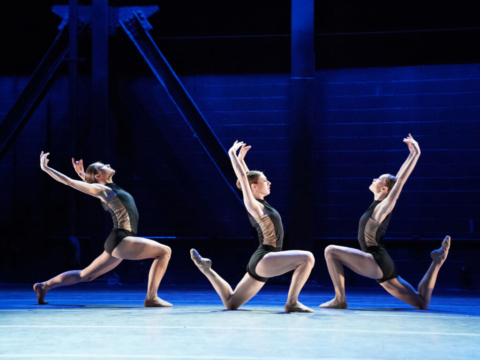
I’m always saddened by the sparse attendance at its matinees, as the New Jersey-based American Repertory Ballet consistently proves itself a top-notch company local audiences can depend on to deliver exciting dance events. At the New Brunswick Performing Arts Center, June 10 and 11, the dandy little troupe served up “Premiere3,” a triple bill comprising world premieres of Amy Seiwert’s sublime “Sight Line” and artistic director Ethan Stiefel’s irreverent “VARIANTS,” alongside a company premiere of Arthur Mitchell’s lovely “Holberg Suite” (1970).
Staged by Cassandra Phifer, an original member of Dance Theatre of Harlem, ARB’s revival of “Holberg Suite” is a gift. It offers ballet-goers the rare opportunity to consider Mitchell’s accomplishments as a choreographer, which are overshadowed by his achievements as a pioneering performer — the first Black male permanent member of a major ballet company (New York City Ballet) — and as the visionary co-founder of Dance Theatre of Harlem. Created in 1969 to give ballet-performance opportunities to Black dancers, DTH emerged at a time when many still believed Black bodies were not physically suited to classical technique, which involved an aesthetic of uniformity that overrode any commitment to diversity within a ballet ensemble, thus classical companies included few, if any, performers of color.
Set to the eponymous collection of dance tunes composed in 1884 by Edvard Grieg to honor the 200th anniversary of the birth of Scandinavian writer Ludvig Holberg, “Holberg Suite” is a gem of a ballet. Just as Grieg, a Romantic-Era composer, paid his tribute via forward-sounding variations of the baroque musical forms of Holberg’s time, Mitchell rooted his choreography firmly in classical vocabulary but sent small groups of dancers soaring through space in fetching, unpredictable patterns with the speed and expansiveness of George Balanchine’s new 20th-century neo-classicism. His abstract ballet is also doused with more than a dollop of emotional expressiveness and hints at human relationships, marking the Balanchine-influenced work with its own distinctive stamp. One only wishes the ARB dancers had been a bit more daring in their skillful, nuanced performances, as it’s the interpreters’ fearless embodiment of the risky moves that makes neo-classical ballet truly thrilling.
“VARIANTS,” too, spotlights the choreography of an artist better known for his work as a performer and director. A former principal dancer with both New York City Ballet and American Ballet Theatre, and teen-idol star of Hollywood’s Center Stage (2000), prior to taking the helm at ARB in 2021 Stiefel served stints as artistic director of Royal New Zealand Ballet and dean of dance at the University of North Carolina School of the Arts.
His new ballet, set to the piano music of Brahms’ “Handel Variations,” kicks off with a spectacular scenic effect designed by Howard C. Jones. (Spoiler alert!) An onstage grand piano breaks apart and flies away leaving only the hammers and felts of its “innards” hanging aloft, setting the tone for Stiefel’s playful piece. While the choreography’s quirky, sometimes-parodic antics demand that we find the fun in ballet and not treat it with a pretentious “sacredness,” the work’s opening “dissection” sets expectations for more thought-provoking choreographic statements. How exactly do we “deconstruct” ballet? What does that look like and how does it make us feel? Alas, the lively ballet displays the dancers’ technical agility, but as it mixes ballet steps with silly actions (such as wavy, fish-like belly-flopping along the floor) we learn nothing new and don’t even laugh much, as comedy does not derive from silliness alone.
Unlike Mitchell and Stiefel, the Bay Area-based Seiwert is most familiar as a contemporary-ballet choreographer, and her superb “Sight Line,” a passionate septet, proffered the program’s meatiest choreography. Its dramatic depiction of a prideful community energized by uninhibited individual “voices” recalls the earthy, folk-inflected aesthetic of influential Israeli choreographer Ohad Naharin. Seiwert’s grounded vocabulary sits beautifully on the versatile ARB dancers, especially Annie Johnson, who, in an opening duet, sets an unsurpassed standard of strong, contemporary technique. I first noticed Johnson’s exemplary modern-dance sensibilities four years ago in ARB’s presentation of a Paul Taylor piece, and she continues to stand out whenever tasked with interpreting powerful contemporary movement.
ARB concludes its 2022-23 season in a performance with the Attacca Quartet at The Princeton Festival, June 17. www.arballet.org.