
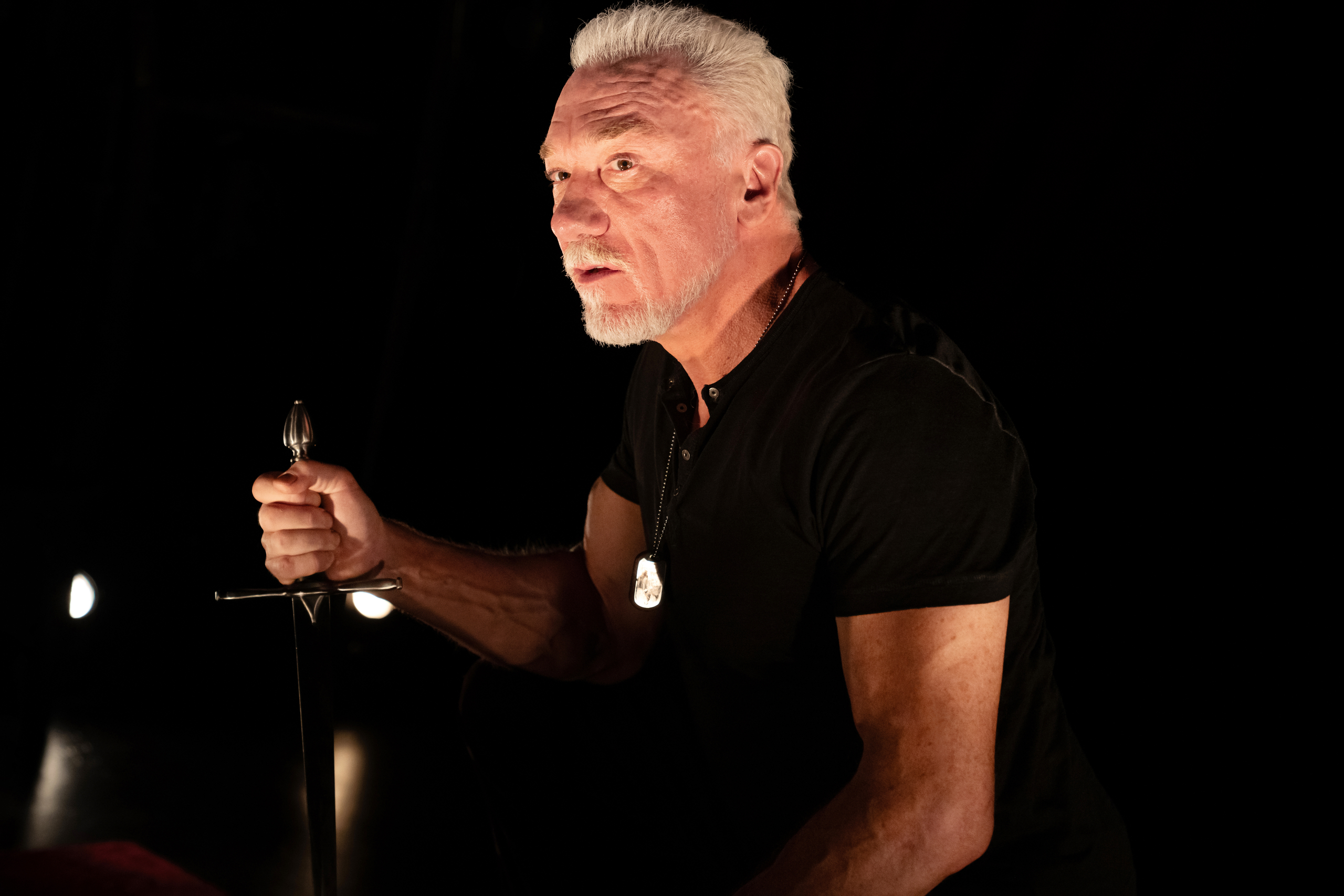
Richard III, Aaron the Moor, Shylock, Marcus Junius Brutus, Claudius, Iago, Macbeth.
The order in which Shakespeare’s most notorious villains appeared on stage.
Also the order in which Patrick Page first played them.
Page is not only a career-long performer of Shakespeare. He is a devotee and scholar of the Bard who has assembled several anthology pieces featuring Shakespeare’s characters and delves deeply into the plays in which they appear and Shakespeare’s progression in developing them.
In a telephone interview from New York, Page agrees with me that Shakespeare was the original psychologist. Page’s studies go further. He tells me Jung and Freud cite Shakespeare in their writings.
“Shakespeare is the first playwright to give characters dimension, motivation, and psychology,” Page, whose piece, “All the Devils Are Here: How Shakespeare Invented the Villain,” runs at Princeton’s McCarter Theatre through Sunday, Aug. 30, said during our conversation.
“He was the one who matched telling behaviors and intention to action. He differed in creating a physical vocabulary to go with the language his characters use.
“I spent a life playing these characters and seeing how the Shakespearean villain evolved from compensating for a deformity like Richard III or seeking revenge like Aaron the Moor to the complexity of Shylock, the rationale of Brutus, the way an appearance of conscience affects Hamlet’s intention to kill Claudius, the total absence of conscience in Iago, and the culmination of all, the man who has a conscience but decides for villainy in spite of it, Macbeth,” continues Page, whose resume includes a range of characters not created by Shakespeare, such as the sly and slithery Hades in the musical “Hadestown,” which can be seen in an excellent and commercially successful stage capture at local movie theaters, and his ongoing role as Richard Clay, right-hand man of robber baron George Russell, on HBO’s “The Gilded Age.”
“It’s all there in the text,” Page says. “Shakespeare gives clear instruction about who these characters are and how they should be played. It’s up to the actor to see the cues and get it right.
“A lot of people blame Shakespeare when they don’t like a production of one of his plays. Or they blame themselves for not catching on to the language or action in the play. They tell themselves Shakespeare is beyond them.
“Neither the playwright nor the person is responsible when this happens, and it happens a lot. It’s usually because attention wasn’t paid to Shakespeare and how he crafted his stories and characters, all of which were meant to be seen, not read, to be absorbed in a single sitting. Some productions of Shakespeare are like going to a concert of Mozart, his ‘Requiem,’ for example, played by musicians who only studied jazz.”
Page knows whereof he speaks. He has been seeing Shakespeare since he was 4.
His father was an actor at the Oregon Shakespeare Festival in Ashland, Ore., one of the most respected programs of its kind.
Page was fascinated by Shakespeare and his language. He says he never considered, could never think of anything he wanted to do but act, and especially in the classical repertory.
“To this toddler, acting on stage seemed glorious, and Shakespeare was the pinnacle. I aspired to act at the Oregon Shakespeare Festival like my father did. In some ways that seemed far-fetched. There were other theaters in Oregon, but not all that many.”
For college, Page chose Whitman College in Walla Walla, Washington. “It was a small liberal arts college that offered courses in theater and Shakespeare. My aim was always to be an actor, but it seemed a good idea to have another profession to fall back on, such as teaching.”
The desire and ambition to act superseded such prudence, and Page looked for opportunities to advance his stage career.
“I saw an ad that the Utah Shakespeare Festival in Cedar City, Utah, was holding auditions for new members of the company.
“If I’d read the ad carefully, I might have noticed they were looking mostly for administrative people, but nonetheless they were looking. And auditioning. I decided I needed to go to these auditions, which were at the University of Washington campus in Seattle.”
Page’s theater professor at Whitman was not encouraging. He told Page he would never come near the audition. The folks from Utah, he said, were looking exclusively for acting students from schools with conservatory training programs in theater. Whitman and its program would not qualify.
As driven, successful people do, Page was not buying that.
“I had to figure out how to get from Walla Walla, which on the day of the audition was blocked with snow, to Seattle. The ride would take five hours in the best of circumstances. The snow forced me to leave before 3 a.m. for a 9 a.m. starting time.”
Page made it, but the obstacles his professor presaged began working against him.
Proctors and UWash theater folk told Page he was ineligible. Whitman did not provide the right credentials. He would not be given an audition or even the hope rules would be bent.
“Faint heart never won…” is not Shakespeare, but Page took the inspiration of Thomas Lodge, Gilbert & Sullivan, Anthony Trollope and others who employed that famous quote.
He did not give up. He stood in the lobby and buttonholed anyone who would hear his plea. “No one knew how to direct me to the place the auditions were happening. People kept telling me I ‘can’t wait here.’ I waited there.”
Eventually he found the right ear. “The foolishness of youth forced me to persist. Then who should walk by but Sanford Robbins from the Utah Shakespeare Festival. I didn’t know it was Sandy (later the founder of the University of Delaware’s REP Theatre), but I told him, ‘I am here to audition.’ Someone yelled, ‘No. He’s not from a conservatory. You don’t have time to see him.’ Sandy said, ‘There’s always time. Follow me.’”
Page spent the next six years in Utah, cutting his teeth on many Shakespearean and other roles before moving on to regional theaters, New York, and the Broadway and London stages.
“I received my acceptance letter to the Utah Fest on April 23, Shakespeare’s birthday. I arrived, and they told me the fee would be $1,200. I was crestfallen. I told them I didn’t have $1,200. They took my naivety in stride and said, ‘No, kid, we pay you $1,200.’ I thought I landed in luxury.”
Page honed his craft and increased his study of Shakespeare. His analysis of how Shakespeare put evil on stage by inventing and developing a villain who eventually has some humanity, then none, then the pantheon psychological struggle of Macbeth, was as good as taking a college course. His discourse made the opportunity to see “All the Devils Are Here” more exciting. Page made it imperative to see his words put into theatrical action.
“Shakespeare wrote 37 plays (38 if you count ‘Two Noble Kinsmen’), and when you read them in sequence, it becomes a single narrative with increasing plot and character complexity.
“You can trace Shakespeare’s mind moving to the next logical step of development.
“Shakespeare knew ancient and contemporary texts. He drew on historical tracts. He particularly knew the medieval morality plays. What happens next is a developing tale of human wrongdoing, using ancient models like Herod and evolving from there. Richard III, deformed, needed to define himself as a human being and a force. The person ignored, cast aside, asserting power, becoming an influence.
“Shylock startles with his humanity and his humor. He is one of the most misunderstood figures in literature, so close to winning what he wants but too obsessed with obtaining his promised reward to claim his victory.
“Claudius is doomed until Hamlet notices him praying and backs off from his purpose without knowing Claudius senses no response or solace from those prayers. Claudius is mistakenly credited with having a conscience that temporarily saves him. Iago has no conscience at all. And there’s Macbeth, who dismisses his conscience.”
Filmgoers seeing the stage capture of “Hadestown” will notice Page wears a therapeutic boot in his performance as Hades, one that doesn’t totally impede that stride that announces evil.
“About two weeks before we were going on stage, I tore my Achilles tendon. Luckily, I was a clean, complete tear. Doctors in London told me that meant I could do no more injury and that I could go on stage in the boot.
“The play ran at the Lyric Theatre for five weeks before the three performances that were filmed. I wouldn’t miss those. It was such a wonderful opportunity to be reunited with and be recorded for history with the original cast. I am as surprised as anyone it is such a box office hit, yet not surprised because ‘Hadestown’ is such a good piece, Brett Sullivan did such a sensitive job in bringing it from stage to film, and the original stage director, Rachel Chavkin, was there to work with Brett on key aspects of the staging.
“Playing Hades has made me more recognizable than anything else I’ve done, more even than ‘The Gilded Age.’ Not only in London or New York, but in Lisbon, Amsterdam, Prague, Seoul, you name it, people point to me and know Hades when they see him.”
