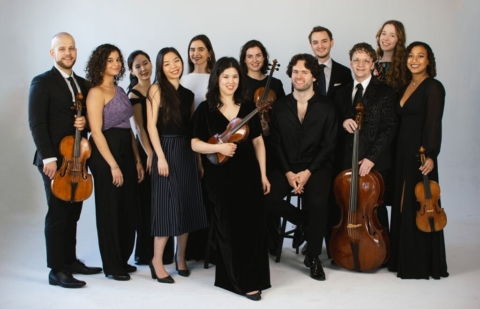
David Belkovski, cofounder and co-artistic director of the Early Music ensemble Twelfth Night, gave a fascinating little history of Italy to this writer, before getting more in depth about the music the group will present on June 11, at Trinity Church in Princeton.
It’s especially appropriate since the concert, part of the 2026 Princeton Festival, features three Italian composers: Antonio Vivaldi (1678-1741), Francesco Durante (1684-1755), and Pietro Locatelli (1695-1764).
“It’s easy to forget how alive Italy was in Vivaldi’s time,” Belkovski explains. “It wasn’t one unified country at all, but an incredible patchwork of rival cities trying to outshine one another through art, music, expressions of religion, and spectacle. Venice had this glamorous, almost theatrical independence, while Rome projected authority and spiritual gravity, so there was always a tension between those worlds.
“By then, Naples had become this enormous cultural force in the south, especially in opera, almost setting the standard for Europe,” he adds.
The keyboardist, conductor and early music specialist, who founded Twelfth Night with violinist Rachell Ellen Wong in 2021, reflects that composers like Francesco Durante were shaping generations of musicians through the Neapolitan conservatories, while someone like Pietro Locatelli, in contrast, took the virtuoso violin tradition “…and made it feel almost dangerous and modern. Arcangelo Corelli is arguably their forefather, effectively a poster child for Italian music,” Belkovski says. “And Vivaldi finds himself right in the middle of this great bubbling cauldron.”
There’s a special buzz around New York-based Twelfth Night, which describes itself on Instagram as “old music, old instruments, and new energy.” Belkovski, Wong and a flexible contingent of players breathe contemporary vigor into works that are 300 years old, or older. The ensemble’s vibrant, modern presentations — perhaps more like revelries — challenge the sometimes stuffy and formal concert environment.
Twelfth Night enjoys playing well-known works from the 17th and 18th century, but also dives deeper into lesser-known artists and their compositions.
For example, Princeton concertgoers will surely know Vivaldi’s “The Four Seasons,” but it might be one of the first times they’ll hear the music of Locatelli and Durante.
“The pieces we’ve pulled together, in addition to ‘The Four Seasons,’ reflect the best of Italy,” Belkovski says. “There’s an operatic sinfonia by Vivaldi to raise the metaphorical curtain on the evening, then Locatelli’s brooding C minor concerto grosso — a radiant violin sonata by Corelli that was beloved across Baroque Europe — and a fantastically fun concerto by Durante which seems ready to burst at the seams.”
He explains that Durante has some of the deepest ties to the famed Neopolitan conservatory network, “…which pulled many indigent young boys out of poverty to wildly successful international careers,” he says. “Durante is a dead-on contemporary of Bach but was much more interested in the ‘no-frills’ musical language of the Italian tradition. Despite not being much interested in writing opera, his music has a keen dramatic sensibility and his most famous students — Vinci, Leo, Pergolesi, etc. — dominated the opera world.”
Belkovski reflects that, in contrast, Locatelli worked out of Rome and championed the Roman style of music established by Arcangelo Corelli.
“Locatelli is the most ‘modern composer’ on our program,” he says. “His dark and stormy concerto grosso speaks to Corelli’s enduring legacy, alternating virtuoso solo moments with sections for the whole ensemble, hence the term ‘grosso,’ meaning big.”
Interestingly, Twelfth Night can range in size from just a handful of musicians performing intimate pieces, to more than two dozen for symphonic concerts.
“The group’s size certainly changes depending on the repertoire,” Belkovski says. “Over the past month we have presented three programs ranging from three to twenty players. It’s always in the interest of bringing the most exciting version of a performance to the audience. Our Princeton show will bring nine performers, including a harpsichord and theorbo.”
The theorbo has its origins in late 16th century Italy, and is described as a large, plucked string instrument from the lute family, primarily used during the 17th and early 18th centuries. It’s characterized by an extended neck with a secondary pegbox that holds long, unstopped bass strings, producing a deep, resonant sound.
“In addition to the strings (strung with animal gut and furnished with baroque set-ups), we use harpsichords, organs, all kinds of lutes and theorbos, flutes, recorders, oboes, bassoons and dulcians, along with many other instruments which, while familiar to a modern audience, have distinct baroque or classical counterparts,” Belkovski says. “It’s always fun to get into the weeds searching for the exact right instrument for a piece.”
The two co-founders of Twelfth Night are regarded as key young representatives of Early Music: Wong is the only baroque artist to receive an Avery Fisher Career Grant and Belkovski is the only recipient in the field of Early Music to receive the Levinson Arts Achievement Award.
Born in Skopje, Macedonia, Belkovski has made a journey as a musician that has spanned styles ranging from the Balkan folk music he played in his younger years, to performing classical works on harpsichord, fortepiano, and modern piano.
He’s been acclaimed for his skills on both historic and modern keyboards, and is quickly building a reputation as a conductor/director from behind those historic keyboards. Known for his vivid programming and compelling interpretations, Belkovski has directed ensembles including Philharmonia Baroque Orchestra, Juilliard415, New World Symphony, the Milwaukee Symphony, and Les Violons du Roy.
Belkovski’s collaborations include performances with tenor Nicholas Phan, soprano Mireille Asselin, and countertenor Reggie Mobley. In addition to ensemble playing, Belkovski has performed solo works on harpsichord across Italy and at the Marquês de Pombal Palace in Oeiras, Portugal.
Belkovski and Wong met during their time as students in the historical performance division of the Juilliard School and, through numerous performances together, recognized a certain musical compatibility. Shaping an ensemble for contemporary times became a shared vision.
Originally from Seattle, Washington, Wong is a rising star on both the historical performance and modern violin stages. Her reputation as one of the top historical performers of her generation has resulted in appearances with renowned ensembles such as the Academy of Ancient Music, the Jupiter Ensemble, the Bach Collegium Japan, and others.
Equally accomplished on the modern violin, Wong made her first public appearance with Philharmonia Northwest at age 11 and has since performed as a soloist with orchestras such as Orquesta Sinfónica Nacional de Panamá and the Seattle Symphony.
She plays on a violin made in 1953 by Carlo de March, and a baroque violin from the school of Joachim Tielke, circa 1700.
Belkovski says he and Wong recently travelled to Rome to direct the Rome Chamber Music Festival in the magnificent Teatro Argentina, one of the oldest theatres/opera houses in the Eternal City, dating back to the 1730s.
“Then, later this year Twelfth Night records its first album, a project we are very much excited for,” he says.
He and Wong chose the name Twelfth Night “…as direct homage to what is in many ways Shakespeare’s most musical play,” Belkovski says. “Feste sings many songs throughout the play that act as commentary on the shenanigans taking place.”
“The other nod is, of course, to the actual celebration on the twelfth night after Christmas and the feelings of togetherness and joy which accompany it –feelings which we hope are felt at every Twelfth Night concert,” he says.
Twelfth Night performs works by Vivaldi, Durante and Locatelli, Thursday, June 11, 7 p.m., at Trinity Church, 33 Mercer Street, Princeton. Tickets cost: $32.50-$100. There will be a post-performance reception at the church’s Pierce-Bishop Hall. Part of the 2026 Princeton Festival. (609) 497-0020. www.princetonsymphony.org/festival. Twelfth Night on the Web: www.twelfthnightensemble.com.