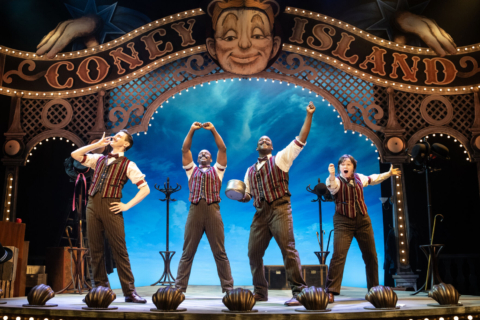
The words “new musical” were rarely more precise than they are as applied to “The Apple Boys,” which in format and style might be the most truly original new piece I’ve seen in ages.
The show’s uniqueness is only one part of its overflowing charm. “The Apple Boys,” at New Hope’s Bucks County Playhouse through May 25, goes in a nanosecond from being loopily silly to being smart and astute. Writer Jonothon Lyons and composer Ben Bonnema are so slick with puns, wise cracks, and double entendres, you may be laughing at low comedy and high wit at the same time.
The point is you’ll be laughing. With an approach that marries innocence with shrewdness and overweening confidence with abashing self-effacement, much of the abundant fun is catching the wry wrenches Lyons fits into his script and Bonnema into his lyrics.
Saving the best for last, Bonnema’s score is written in tight four-part harmonies.
Yes! Barbershop quartet!
And like everything else in “The Apple Boys,” it’s corny and brilliant in one tonal swoop.
Acting and singing, the ensemble cast of Josh Breckenridge, Jelani Remy, Emily Skeggs, and Teddy Yudain, joined at times by pianist Sujin Kim Ramsey, fulfill the simultaneous demands of slapstick and vocal pyrotechnics with showman’s aplomb. The are individually and collectively terrific.
Simply put, “The Apple Boys” is a constant delight. With one slight glitch, but only one by my take-no-prisoners count, the show is theatrically well-crafted, Lyons and Bonnema dispelled any cavils I had one by one as their musical proceeded.
“The Apple Boys” is a sharply hewn good time. It had so many ways to win you over, it does so without trying.
Well, seemingly without trying. Lyons and Bonnema have been presenting their piece in readings and workshops for about seven years. David Alpert’s production for the Playhouse shows how completely they’ve honed it. The Playhouse is drawn to new works. It’s launched several new plays and musicals since the Alex Fraser-Robyn Goodman-Josh Fiedler regime arrived about 10 years ago.
Some, like a musical based on “Clue” have found commercial success despite being wanting in aspects. One, “The New World” (2017) was a comic gem in the style of inane 1940s movie musicals, but it couldn’t overcome the scrutiny of today’s moralists who can’t spot a joke or know when it’s harmless.
With “The Apple Boys,” the Playhouse hits genuine paydirt. The show may be too small to work on Broadway (although Robyn Goodman in particular has been consistently canny in working around such an obstacle), but it has a potentially sunny future off-Broadway and in the country’s regional theaters. The question there will be whether a production will be as deft and on-key as Alpert’s and if casts can be assembled to match the clockwork synchronicity of Breckenridge, Remy, Skeggs, and Yudain.
Though the charm of Alpert’s production derives from a look of looseness that masks tightly choreographed precision and the gorgeous melding of the cast’s unfailing harmonies, “The Apple Boys” has a lot of interior wit that shows how aware Lyons and Bonnema are about what they created. Giddily enjoyable are the dozens of occasions when the characters comment self-effacingly on something they just said and the raft of word plays the authors seemingly, and blessedly, can’t seem to resist.
The piece has genuine merit, but it’s the performance that counts. Alpert and company, abetted by choreographer Marc Kimelman, set designer Adam Koch, and whoever handles props, are just plain superb.
So far, I’ve used the words “delight,” “charm,” “fun,” and “good time” to put “The Apple Boys” into perspective. It’s hard to come up with other words to match them when they’re so perfect.
Here’s one: entertaining. “The Apple Boys,” as presented at the Bucks County Playhouse, entertains with such consistency and spirit, it is buoying from start to finish and admirable in the way it remains fresh and pulls securely away from anything that might bog it down.
Harmonies and affection for the characters dominate, but “The Apple Boys” is also clever, and never cloying, in advancing positive themes such as the power of dreams, the joys and frustrations of their pursuits, the effectiveness of cooperative collaboration, the forming of friendship, and the harmony folks find in achieving a goal together.
“The Apple Boys” is just a happy confection of a show that goes about sweet business without ever making you run for the nearest vial of insulin. It has a knack for pleasing and making you feel good for being in the audience to see it.
Lyons and Bonnema set their show in Coney Island, though it travels all around the New York area, including to New Jersey.
There we meet characters who all want to achieve something that is both personal and grand. Jack (Jelani Remy) is a descendant of Johnny Appleseed and wants to see his grandfather’s dream of supplying the general populace with nourishing fruit come to — oh, oh, Lyons’ script is rubbing off on me — broad-based fruition.
Warren (Josh Breckenridge) is a strongman at a Coney Island side show and wants to fend off a pesky rival (Teddy Yudain), who wants to strip him of his title of “strongest of the strong” and relegate him to working only in New Jersey.
Nathan (Yudain in his main role) has a hot dog recipe he knows the public will pay top price — 10 cents — for and needs to get his sausages sampled.
Hank (Emily Skeggs) is an engineer who has designed the ultimate roller coaster, better than the lauded Cyclone of the time, the early 1900s, but needs to get the arcade owner to give it a legitimate look.
Of course, Jack has the moxie of Jonny Appleseed, Nathan develops and markets his remarkable hot dog, Hank wins over his doubter, and Warren become the champion lifter in Coney Island — “The Apple Boys” is ineluctably upbeat — but the joy comes when the men are striving towards their dreams, band together to pick Jack’s apples in the meantime, and begin to sing as they work.
Even stringy ends merge eventually in this show. One plot line, involving a mortgage that made no sense, worried me for three-quarters of the show, a worry that was eventually resolved but needs to be put to rest sooner. Talk about dreams threatens to become too recurring even though dreams drive Lyons’ basic story. That criticism also fades in time.
About the only thing I would recommend to make “The Apple Boys” stronger for its next phase is for Bonnema to inculcate one grand number, like “Lida Rose” in “The Music Man,” to give his impromptu quartet a singularly splashy moment.
Don’t get me wrong. Bonnema’s current score is fine, and it contains songs that go beyond occasional ditties and commentaries. I just kept looking for a breakout number that gave Breckenridge, Remy, Skeggs, and Yudain a moment of supreme bravado.
Even as I write that, I think of several scenes and sequences that show the quartet’s mettle. One is a barbershop quartet tournament in which “The Apple Boys” characters play every competitor. This sequence is a joy among joys, my only cavil being I liked a couple of the rival ensembles better than I liked the Boys’ finale.
A few of Lyons’ and Bonnema’s notions provide a special kick. One involves a wonderful use of Hank’s engineering prowess and knowledge of abandoned New York subway excavations. Another is naming Kim-Ramsey’s piano player Alexander and having her yell, “ragtime” when it’s time for them to close and wipe down the tables in their saloon.
Tribute must be paid to “The Apple Boys’” flawlessly nimble cast.
Each actor plays multiple characters and does so with definition and a large measure of personality and humor.
Jelani Remy is sweetly innocent yet mobilizingly commanding as Jack. He is the one who binds his fellow singers. Remy is also priceless as Nathan’s supporting yet slightly scolding wife, who shares his dream of the perfect hot dog at a perfect price. Teddy Yudain is enthusiastic as Nathan but winningly bombastic in two different directions as Warren’s rival for Coney Island’s strongest strongman and a nasty rival barbershop singer from New Jersey.
Emily Skeggs marries modesty with genius as the humbly plodding but technically brilliant designer who can make a snazzy sandcastle, build the ultimate roller coaster, and figure out how to get from Coney Island to mid-Manhattan in three minutes. Josh Breckenridge is a strongman with a generous spirit as Warren.
Their joint singing is divine.
Adam Koch’s set takes us several places but provides the spirit of Coney Island with an iconic sign that evokes the beach and world of 1900. Johanna Pan’s costumes also capture the period. Rui Rita’s lighting and Beth Lake’s sound design enhance Alpert’s production. I thank Lake in particular for setting the sound at a level that kept harmonies crisp and lyrics intelligible.
The Apple Boys, Bucks County Playhouse, 70 South Main Street, New Hope, Pennsylvania. Through Sunday, May 25, 7:30 p.m. Tuesday and Thursday through Saturday; and 1:30 p.m. Wednesday, Thursday, Saturday, and Sunday. $32 to $75. www.bcptheater.org or 215-862-2121.