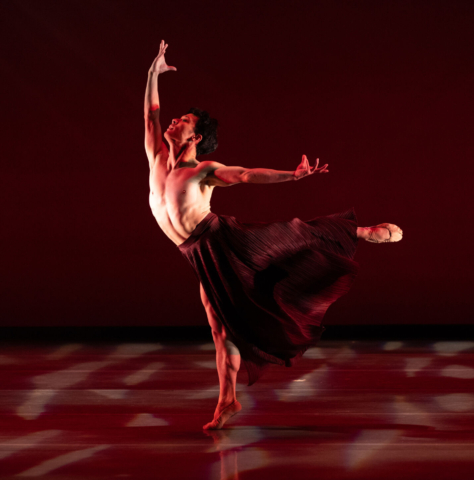
While American Repertory Ballet proffers fine performances of new and contemporary ballets, it’s their renditions of the classics that I most appreciate. “Pasión,” the emotionally charged triple bill the company brought to New Brunswick Performing Arts Center, May 9 through 11, opened with the world premiere of a sultry ensemble piece, “Compasso,” followed by “The Time That Runs Away,” a stylish, pop song-driven work premiered by ARB in 2023. Yet, as expected, the program’s highpoint was its closer, “Paquita,” a rousing, Spanish-flavored classical ballet dating back to the 19th century.
Choreographed by Luis Napoles, “Compasso” is set to luscious Latin jazz music, composed and performed live onstage by Jonathan Benjamin (piano), Raul Cordies (saxophone), Elvis Ferrera (percussion), and Ian Howells (keyboard). The ballet’s accompaniment also includes a recorded segment of Alberto Ginestera’s “Violin Concerto,” to which Napoles sends dancer Tomoya Suzuki into a virtuosic solo of amusingly altered ballet steps that cleverly capture the agitated scratchy sounds and big booms of the music. Suzuki performs furious entrechats quatre — neatly beating his switching legs, but with flexed ankles rather than pointed toes — and whips off huge grand jetés en tournant, adding overhand hand claps, as if applauding himself on each rotation. While the live portions of the music conjure completely different moods, Napoles remains highly responsive to the ebbs and flows of the musical phrasing and often uses sharp, sudden movements to mimic the isolated sounds of spare passages, or to create accents amid impressionistic washes of sound.
Despite its appealing musicality, Napoles’ work is built of unmemorable contemporary ballet vocabulary and suffers from an overuse of unison choreography. Not only did the dancers have a difficult time performing in exact unison because of the music’s lack of clear, predictable beats, but Napoles’ ensemble sections make little use of space as a choreographic element — individual dancers (or couples) generally stay in the same spot and do the same thing at the same time — so the multiple bodies in his stage compositions appear repetitive, not choreographically enriching. A quartet of men performing unison jumps and turns would have registered more powerfully as a solo, while a passage in which two couples perform the exact same lifts and swirls side-by-side might have felt more romantic if danced by just one couple.
Set to familiar pop music, as well as bits from Jean Sibelius and Phillip Glass, “The Time That Runs Away,” choreographed by Stephanie Martinez, serves up hints of character and comedy via gestural ornamentation of contemporary dance movements. And it’s when the dancers capture and run with those theatrical elements that the piece really takes off. Roland Jones hammed it up deliciously throughout, and Lily Krisko stood out consistently among the ensemble for how comfortably she embodied the dance style’s combination of torso fluidity and percussive attack in the limbs. But it was Aldeir Monteiro who won our hearts with his solo to “Smile.” The choreography is a poignant melding of technical dance vocabulary and clowning, the artistic, masking-of-sorrow-with-pleasantries sort of clowning that recalls Charlie Chaplin — who composed the music for the song.
As usual, I was blown away by the women’s ensemble as they gave flawless interpretation to the flashy group choreography in “Paquita.” Savannah Quiner exhibited impressive command of the principal role’s technical challenges, and was zestfully partnered by Seth Koffler. Granted, some of the soloists struggled a bit with the demanding steps of their variations, but I think that’s because they don’t get to do enough performances in any given role. The company’s runs are short, and there’s lots of double-casting. These dancers are clearly well-rehearsed, yet artists can only grow so far in the rehearsal studio. They need stage time in order to really blossom. In the meantime, for us viewers, seeing the struggle is exciting. It renders the performers endearing in a personal way, and reminds audiences how difficult this “classical ballet thing” really is.
Dancers from American Repertory Ballet can next be seen on Saturday, June 14, at Morven Museum & Garden as part of the Princeton Festival. ARB dancers perform pas de deux, accompanied by the Princeton Symphony Orchestra. The program includes selections from “Swan Lake” and “Don Quixote” as well as “Delibes Duet,” choreographed by former ARB artistic director Ethan Stiefel. Tickets are $25 to $90. Visit arballet.org.