Area art galleries are celebrating the new year with new exhibits, bringing color and light to the dark days of winter. Best of all, these venues charge no admissions fees, making a trip to the gallery the perfect free activity for a chilly January day.
D&R Greenway
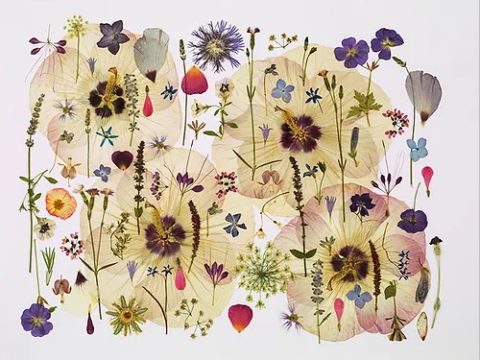
Retired Princeton Day School teacher Liz Cutler, who led the school’s sustainability club to inspire students to observe and care for nature, is showing her botanical art in memory of her son, Isaac, at the D&R Greenway Land Trust’s Johnson Education Center. Together, Liz and Isaac walked Greenway Meadows park throughout his lifetime. A talk and dessert reception with the artist takes place Thursday, January 18, at 6:30 p.m. The event is free to attend but registration is required by email to info@drgreenway.org.
Cutler, a self-taught artist, turned to the meditative art of collecting and pressing flowers into unique artistic expressions during his illness. She follows the Flower Pressers Ethos to ensure that anything she collects will do no harm to the species or environment.
In a statement, she writes: “I collect carefully, conscious of which flowers are ephemeral or how many are growing in a patch, and whether my taking one or two will matter to their survival. As I write this, the late afternoon light throws long shadows from trees now bare of their leaves, stark, winter closing in. It’s a different kind of beauty. There is nothing left to pick, but my closet desk drawers burst with labeled bags of sunshine: flowers and leaves, stems and stamens, even an intact eastern Swallowtail butterfly I found dead on the road. They beg to be slowly and quietly drawn into a picture for a second life through art, to remind me that mine is a story of grace and gratitude, and to help others see, perhaps for the first time, the beauty of nature. I lose myself in the meditation.”
Guests are encouraged to take time to enjoy desserts, hot chocolate and cider and the works of other award-winning exhibiting artists including accomplished quilting artist, Deb Brockway; syndicated cartoon artist, author and playwright, Patrick McDonnell; and internationally acclaimed watercolorist James Fiorentino. Art sales will benefit the land trust’s work to preserve and care for land, maintain public trails, and inspire a conservation ethic.
D&R Greenway, One Preservation Place, Princeton. Thursday, January 18, 6:30 p.m. 609-924-4646 or www.drgreenway.org.
Artworks Trenton
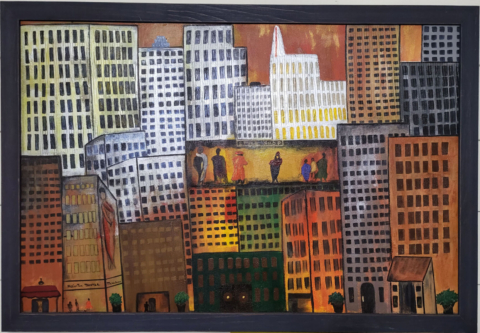
Artworks Trenton presents “Freda Williams: A Retrospective” from January 23 through March 16 in its main and community galleries.
Self-taught artist Mabel “Freda” Williams has been a resident of the Trenton area and Ewing Township for more than 70 years. A native of North Carolina, she has been expressing her love of art since the age of 10.
She attended Rider College (now Rider University) and retired after serving 20 years in the steel industry as manager of employment and 25 years as manager of affirmative action with the State Department of Education.
Throughout her career, her art was primarily for personal and creative expression, to balance the intensity of professional life. When contemplating retirement, she decided to view it as a time for creative exploration. She has exhibited in numerous area venues and juried exhibits.
She has served on the Ewing Township Arts Commission, and she continues to encourage people of all ages and backgrounds to participate in the diversity of art. She is an advocate for seniors in art and organized a senior art ministry for members and non-members of her church — the ministry is titled “Golden Arts Ministry.”
This retrospective offers a variety of styles and themes, including florals, politics, African American history, Trenton historical sites, southern themes, landscapes and cityscapes; also included is the, “To The Left Series,”( a personal journey). Williams’ work is heavily inspired by African American history, which is an attempt to remind people of the importance of history.
“Most people enjoy seeing things that are familiar to them and give them a sense of community and fond memories of a time gone by,” Williams says. Her paintings reflect her love of color, and are vivid images of nostalgic memories, cultural experiences, and political impressions.
Artworks Trenton, 19 Everett Alley, Trenton. On view January 23 to March 16, Tuesdays through Saturdays, 11 a.m. to 5 p.m. Opening reception Friday, February 2, 6 to 8 p.m. www.artworkstrenton.org.
Princeton Public Library
“Anthropomorphic: Photos and Stories,” an exhibit by photographer Darren Sussman, opens at Princeton Public Library with a reception on Thursday, January 18.
The exhibit, featuring a selection of photographs and text from the book of the same name, is on view through March 15 and explores the human tendency to assign human emotions and characteristics to animals.
“I can’t help it, when I look at an animal, I give it a human story,” said Sussman. “I’ve been doing it my whole life. So it was only natural, when I started into wildlife photography, that I’d make up stories for my subjects. That’s how ‘Anthropomorphic,’ the book and exhibit, was born.”
Sussman will give a presentation in the Community Room prior to the official opening of the exhibit on the second floor and will be on hand to discuss his work and sign copies of his book.
Sussman is a self-taught photographer who has been taking pictures since 2015. Not limited to one style, he creates images of landscapes, wildlife, street photography and special events. He lives in New Jersey and travels extensively throughout the United States to fine new places to photograph.
Princeton Public Library, 65 Witherspoon Street, Princeton. On view through March 15. Opening reception Thursday, January 18, 6:30 p.m. www.princetonlibrary.org.
Arts Council of Princeton
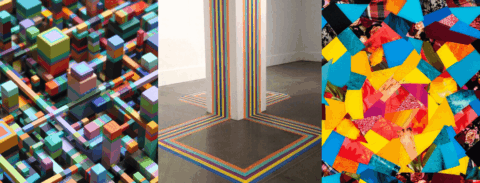
“Waiting to Detonate,” on view through Saturday, February 3, at the Arts Council of Princeton, features work in vibrant colors and shapes by Andrew Chalfen, Ida Ochoteco, and Katelyn Liepins.
Materials from the Arts Council describe each artist’s work as follows:
“Andrew Chalfen is fascinated by patterns, how they ripple, radiate, refract, bloom, interact, cluster, construct, and deconstruct. His works allude to aerial views, cartography, architectural renderings, musical notation, urban densities, and other natural and man-made patterns, while not literally being any of those things. Rather, his pieces reflect his psychological states during their creation, a kind of topography of thought and mood as he works through various aesthetic themes that have long held his attention. Shapes often spill out over edges, suggesting unseen continuations beyond, while others seek containment. His recent mixed media work with painted dowels focuses on connections, intersections, and layers, a non-representational way of depicting how we relate to the world and to one another.”
In an artist’s statement, Chalfen writes, “My process mirrors that of his songwriting and music arranging. I utilize the repetition of a small selection of formal elements, subtle variation, the timbre of color palate, rhythm, and a combination of randomization strategies and intentionality. Every work is a process journey, in which I refine elements that grab me from previous pieces, and then push into unknown territory with experimentation and risk, always iterating. I follow my instincts, deviates from them when necessary, and trusts the process to guide the work to a successful outcome and maybe even a breakthrough or two.
“Viewers may not know what to focus on first, becoming overwhelmed and subsequently absorbed in the details. The experience is reminiscent of mediation. Certainly working on these pieces in the studio is a meditative, flow state way of being, where I can take my time to think about and explore through art-making themes of nostalgia, anxiety, play, musicality, fragility, impenetrable data, accelerating planetary chaos, and physical and psychic fragmentation.”
“Ida Ochoteco was born in Hamburg, Germany, and spent her formative years in the U.S., Japan, Mexico and Uruguay before taking her Basque-Italo-Uruguayan roots around the world, ultimately settling in New Jersey. Inspired by artists like Piet Mondrian, Joaquín Torres-García, and Andy Warhol, she creates abstract collages by recycling paper from magazines, books, catalogs, junk mail, post cards, brochures, gift bags, etc. The pieces are finished with a thin layer of clear resin.
“If she were asked to describe her artwork, she would use the word sarambí, a Guarani word meaning ‘chaos.’ In her pieces, colors, textures, and geometrical shapes dance in an ‘organized mess.’ Elements that at first glance look out of place are consciously positioned, deliberately to express her rebellious side.”
She describes her process in an artist’s statement:
“First, I imagine a new project: the colors, textures, and shapes I want to play with. Then I put together all the paper pieces needed and paint a wood panel to serve as the base. The long process of gluing and placing the pieces comes next. Those pieces of paper are like pieces of my own life being put together. Sometimes I place a piece that doesn’t necessarily look like it belongs with the rest, but that’s done deliberately as a way to express my broken side, or to be rebellious, silly, or irreverent. Putting the pieces of my life together keeps me going, moving forward, and evolving. Just as life has a cheerful side and a gloomy side, there are happy and bright collages, and there are the darker ones. I am a complex person, messy, struggling to fit, and my collages represent that. When immersed in a project, everything around me fades away. There is no past, no present, nor do I think about the future. I’m at peace. There’s no pain. It’s as if I am in another dimension. It’s a great feeling. I don’t want it to end. That’s why since I started doing art, I haven’t stopped, because it takes me to a better place.”
“Katelyn Liepins has been working with lines and how they can exist beyond the traditional drawing form for the past few years. She is constantly challenging what is a drawing and how can it exist in multiple mediums, her favorite being tape. Coming from a family of architects, she is attracted to the sharp crisp lines within a space and uses them consistently within her art. By using line, she likes to draw the viewer’s focus to a particular area of the space or to point out architectural elements that are typically overlooked. For example, the way the wall meets the floor, or how the corners of a room interact with one another. Katelyn creates large-scale installations as well as smaller representations of these demarcations.”
Arts Council of Princeton, 102 Witherspoon Street, Princeton. Open 9 a.m. to 5 p.m. Monday through Thursday, 9 a.m. to 4 p.m. Friday, 10 a.m. to 4 p.m. Saturday, and 9:30 a.m. to 12:30 p.m. Sunday. On view through February 3. 609-924-8777 or www.artscouncilofprinceton.org.
New Jersey State Museum
A new exhibit at the State Museum in Trenton explores the work of a little-known New Jersey photographer from the turn of the 20th century.
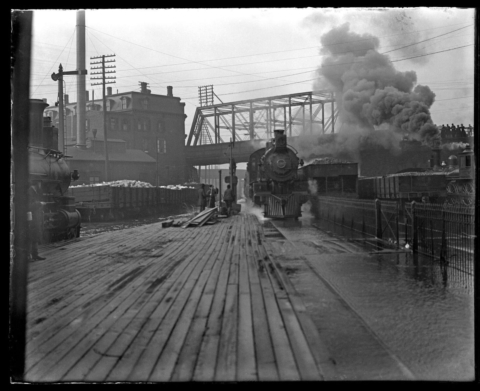
“Discovering Grant Castner: The Lost Archive of a New Jersey Photographer” opens Saturday, February 3, and is on view through September 15, featuring a recently discovered archive of photographic negatives that once belonged to a prolific, but long-forgotten, local photographer.
The exhibit celebrates one New Jerseyan’s passion for photography — from the 1890s through the 1910s — and is curated from the museum’s extensive collection of the photographer’s original negatives.
In 2019, the NJSM received a donation of more than 1,200 glass plate negatives. The plates preserve pinpoint moments of everyday life in New Jersey at the turn of the 20th century, snapshots of our collective past. They belonged to Grant Castner (1863-1941), an amateur photographer born in Belvidere (Warren County) who later lived and worked in Trenton and is buried in Greenwood Cemetery.
The 200 images featured in the exhibition reflect Caster’s artistic talent and illustrate numerous aspects of New Jersey history, from close-up portraits of family and friends to the marvels of turn-of-the-century transportation, to the flurry of excitement and activity at the famed Inter-state fair in Hamilton Township.
Other photography subjects include faces of New Jersey; railroads and canals; the shore; leisure and recreation; adults at work and children at school; famous landmarks; floods, fires, and other disasters; and nature.
New Jersey State Museum, 205 West State Street, Trenton. On view February 3 through September 15. Open Tuesdays through Sundays, 9 a.m. to 4:45 p.m. 609-292-6464. www.nj.gov/state/museum.
Present Day Club
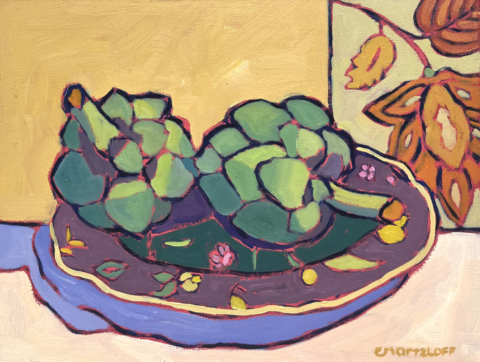
“The Tapestry of Color,” an exhibit by Cranbury-based artist Catherine J. Martzloff, is on view through March 3 at the Present Day Club.
This expansive exhibit of oil paintings features ametaphorical tapestry where a symphony of vibrant and unique colors are symbolically woven together, creating a visual narrative that transcends time. Just as a tapestry consists of threads intricately intertwined to form a coherent design, these paintings convey a deeper connection and a profound sense of unity, celebrating the diverse threads of life and emotions.
This solo exhibition features a range of larger paintings that showcase her evolution as an artist, pushing the boundaries of her creative expression. Martzloff’s unique use of expressive color and commitment to her craft contribute to creating art that not only pleases the eye but also touches the soul, the artist says.
For more information about Martzloff, her artwork, and the show, visit www.catherinejmartzloff.com or contact her at cmartzloffart@gmail.com.
Present Day Club, 72 Stockton Street, Princeton. On view through March 3 on Fridays, 10 a.m. to 3 p.m. Contact the artist to meet her at the venue.
Tulpehaking Nature Center
The nonprofit Friends for the Abbott Marshlands’ opening exhibit of 2024, “Nature’s Duet,” is currently on view at the Tulpehaking Nature Center in Hamilton through February 28 with a reception set for Sunday, February 4, from 2 to 4 p.m.
“Nature’s Duet” is a collaborative fine art show by artists Abigail Johnson of Princeton and Laura Beard of Ewing. It combines the individual expressions of each artist — Johnson as an abstract painter and Beard as a realism painter — to express their appreciation and wonder in the natural world and its complex interactions. The paintings reflect the land, water, and animals of the greater central New Jersey area. The artists hope to draw attention to FFAM’s efforts to build awareness and support for the protection and stewardship of the Abbott Marshlands. A percentage of sales from the show will also benefit the nonprofit.
Johnson’s work has been showcased in several local venues, such as Ellarslie, West Windsor Arts Council, and the Arts Council of Princeton. Beard’s work has also featured in many local area exhibitions, including the John James Audubon Center in Audubon, PA; Ellarslie, the Trenton City Museum; Garden State Watercolor Society; and Artworks Trenton. Both artists were recent awardees in this year’s Ellarslie Open 40: Johnson for digital art, and Beard for watercolor.
Tulpehaking Nature Center, 157 Westcott Avenue, Hamilton. On view through February 28. Open Wednesdays through Saturdays, 10 a.m. to 4 p.m. 609-888-3218 or www.abbottmarshlands.org.
Art@Bainbridge
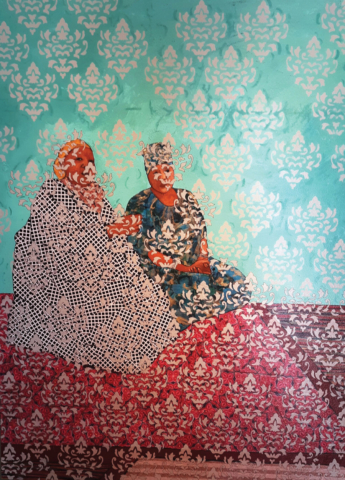
“Reciting Women: Alia Bensliman & Khalilah Sabree” opens at Princeton University’s Art@Bainbridge gallery on Saturday, January 20, and remains on view through March 31. An opening reception takes place Saturday, February 3, at 2 p.m., and a conversation with the artists follows on Thursday, February 15, at 5:30 p.m. in the Friend Center at the corner of William and Olden streets.
Materials from the museum describe the exhibit as follows:
“Alia Bensliman (born Tunis, Tunisia) and Khalilah Sabree (born Macon, GA) deliberately disrupt conventional divides between tradition and modernity and the sacred and the secular. As Muslim-American artists and educators deeply rooted in the Trenton community, their imagery grapples with human rights struggles and the challenges of cultural belonging. Bensliman’s images of Amazigh women focus on the Indigenous population of North Africa in richly patterned watercolors informed by local artistic motifs, with her own triple portrait as an introspective counterpoint.
“Sabree’s painting suite turns a photograph taken during Hajj, the annual Muslim pilgrimage to Mecca, into a meditation on loss and the devastations of war. Seen together, the artists’ works testify to seemingly incompatible commitments: preserving cultural traditions that are under threat while forging visual vocabularies that resonate with their own unfolding identities. Through their experiments with technique and composition, the artists create visual repetitions that function as prayerful recitations, retelling time-honored stories from the depths of personal and spiritual experience.”
Art@Bainbridge, 158 Nassau Street, Princeton. On view January 20 through March 31. Open Tuesday and Wednesday, 11 a.m. to 5 p.m.; Thursday and Saturday, 11 a.m. to 6 p.m.; Friday, 11 a.m. to 7 p.m.; and Sunday, 11 a.m. to 4 p.m. artmuseum.princeton.edu/artbainbridge.
Zimmerli Museum
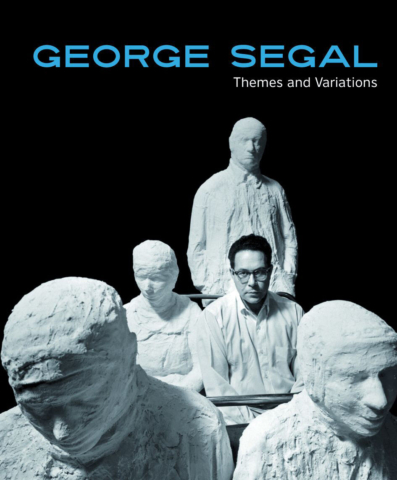
Marking the centennial of George Segal’s birth in 1924, the Zimmerli Art Museum at Rutgers welcomes visitors to experience more than 60 works: some familiar, others rarely seen. The exhibition highlights not only the breadth of Segal’s work, but also the people and the state that helped to shape his career.
“George Segal: Themes and Variations” is on view from Wednesday, January 24, through July 31. A free opening reception at takes place Saturday, January 27, from 4 to 7 p.m.
With works drawn from the Zimmerli’s collection, as well as loans from the George and Helen Segal Foundation and private collections, the exhibition offers the unique opportunity to view Segal’s less well-known paintings, drawings, and photographs alongside his renowned life-sized plaster cast figures. In addition, photographs by Arnold Newman and Donald Lokuta capture Segal in his studio, providing insights into the artist as not only maker, but also curator who arranged the sculpture in his studio to convey connections across time and theme.
“This exhibition explores George Segal’s significance in art history, guiding his generation from abstraction back to realism,” said Maura Reilly, director of the Zimmerli. “It also reinforces the significant role that Rutgers — where he received his M.F.A. — and New Jersey played in the art world during the second half of the 20th century.”
Raised and educated in New York City, George Segal (1924-2000) relocated in the 1940s to a central New Jersey farm, which remained his home and studio for the rest of his life. In the 1950s and 1960s, Segal was among the avant-garde community of artists in Lower Manhattan, many of whom became his friends and mentors. Photographs document significant events such as Allan Kaprow’s Happenings, Fluxus events with Rutgers-affiliated faculty, and Robert Frank’s filming of “The Sin of Jesus” at the farm.
The exhibition is structured to explore significant themes that Segal returned to throughout his career — figural groups, single figures, the nude, portraits, and still life. In addition, a group of Segal’s early expressionistic paintings from the late 1950s that won him renown as a young painter, but ultimately were left behind as he focused more intensely on sculpture, are included. Segal’s early paintings and figural sculptures, for which he is now best known, were focused on efforts by the artist to combine physical (visible) and emotional (invisible) subject matter.
With a gift of Johnson & Johnson’s new plaster bandages, Segal soon realized his signature technique of plaster cast figures, which he debuted in the historic New Realists at Manhattan’s Sidney Janis Gallery in 1962. Though it was the first major Pop art exhibition, Segal stood out for his ability to portray human psychology, rather than consumerism and pop culture. His sculptures captured gesture and posture and an uncanny sense of the model’s presence that was noted in the earliest reviews of his work. In sculptural groups such as The Dancers (1971), Appalachian Farm Couple (1991), and Bus Shelter (1996), he was also able to express the figures’ emotional connection to — or distance from — one other.
Segal also examined his love of art history and used still life to update the modernist still lifes of his favorite artists and his everyday experience. He was fascinated by Paul Cézanne’s ability to reimagine space and recreated one of the 19th-century artist’s still-life paintings in painted plaster. Segal also immortalized contemporary subjects from familiar places. The plaster sculpture Paint Cans with Wainscoting (1983) offers a vignette of items in his studio that suggests the artistic experiments of Robert Rauschenberg, Jean Follet, and Richard Stankiewicz, who also incorporated non-precious materials into their sculpture and assemblages. Segal, who loved to visit New Jersey diners, created a series of drawings and sculptures with table settings from the iconic local restaurants that he frequented.
The exhibition is accompanied by a full-color catalogue of the same title, with chief curator Donna Gustafson’s essay “Themes and Variations, Complications and Contradictions,” which examines his place in a community of artists and an expansive vision that underlies his work across different media, as well as a personal and illuminating interview with sculptor Charles Ray.
Zimmerli Museum, Rutgers University, George and Hamilton streets, New Brunswick. On view January 24 through July 31. Open Wednesdays and Fridays, 11 a.m. to 6 p.m.; Thursdays 11 a.m. to 8 p.m.; and Saturdays and Sundays, noon to 5 p.m. zimmerli.rutgers.edu.
Considine Gallery
The winter art exhibition in the Considine Gallery at Stuart Country Day School celebrates the all-girls independent day school’s 60th anniversary and features artists from within the Stuart community.
“This special anniversary exhibit represents the wonderful vision of the founders of Stuart and the creative legacy of the architect Jean Labatut in a historic space,” said Andres Duque, the gallery director and Stuart art teacher whose work is featured. “With artwork in different formats (paintings, drawings, sculptures and photography) that represent contemporary dialogues, we will continue to bring the spirit of love and art to all at Stuart.”
Following are excerpts from biographical and creative statements by each of the artists included in the exhibit.
Andres Felipe Duque completed his B.A. in fine arts and anthropology at Los Andes University in Bogotá, Colombia, where he later worked on urban planning and national communication projects. He came to the United States to continue his studies at California State University Bakersfield and at the School of the Art Institute of Chicago. He now teaches fine arts at the Arts Council of Princeton, the Summer Institute for the Gifted, and at Stuart Country Day School. Learn more at aduqueart.weebly.com.
“I believe in the power of art to communicate and bring ideas together. As a teacher this is the principle of my practice and as an artist it is in my philosophy,” he says of his outlook. “I enjoy exploring materials, drawing techniques and architecture history. To celebrate the 60th Anniversary of Stuart I created a ceramic work of the plan of the Stuart campus, a portrait of Jean Labatut in charcoal and sculptures in clay related to our school vision of design.”
Joe Kossow is from Washington, DC, where he received an M.F.A. in painting in 1982, and co-founded the Washington Studio School, a non-profit art school and gallery now in its 37th year. After working as a professional artist in his 20s, Kossow set painting aside to raise a family and pursue a corporate career. He returned to art in 2016 and now teaches Advanced Placement Art History at Princeton Day School and is the president of the board at the Arts Council of Princeton.
“One of the best ways of remembering places we’ve visited is to photograph them, but for a painter an even better way is to draw them,” Kossow says in his statement. “Why is it better? Because when you spend hours making a drawing, you remember what it was like to be there: the colors, the light, the people, the smells, even the temperature of the day. Working on site is best, but if you can’t stop for hours to make a drawing, then working from a photograph is a good way to bring the memory to life. As you make a new thing, the drawing, you also experience in a new way the places you visited. In this exhibit, I’m happy to share four drawings from Switzerland, made from looking at photographs taken on a trip there in the summer of 2023.”
Monica Vagnozzi Vogel is a designer involved in marketing, event branding, photography, illustration, and leading creative projects, and her career has included collaborations with such clients as Disney, T-Mobile, Samsung, and Sephora. She has been part of Stuart’s marketing and communications team since 2018.
“My passion for photography is rooted in discovering the unexpected joys of nature — whether it’s the vibrant color splash of a flower, light weaving through leaves, or the subtle beauty in a serene landscape. Each photograph I take captures a piece of the world’s beauty as I see it. It’s the little things that captivate me the most, those delicate details that demand a second glance,” she writes. “This collection of images represent those serendipitous moments. Every image has a narrative — it might be mine, it might be yours, but above all, it’s a tribute to the extraordinary wonders that surround us, just waiting to be seen.”
Phyllis E. Wright has been teaching middle and upper school art and directed the gallery at Stuart since 2007. She received her B.F.A. from Carnegie-Mellon University and her M.F.A. from The George Washington University. Upon graduation she became an assistant professor of art teaching printmaking, two-dimensional design and mixed media for a decade.
She also taught continuing studies classes at The Maryland Institute, College of Art, and was one of the original members of Maryland Printmakers, a nonprofit established to encourage the making and collecting of fine art prints. She moved back to her hometown of Princeton in 2003.
She offered the following statement on her recent artistic journey: “On March 25, 2020, while teaching virtually during the Covid-19 shutdown I began painting as a way to document the day. This became a daily ritual. I began to paint every afternoon finding an ever-growing audience of supportive, appreciative Facebook followers with whom to share my work. This practice, along with the generous messages it inspires, has sustained me through the hardest part of the pandemic into the present. . .
“I begin every painting with a single color on my canvas. I continue to add paint until I feel the painting is complete. On a regular basis a painting moves through a period of ‘ugly.’ I continue to paint, use techniques to create texture, layering, and balance. I consider this dialogue with the painting. It is a dance. Once out in the world, my paintings are also in a dialogue with you.”
Christine D’Alessandro has served as the Head of EC and Lower School at Stuart since 2020. She has decades of experience as a teacher and administrator for the lower school and early childhood age groups. She received her undergraduate degree in psychology from Lyndon State College and her Masters of Education degree in administration and supervision from Antioch New England Graduate School.
“For nearly four decades, I’ve devoted myself to the field of education, yet my heart has always been captivated by the world of art,” she says. “The allure of color and form has always held me in its embrace. My creative spirit finds joy in the interplay of shapes, colors and designs. My preferred mediums are ink and watercolors, though recently I have also ventured into the realm of collage. Within collage art, I love incorporating elements from the tapestry of my life experiences.
“Art serves as my steadfast companion, offering not only a canvas for creative expression but also a means to navigate my personal journey and process its intricate contours.”
Madelaine Shellaby has been a practicing artist in California, Louisiana, and New Jersey. Her recent work updates the Vanitas tradition, combining material from multiple sources into a digital collage of drawings, photographs, paintings, scans and more. She has worked similarly making artist books and installations. “Fablestones,” her Stone Stories Archive, is an installation of her museum, and has been shown in different configurations in France, California and New York. She has recently been a docent at the Rubin Museum of Himalayan Culture in New York City and curates art exhibitions in the Princeton, NJ area.
Deborah Land received a BFA from Bennington College and an MFA from Hunter College, C.U.N.Y., where she studied studio art. Land is the executive director of the Jeremiah Photo Project, an international non-profit organization that gifts family heirloom, photographic portraits to persons who would not otherwise be able to purchase them. Her photographs can be viewed at deborahland.com.
“Digital imaging attracted me from its earliest incarnations. As a painter trained in post abstract expressionism and color field painting, I longed to use color as I had with paint, layering veils of color, and controlling tints and shading. I have discovered a digital technique where I am able to layer images and move my focus to different aspects of the images,” she writes.
“I have also re-examined earlier techniques of sandwich printing with two negatives in the enlarger in the wet darkroom, and also rewinding film inside the camera to create double exposures. I employ a method of making double exposures in camera which allows me to explore time as well as the pictorial image. Unlike joining two disparate images, these images were taken within moments of each other and offer the viewer a fresh and personal view of the subject, influenced by the surroundings.”
Stuart Country Day School, 1200 Stuart Road, Princeton. Gallery open Monday through Friday, 8 a.m. to 6 p.m., while school is in session. On view through March 8. www.stuartschool.org.