People crossing the bridge that separates Princeton and Kingston are more likely to notice the beautifully restored mill, Woodwinds tree care, Eno Terra restaurant, or the Rider furniture store than the cluster of small buildings near the edge of Carnegie Lake.
The dedicated volunteers of the Kingston Historical Society (KHS) are working to change that. The non-partisan, non-profit organization was formed in 1997 to preserve, enhance, and promote the history of the village of Kingston.
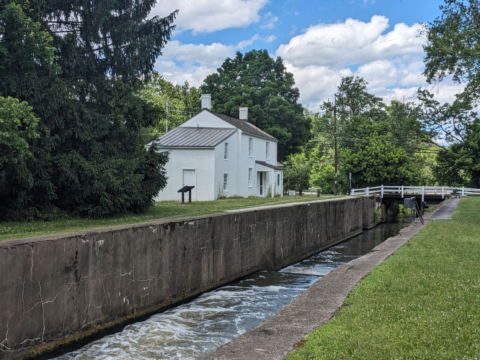
Its headquarters is the Lock Tender’s House, one of those small, easily overlooked buildings on the Delaware and Raritan Canal where volunteers maintain the original circa 1834 home of families who operated the Kingston canal lock and the adjacent canal bridge.
The history of those buildings has been brought to life as part of the KHS’ observation of the 50th anniversary of the creation of the D&R Canal State Park and the D&R Canal Commission.
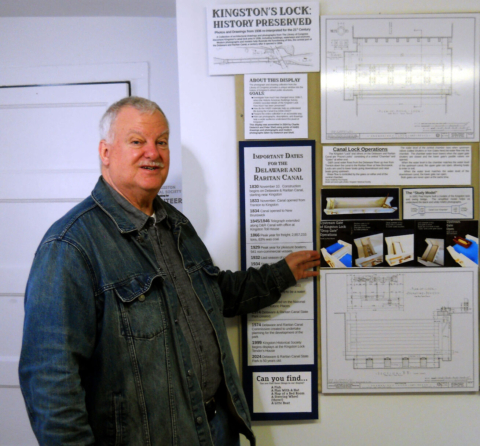
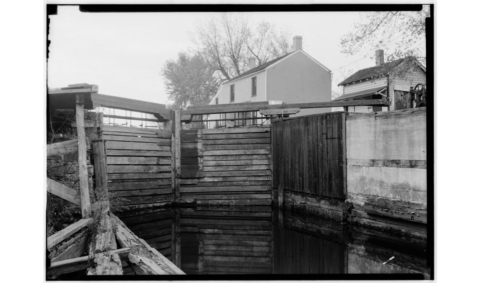
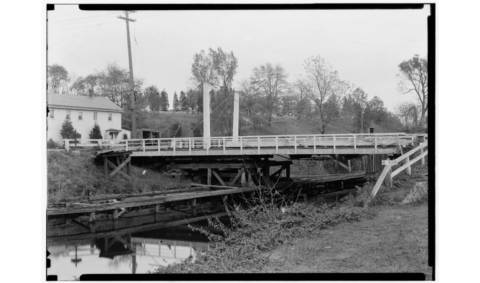
Earlier this year, the KHS’ kickoff exhibition was “Kingston’s Lock: History Preserved — Photos and Drawings from 1936 re-interpreted for the 21st Century,” commemorating the preservation of photographs and architectural drawings of canal structures that were created during the Great Depression. Models of the lock and the swing bridge that crossed the canal were on display. In addition, the KHS has made these historic images and drawings available online.
Newcomers to the area may not be aware that the village of Kingston served as the central port of the Delaware and Raritan (D&R) Canal. The D&R began operating in 1834, connecting Pennsylvania coal fields with New York markets and providing inland passage for pleasure boats and other commercial traffic until it ceased operation in 1932.
In 1934, the canal property reverted to the State of New Jersey, and in 1936 the Historic American Buildings Survey (HABS), now a program of the National Park Service, documented Kingston’s recently closed lock, bridge, and canal buildings.
How did the project come about? “What I believe happened was that soon after the formation of the WPA (The Works Progress Administration, an American New Deal agency that employed millions of unemployed people to carry out public works projects), someone approached the agency with a proposal to put unemployed architects to work,” notes Charlie Dietrich, secretary of the Kingston Historical Society.
“There were a lot of historic buildings that no one had documented,” Dietrich continues, “and the WPA put architects to work making measured drawings of them. One of the sites was the Kingston Lock and the D&R Canal, and in 1936 decision was made to document the buildings on the site.”
The professionally rendered architectural drawings and photographs provide a snapshot of the canal at the end of its role as a commercial hub. The Kingston Historical Society’s project adds context to the drawings and links to images of the originals housed in the Library of Congress, with additional photographs and text to help modern day viewers appreciate the significance of the site.
What other buildings were on the Kingston Lock site in the heyday of the canal’s operation? “As I understand it, there were mule barns that were important in the 19th century, when mules pulled the barges,” Dietrich says. “They appear in a couple of photos. One from around 1900 shows two barns on the other side of the spillway feeding a retention pond on the site of what is now a parking lot. By the 20th century, powered boats largely replaced the mules, but not entirely.”
Did pleasure boats actually use the canal? “The canal was part of the intracoastal waterway in those days,” Dietrich says, “If you had a yacht and wanted to spend summers in New England and winters somewhere warmer you’d travel on the intracoastal waterway to avoid sailing on the open sea, and that included the canal.”
A toll house and telegraph office were once part of the complex; what is known about that? “Coal and other goods initially paid a toll based on tonnage, later a percentage of the value of the cargo,” he says. “We don’t know if that was part of the lock tender’s job. We know a lot about the lock tender’s house, but when it comes to the toll house, we’re a bit baffled, because for a while it was used solely as a toll house, then when telegraph was invented the canal was the ideal place to locate the telegraph office, because the telegraph signal required a return pathway, a ground, to complete the circuit in order to function, and the canal served as the return because water has higher conductivity than earth.
“So the nature of the business that took place here changed,” he continues. “We have two pictures that appear to have signs that read ‘Kingston Telegraph Office’ on the sides of the building. A telegraph operator would have to constantly monitor incoming telegraph messages and send outgoing messages, a lock tender had their duties to attend to, and tolls would have to be calculated and collected.”
To get a sense of how busy the Kingston Lock was in its heyday, Dietrich notes that an estimated 2.8 million tons of coal passed through the canal daily following the Civil War. “The canal was a reliable and safe way to transport coal from the coal fields to New York,” he says.
Fast forward from the Civil War, to the turnover of the canal to the state in 1934, to 1974, when legislation was passed creating the D&R Canal Commission and the D&R Canal State Park, helping to assure the preservation of its structures for future generations.
The New Jersey Department of Environmental Protection, Division of Parks and Forestry, State Park Service owns and manages the Delaware and Raritan (D&R) Canal and towpath as a state park. The D&R Canal Commission, legislated in 1974, assists with the development of the park and regulates land use in the park’s 400-square-mile watershed.
“The Kingston Lock area is one of its most popular access points in the State Park,” says Dietrich. “The significance of these architectural drawings online makes more of its history accessible to folks. The models of the swing bridge and lock are wonderful because you can see how they actually worked. The historical society continues to work hard to bring Kingston’s past to light, to discover as much as we can about this site and share it with others.
“We hope you will join us at the at the lock tender’s house,” he says. “It’s an opportunity to engage with KHS members and learn more about the exhibits, the D&R Canal, Kingston’s history and the KHS.”
Kingston Lock Tender’s House on the D&R Canal just off Route 27, Kingston, New Jersey.(GPS address: 39 Old Lincoln Highway, Princeton NJ, 08540).
The Lock Tender’s House is open to the public on weekends and major holidays April through October from 10 a.m. to 5 p.m. and in November from 10 a.m. to 4 p.m. Free.
To view the historic images, architectural drawings and find out about upcoming events visit the Kingston Historical Society online at www.khsnj.org.
D&R Canal Focus of History Talk
Canal and railroad historian Bill McKelvey presents an illustrated program on the historic Delaware & Raritan Canal on Sunday, June 16, at 2 p.m. The free event takes place at Griggstown Reformed Church’s Fellowship Hall, located behind the church building at 1075 Canal Road, Griggstown.
McKelvey is the author of “The Delaware & Raritan Canal: A Pictorial History,” a photographic treasure trove of historic views of the canal. He later wrote “Champlain to Chesapeake: A Canal Era Pictorial Cruise,” which included many photos of the D&R Canal as well as the other inland waterways along the East Coast. He is director emeritus of the American Canal Society and director of the New Jersey Canal Society.
Light refreshments will be served.
The nonprofit D&R Canal Watch helps promote, enhance and preserve the Delaware & Raritan Canal State Park.
For further information, contact Canal Watch President Linda Barth at 908-240-0488 or barthlinda123@aol.com.