American Repertory Ballet launched its 2024-2025 season with “Wonderment,” the most stylistically diverse program I’ve ever seen this versatile little company tackle. Presented at the New Brunswick Performing Arts Center, October 18 through 20, the quadruple bill — curated by ARB Artist in Residence Ethan Stiefel — requires four radically different performance styles, all impressively captured by ARB’s adventurous dancers.
The opener, “Little Improvisations” — a deceptively innocent duet by Antony Tudor, the 20th-century master of psychological ballets — is followed by the flashiest classical-ballet showpiece of the 19th century, Swan Lake’s “Black Swan Pas de Deux.” Then comes the quiet elegance of modern-dance choreographer Lar Lubovitch’s “Something About Night” and, finally, the period drama of Steifel’s “Baroquen Dreams,” a brand new, character-study ballet inspired by Baroque-era composer, dancer, and conductor Jean-Baptiste Lully.
A 12-minute depiction of the imaginative play of two children stuck in an attic on a rainy day, the Tudor duet was first performed in 1953. It’s an enchanting exploration of identity, from a child’s perspective, and was charmingly rendered by Rachel Quiner and Seth Koffler (at the October 19 matinee I attended). With their squeaky clean technique, comic sensibilities, and child-like energies, the duo convincingly communicated youngsters’ delight in trying on different roles — he, a hero in battle, she, a mother nurturing a newborn, and the two together impersonating a galloping horse. They also unearthed feelings sparked by the various characters’ relationships to one another — Tudor’s favorite choreographic terrain — as miscommunications and game-playing generated new, albeit youthful, emotional awarenesses.
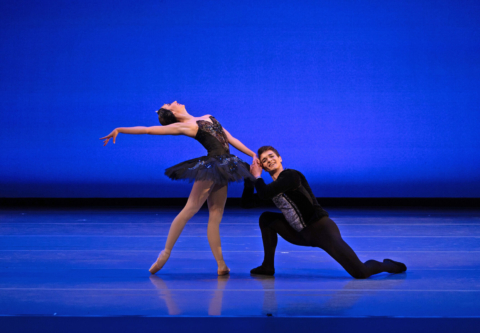
Then, right out of the starting gate, Clara Pevel showed that she “owned” the role of the Black Swan. Not only is her technique downright wowing (yes, those 32 fouettés went off without a hitch), but every move she makes exudes the evil Swan’s deceptiveness and the creature’s glee in being such a wily bird. Bravi, to Pevel, to her more-than-capable partner, Andrea Marini, and to the ARB artistic staff who coached this thrilling performance.
Equally thrilling to me was the program’s inclusion of the Lubovitch work. A warmly lyrical quintet set to Schubert choral music, it was created in 2018, yet contains passages from previous Lubovitch dances. Lubovitch’s choreography is marked by flow, spiraling three-dimensionality, no edges, lots of communal floorwork, and torso-generated impulses that don’t come naturally to ballet dancers. Yet while its members are primarily ballet-trained, ARB has had great success mounting modern-dance classics. (I’m thinking of the troupe’s first-rate interpretation of Paul Taylor’s “Airs.”) My expectations for the company’s performance of this gorgeous Lubovitch piece were high — and they were exceeded! Michelle Quiner and Roland Jones were especially sublime in the work’s central duet, and Aldeir Monteiro imbued his absorbing solo with a passion that felt extremely personal.
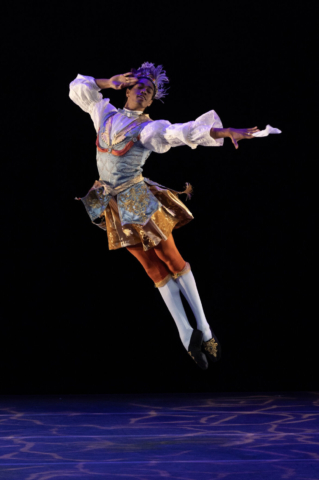
Stiefel’s theatrical ballet, illuminating the creative process of its Lully-based character, here named Le Maestro, and portrayed with appealing panache by Leandro Olcese, stretched the ARB dancers in yet another stylistic direction — mixing ballet steps, fussy Baroque court-dance sensibilities, and Stiefel’s signature goofy moves. It’s his jarring insertion of those silly movements — in this case vibrating heads, sawing arms, and doing the twist while yelling “woo” — that time and again compromises my appreciation of Stiefel’s choreography. And while this ballet entertainingly reveals a bizarre Maestro drawing inspiration from musical sounds and manipulating the actions of his ensemble of performers, it ends abruptly and with too little fanfare. We don’t know what to think when Le Maestro suddenly falls “dead” into a sideways tilt, and the curtain descends. Perhaps a program note would have helped, providing some background on the greedy, unscrupulous Lully, and that big stick Le Maestro wields throughout the ballet. It was common practice for conductors of the era to use such a stick to beat time against the floor. One day, while conducting, Lully struck his foot with his stick. The foot turned gangrenous and, a year later, Lully died.
American Repertory Ballet presents The Nutcracker at various New Jersey venues, November 29 through December 22, and appears at NBPAC in “The Spirit of the Highlands,” March 7 through 9, 2025.
More information: www.arballet.org.