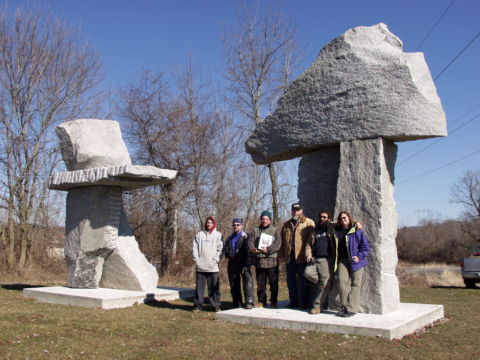
Ah, sculpture. Exactly how does it get to where it stands? It doesn’t just float down on magic wings and situate itself.
Moving and placing sculpture takes a specialized technique, an expert mover and installer, a team of skilled and focused assistants, and some seriously heavy-duty crane trucks.
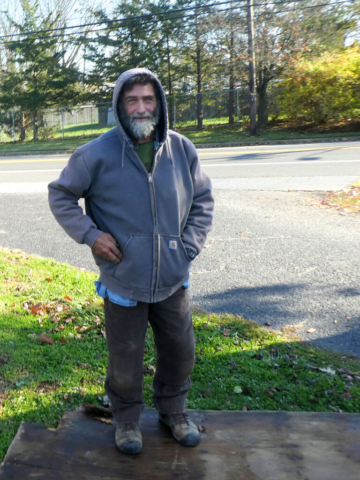
Lambertville resident and artist Harry Gordon has mastered the art of sculpture installation. With assistance from his wife, Wendy Wilkinson-Gordon, who handles all the behind-the-scenes work, Harry Gordon Studios is in demand for a variety of projects.
The work ranges from recently installing two iconic sturgeon sculptures by Trenton’s Kate Graves (on view outside the Gardener’s House at the former Point Breeze estate in Bordentown), to assisting the Princeton University Art Museum with moving antiquities to storage while the facility undergoes a renovation.
“The antiquities were, specifically, the mosaics imbedded in the floor,” Gordon says. “We worked with another similar company to ours, Atelier Fine Art Services and conservators in Philadelphia on this, in addition to museum staff.”
A signature project for Gordon’s business was in 2019, when he and his team helped moved the 3,000-year-old red granite sphinx from its longtime location in the Egypt Gallery to the main entrance hall at the University of Pennsylvania’s Museum of Archaeology and Anthropology. This project involved several different companies including C.M. Worrall in Trenton.
The move had the 25,000-pound sculpture riding on a bed of compressed air, along an elevated wood runway, pushed and pulled through an outdoor courtyard, up a ramp, and then squeezing through a window, coming to rest in the museum’s entrance, where it will greet visitors.
It was the first time in 93 years the sphinx had seen daylight.
“This was the most nerve-wracking three-and-a-half hours of my life,” Gordon says. “Imagine, the sphinx was carved 3,000 years ago from one of the hardest stones on the planet, when humans didn’t even have steel (tools). And it’s gorgeous.”
(Look up “Moving the Sphinx” on YouTube; it’s fascinating.)
That move might seem simple compared to the sojourn in 2020, right before COVID hit, to deliver a variety of works by American sculptor Bruce Beasley for his 60-year retrospective at Grounds For Sculpture.
“That was our longest trek, from Oakland to Grounds, and it took seven tractor trailers to move everything,” Gordon says. “We flew out to California to wrap the works and load the trucks, then unloaded and installed them at Grounds For Sculpture. (GFS did the coordination on this project.) Then everything closed down for the pandemic.”
The Beasley exhibit is just one of many, many moves Gordon has overseen and carried out at Grounds For Sculpture, where he was head of the department of sculpture installations at the Johnson Atelier Technical Institute of Sculpture from 1983 to 1998.
Other clients Gordon has worked for are the Philadelphia Museum of Art, the Metropolitan Museum of Art, the Jewish Museum (NYC), and countless galleries and artists. In addition, he has overseen a private outdoor sculpture collection in Greenwich, Connecticut, for 24 years.
“We also handle moving artwork for the George Segal Foundation,” he says.
But for years, Gordon has also been creating his own large works, some on the order of “colossal,” and this is where he learned how to move very big things.
While at Syracuse University earning his BFA (1983), he began carving trees, choosing to work with trees that had already fallen or been felled by removal services.
“My process for making sculpture has always started with finding objects and hoarding them,” he writes in an artist’s statement. “At first I used trees that had been blown over in storms or cut down to make way for construction. Working in this fashion, I have always felt as though I am a conduit for my environment more than a creator of objects.”
Back then, Gordon only had his car to drag the things back to his studio, and he began to realize he was going to need a bigger vehicle as his works grew in size. It occurred to him that sculpture moving and installation would be a practical vocation for him and helpful to his sculptor colleagues.
“At the same time I was doing installations, I was doing larger and larger works myself, and it just made sense,” he says. “If I could move my own work, I could move others’ as well.”
Gordon has done a number of commissions including a work for SEPTA (Southeastern Pennsylvania Transportation Authority) in Norristown, Pennsylvania, and Kean University in Union.
“I’m in the collection of Penn State, the Lincolnwood Sculpture Park outside Chicago, the State Museum of Pennsylvania in Harrisburg, and Runnymede Sculpture Farm in San Francisco,” he says.
In addition, his work can be seen in abundance in the central New Jersey area.
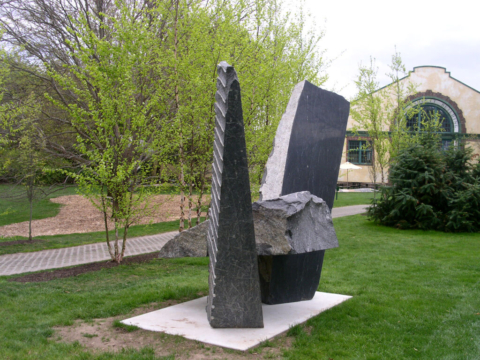
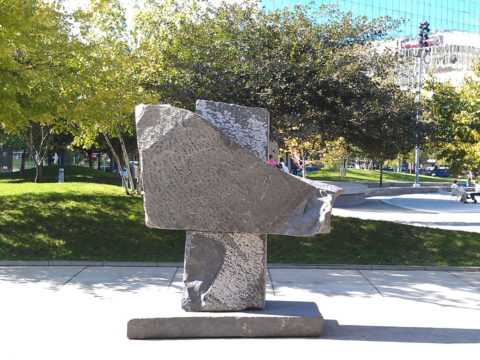
To name a few, “Enki” (black granite, 2007) is at Grounds For Sculpture; “Snaphance” (black granite, 2011) is on view at Bucks County Community College in Newtown, Pennsylvania; “Ghat” is on State Street near GFS; and “Large Granite Arch” (granite, 1998) is off Route 202 near New Hope High School.
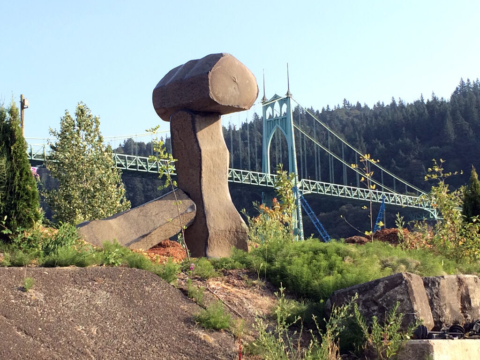
“Tonka” (basalt, 2015), is just north of New Hope on Route 32, and was recently purchased by Solebury Township.
Named after the artist’s childhood dog, it was crafted in the summer of 2015 when Gordon was in residence at St. John’s Sculpture Park in Portland, Oregon. The columns of basalt (a volcanic or igneous rock) came from a quarry in Washington State, and Gordon worked on the piece while living on a tugboat in the Willamette River.
“Basalt is a crystal that grows from lava, so it’s very organic, and I felt a definite spirit while working on it, as well as the spirit of the land where I was working,” he says.
One of the most exciting showings of Gordon’s sculpture was winter-spring of 2016 when five of his mammoth works were on view in New York City’s Garment District Plazas, on Broadway, between 41st and 36th streets. The five pieces — “Sandalphon,” “Snaphance,” “Enki,” “Flying Canoe,” and “Grasshopper” — were envisioned to become part of the environment there, engaging New Yorkers and visitors.
Gordon probably never imagined he would be crafting such outsized works of art when he was doodling and drawing at the family home in Cheltenham, Pennsylvania.
It was not a particularly artistic household, but Gordon’s physician father and teacher mother saw that he had some artistic abilities, so they enrolled him at the venerable Abington Art Center in Jenkintown.
“I loved to draw, and my things were pretty realistic, so my parents thought I should study at Abington,” Gordon says.
A teacher at Abington arranged for Gordon to apprentice with Boris Blai, a classically trained Ukraine-born figurative sculptor who had worked in Auguste Rodin’s studio. Among many other achievements, in 1935, Blai founded and became dean of the Stella Elkins Tyler School of Art at Temple University.
“I studied with Boris privately while I was in high school,” Gordon says. “This is where I concentrated on studying the human form. I also met some fellow students who went on to be influential in the sculpture world.”
He says he is influenced by “everything he looks at,” but also by certain artists who have become colleagues and friends, like Isaac Witkin.
“I got interested in the work of Mark di Suvero when I was at Abington,” he says. “I remember, we saw a show of his work at the Guggenheim when I was only about 13 or 14 and I was blown away — and now I know him.”
After high school it was on to Syracuse, where Gordon continued to work with clay and also branched out to work with different materials. Post-Syracuse, Gordon moved to New Jersey to earn his MFA in sculpture from Rutgers University (1987).
He was professor of Sculpture I, II, and 3D Design at Raritan Valley Community College in Branchburg, from 1998 to 1999, and professor of Metalwork and Foundry at the Pratt Institute in Brooklyn, New York, in 1999.
In addition, Gordon was involved with the founding and launching of the Pratt Institute’s sculpture park, one of the largest in New York City.
“My wife, Wendy, is also a sculptor; in fact, she graduated from Syracuse before me, and I followed her to New Jersey, to the Johnson Atelier,” Gordon says. “I worked there for 15 years, left for Pratt for a year, and then started the business.”
Wendy Gordon says that the couple is very much a team. “I do the job detail gathering and office work, and Harry does the physical aspect,” she says. “We have two (grown up) children, a son Brent, 34, and a daughter, Tory, 31, who both live in Colorado. Brent has a son and Tory has two daughters, so we’re ‘grands,’ as well.”
The couple has lived and worked in Lambertville for 34 years, with a house and studios on the property along River Road. Wendy remarks that she is always creating, and was in a show with Karen Titus-Smith, “Women on the Wall,” at the Arts Council of Princeton, in September-October 2022.
The Gordon sculpture moving and installation business currently has two crane trucks, an investment worth a couple hundred thousand dollars, even before factoring in the maintenance of the vehicles, as well as upkeep and fuel.
“You can easily put 100 gallons of diesel in one of our trucks, so you can imagine what that costs,” Gordon says.
It’s a back-breaking labor, sometimes done on 100-degree summer days, sometimes during single-digit winter nights.
But still, the work has its moments.
“It’s very cool to think that I make a living moving and touching things most people aren’t even allowed to interact with,” he says.
Harry H. Gordon Studios, 17 Old River Road, Lambertville. 609-397-8407. gordonsculpture.com and www.wendywgordon.com.