“Before there were horror movies, there were written or spoken horror narratives, fables handed down from one generation to the next, and, as we shall see, theatrical presentations designed to thrill and horrify audiences.”
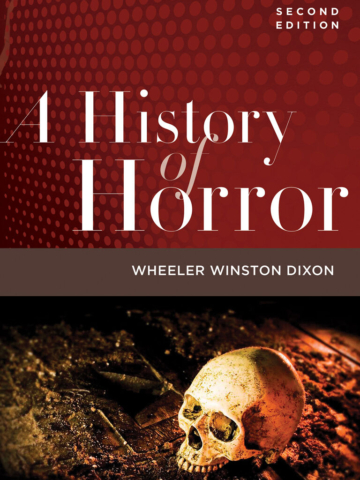
So says professor and filmmaker Wheeler Winston Dixon in his introduction to “A History of Horror,” a Rutgers University Press paperback hitting bookstores this month.
Given the popularity of horror films, the book should attract the attention of those interested taking an intellectual journey back to the beginning of the written word —only to discover that many of those words are about the invisible things that go bump in the night.
As Dixon quickly tells us, “The origins of the horror story may be traced to the beginning of narrative itself, or at least as far back as the Babylonian epic of ‘Gilgamesh’ (circa 2000 B.C.).”
That story is the first — or one of the earliest — written tales that features an encounter between a living man and a ghost.
It also has other ingredients that have stood the test of time: sex, mysterious environments, and otherworldly visitors.
After reminding of us of Homer’s “Odyssey” (circa 800 B.C.), again dealing with a variety of unworldly monsters and struggles with supernatural figures, Dixon moves us through Western literary history to reacquaint us with the ancestors of our current generation of horror tales — now mainly told in films and video.
For example, as he notes in his introduction, “Dante’s ‘Divine Comedy’ (1310), has served as the temple for a series of terrifying visions of eternal damnation, and stories of lycanthropy (werewolves) can be traced to the Middle Ages, especially in French folk tales.
“(English playwright Christopher) Marlowe’s ‘The Tragical History of Dr. Faustus’ (1590), along with (Romantic German writer) Johann Wolfgang von Goethe’s two-part poem ‘Faust’ (1808 and 1833), also proved fertile ground for filmmakers from the later 19th century onward, chronicling the tale of a man who sells his soul to Satan in return for illimitable wisdom and power, only to be (perhaps inevitably) disappointed by the transaction.”
Dixon then starts on the series of spooky novelists, mentioning English writer Horace Walpole’s “The Castle of Otranto” (1764), which Dixon says “is generally considered the first horror novel.”
That book — that started the “Gothic” story featuring a spooky old building — was followed by Ann Radcliffe’s 1794 “The Mysteries of Udolpho” (another gloomy castle tale), M.G. Lewis’s “The Monk” (a 1796 romance involving a young monk and demoness), and Charles Maturin’s 1820 “Melmoth the Wanderer,” which Dixon calls “another ill-advised pact with Satan.”
Yet, he notes, the above seemed to have paved the way for the future with the appearance of the most famous of early horror works, Mary Shelley’s “Frankenstein; or, The Modern Prometheus” (1818).
Dixon reminds us how her story was born one stormy night when Lord Byron “ensconced in his summer house on Lake Geneve in 1816 with Percy Bysshe Shelley, John Polidori, Mary Godwin (Shelley), and Clair Clairmont in attendance, proposed that he and his friends should try their hand at wiring ghost stories to pass the time.
As we know, Shelley and Clairmont ignored the suggestion and Byron abandoned a story he started. But, as Dixon explains, “Mary Godwin (she was at this point Shelley’s mistress and not actually betrothed to the poet) sat down and attacked the task with vigor and imagination — no small feat for an 18-year-old who had never written anything nearly as ambitious in her short life. When it was published in 1818 the novel became a sensation, and it has served, as everyone knows, as the basis for literally thousands of films, of all nationalities, from the dawn of cinema to the present.
“For his part, (Byron’s doctor) John Polidori took Byron’s fragment and expanded it into ‘The Vampyre: A Tale’ (1819), imagining an aristocratic vampire as a figure of heterosexual erotic desire, a concept that would remain unexplored by the cinema, amazingly until Terence Fisher’s (film) ‘Horror of Dracula’ (1958) made an overnight star of Christopher Lee as the bloodthirsty count.”
Dixon also points out another less known vampire story, “James Malcolm Rymer’s serial ‘Varney the Vampyre,’ which ran from 1845 to 1847, consisted of lurid tales told with penny-dreadful relish and the requisite amount of gore, suitably illustrated with blood-drenched engravings of Varney attacking a seemingly endless series of nubile victims.”
That in turn led to Sheridan Le Fanu’s “Carmilla,” an elegant work of literature tinged with an eroticism that later influenced the colorful and sensually charged Hammer films and, as Dixon notes, mid-century French filmmaker (and director of the famously risqué Brigitte Bardot film “And God Created Women”) “Roger Vadim’s hallucinatory ‘Et Mourir de Plaisir’ (1960), which fully exploited the lesbian theme of Le Fanu’s source test.”
Of course, some of the rightfully famous literary works are mentioned: the uncanny tales of Edgar Allan Poe, Nathaniel Hawthorne, Robert Louis Stevenson, Oscar Wilde, and Henry James, whose “Turn of the Screw” is considered one of the most intriguing supernatural tales ever penned.
Dixon says “one can see from this brief survey of supernatural literature, nearly all the major thematic constructs that still fascinate us today — the man-made monster, the vampire, the pact with the Devil — date from this early period of experimentation.
“By the time Bram Stoker published ‘Dracula’ in 1897 and the modern serial killer was embodied by Jack the Ripper, whose string of vicious murders began in August 1888 and ended with no clear resolution in 1889, most of the major themes of cinematic horror were fully formed.”
Then he adds, “Similarly, the horror film has been a cinematic staple since the inception of the medium. Thomas Edison, that most exploitational entrepreneur, produced the first filmic version of Frankenstein, directed by J. Searle Dawly, in 1910 but that film was preceded by a series of equally bloodthirsty entertainments, including the bizarre ‘Electrocuting an Elephant’ (1903) and ‘The Execution of Mary, Queen of Scots’ (1895), the first an authentic ‘snuff’ film depicting the execution of a ‘rogue’ circus elephant, and the latter a lip-smacking vignette depicting Mary Stuart’s death by the ax.
“Indeed, the cinema was made to order for horror, bringing the various special effects, tricks and prosthetic make up devices used in theatrical presentations to a considerably larger audience. “
The book delivers on delving into the great fun of scary staff and even includes a “Best Of” list that will either engage or enrage the reader.
And, as someone who has read many of the books or authors mentioned and seen many of the old key films, I can accept — but not totally agree with — his leading ten of his top 50 horror films:
“Alien,” 1979, basically a suspenseful Gothic tale told in space;“Audition,” 1999, frightening thanks to its real sadism;“Black Sabbath,” 1963, a fun collection of creepy tales with horror veteran Boris Karloff;“Black Sunday,” 1960, a Gothic and grisly graphic Italian film with horror icon Barbara Steele;“Bride of Frankenstein,” 1935, an elegantly filmed and sometimes surprisingly moving film where the monster takes new life beyond Shelley’s moralistic tale;“The Brides of Dracula,” 1960, a colorful and energetic outing with the blood sucker;“The Cabinet of Dr. Caligari” 1920, a hypnotic and mesmerizing silent tale of madness;“Candyman,”1992, where a legendary supernatural figure is released to create havoc;“Carrie,” 1976, a story of blood, adolescent cruelty, and revenge, and“Cat People,” 1942, a moody and suspenseful tale of young woman whose sexual yearnings turn into her a vicious animal.
But don’t take Dixon’s word as gospel, take a look at the book, check out the stories and films, and don’t be scared to decide for yourself.
“A History of Horror,” Wheeler Winston Dixon, 298 pages, $24.95, Rutgers University Press.