Editor’s Note: The Masonic Temple in Trenton was enlivened on June 25 by a large group of people gathered there to experience something distinct: the presentation of “Path of Miracles.”
The 2005 choir work by British composer Joby Talbot is a musical evocation of the ancient yet still practiced pilgrimage along El Camino de Santiago (the Way of St. James) through Spain.
The event that combined choral music and visual art was created by The LOTUS Project, a Trenton organization whose mission is to “craft immersive musical experiences in which we can encounter the world with new eyes and a renewed sense of wonder.”
The organization takes its name from the flower known for its purity and association with spirituality across various belief systems around the globe.
For this production, the LOTUS Project used musical time and the hall’s physical space to suggest the pilgrimage route known for cathedrals that house miracle working reliquary.
The artistic team included LOTUS Project artistic director Alicia N. Brozovich, who conducted the ensemble, and visual artist Chee Bravo, who created the visuals. Both are Trenton residents.
According to New Brunswick-based art historian and professor Rohini Iyengar Vadapall, the tone was set immediately when attendees encountered a “compostela”:
‘As we entered the venue of this immersive artistic project, a piece of the sky lit up with stars like in the ‘milky way’ also stood as an unwound canopy above us. The Spanish word ‘Compostela’ is derived from Latin ‘Campus stellae’, which literally means ‘field of stars’ or the milky way.
According to medieval legends the Milky Way is supposed to have been formed by the dust that rose due to the tedious walk of the pilgrims on their way to the Cathedral of Santiago de Compostela. A slice of that sky as well as the walking experience was thoughtfully brought down inside the Masonic Temple by the efforts of Chee Bravo, a multimedia artist, in collaboration with graffiti artist Leon Rainbow.
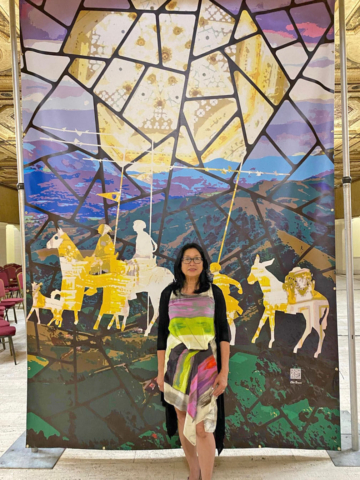
Moving further on our personal aesthetic pilgrimage inside the temple, monumental banners created by Bravo, relating to each of the four stations en route to the cathedral of St. James, struck an awe-inspiring note to the viewers.
Then, following by an introduction to the project and the concept, began the choral concert. An ensemble of four compositions that represented the stations of Roncesvalles, Burgos, León, and Santiago de Compostela were performed. This seemingly effortless and splendid blend of skill and technique was a result of tireless research carried out by Brozovich and several sessions of rehearsals by the musicians.
Mention has to be made of the librettist, Robert Dickinson, who brings in the text from various languages including somewhat distant and unfamiliar ones like Latin, Greek, and Basque using well researched resources of transliteration.
Taking inspiration and guidance from Joe Miller, (an innovative) conductor at Westminster Choir College, and Gabriel Crouch, director of choral activities at Princeton University, (Westminster-trained) Brozovich took up this challenging task. Consequently, the choral music reflected all of those ardent efforts in the enthralling performance that almost transported the audience to another spiritual plane beyond the physical, the human, and the mundane.
This experience of divine music along with the images related to the holy shrines comes close to the belief in and the witnessing of miracles. To make it further feel like the actual pilgrimage (wherein the devotees customarily place small stones, symbolic of burdens, at the base of the Iron Cross thereby metaphorically relieving themselves of worldly encumbrances), the audience was invited to interact and share personal anecdotes by writing on white paper bags that were then illuminated by placing candles within. This act of disclosure and communication of one’s experiences and thoughts generates a powerful feeling of being heard, which miraculously produces a profound sense of unburdening.
Bravo’s background in printmaking, photography, and graphic design all come together in the making of the silkscreens. The banners were produced from the digital collages used to manually create the silkscreens.
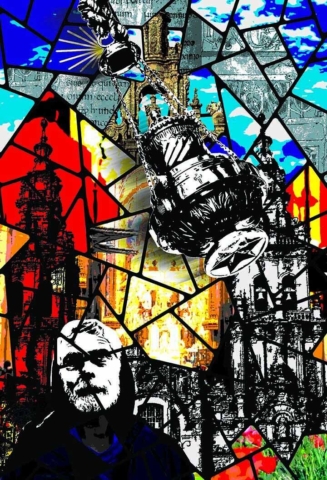
As the path of the pilgrimage is studded by some Gothic churches of the medieval era, which are illuminated with spellbinding stained-glass windows, Bravo incorporates spatial division reminiscent of stained glass geometric patterns. Having taken a short trip to Spain that further boosted her enthusiasm for the project, she created four panels that not only connected with the theme of pilgrimage to the shrine of St. James, but also allude to the origin of Christianity with the story of birth of Jesus Christ.
In the panel titled “Roncesvalles” that depicts “Alto del Peron” (Hill of Forgiveness), the 2D rendering of iron sculptures of pilgrims can be seen in the backdrop of French Pyrenees. However, the work recalls the portrayal of the three Magi, in much of Western art, who travelled from the East guided by a star to visit and offer gifts to the Holy Family commemorating the birth of Jesus. They were the first pilgrims of Christianity.
Next milestone on the path is at Burgos, which is a vast and harsh terrain that has been aptly portrayed by the artist with two long cast shadows of tired travellers. They have finally made it through the unforgiving landscape by the evening just before sunset to reach Burgos where the appearance of the giant cross welcomes them and offers hope. While CMYK (Cyan, Magenta, Yellow and Black) were used to create each silkscreen, she has added a fifth color (a glow in the dark ink) in a couple of them to enliven the path.
As the journey continues it reaches the highest point from where a beautiful view awaits the pilgrim like in the third banner that depicts the station of Leon. Even as the pilgrim shown on the left foreground is weary due to the tedious travel, the golden glow from the sunlit sky along with the famous ‘Cruz de Ferro’ or the Iron Cross offers solace and blessing. As if this knowledge and accomplishment bestow enlightenment to the individual souls represented by the emblematic sea shell, found abundantly across the route, is portrayed over the blue waters. Symbolically, like a sea shell that sails over and reaches the shore, humans have the potential to realize through spiritual guidance the way or path to salvation and are relieved of ones burdens and bindings.
This understanding leads one to the final destination on one’s path, the cathedral in Santiago de Compostela. In this banner, Bravo portrays the central spectacle of the church, which is its gigantic incense pendulum known as the ‘thurible’. In this fourth and the ultimate station it takes eight monks to set the thurible in swinging mode.
Overall the sojourn within the Masonic temple was the path of choral music and visual art that was orchestrated to produce a complete immersive experience of the spiritual via aesthetics and acoustics. Thus, the audience was guided by the painted ‘milky way,’ followed by the choral music performed with the silkscreens of nodal cathedral venues on El Camino de Santiago as a backdrop. This thoughtful blend of art forms, like the ethos of The LOTUS Project, succeeded in reinvigorating and reinstating one’s faith in the divine as much as in the collective human endeavor that make miracles possible.
For more on the LOTUS Project, visit www.thelotusprojectnj.org.
Information on Chee Bravo is available at www.jcheebravo.com.