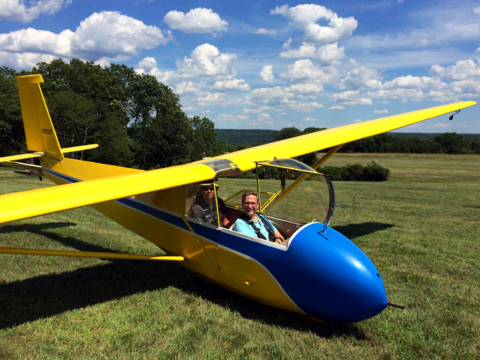
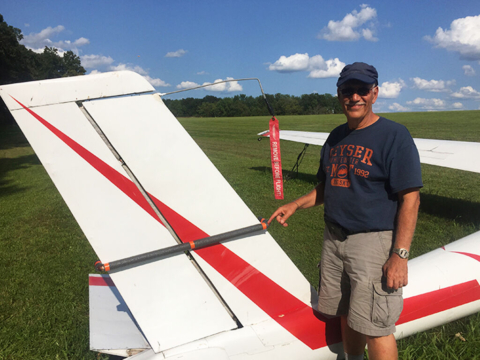
“Oh! I have slipped the surly bonds of Earth” may be a good line of poetry to slip into the spirt of Princeton resident Marty Schneiderman, a member of the Princeton area’s Soaring Tigers glider club since 1975.
Schneiderman served as the club’s chief flight instructor for 38 years.
Established in 1974, the nonprofit club that has been soaring for five decades says on its website that it is “dedicated to the development and promotion of safe motorless flight, and to the training and instruction of its members in the art, science, and sport of soaring.”
The major focus of the club is on flight instruction for new pilots.
It is limited to active members, who pay annual dues ranging from $500 for high school and college students to a $1,500 “Standard” membership. Membership includes access to the club’s three aircraft. Discounts are available for family memberships and owners of their own aircraft. Members are also expected to pitch in and help maintain and secure the aircraft and perform other tasks related to running the club.
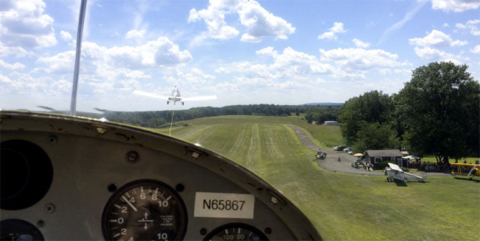
Van Sant Airport, a public use airport located near Erwinna, Pennsylvania, and owned by the Bucks County Airport Authority, has been the home to the Soaring Tigers since about 1988, according to Schneiderman.
The club began flying in 1974 from Forrestal Airport, a small, private airport that was located along the east side of Route 1 and operated by Princeton University for aeronautical research. The university disbanded the flight laboratory in 1983, and the Soaring Tigers continued to operate there until rising land values and concerns about liability prompted the university to close it.
What drew Schneiderman to the world of soaring? “I was a kid in New York City,” he says, “but I’d always loved airplanes and wanted to be an airplane pilot, although there was no airport near our house on 75th Street and West End Avenue. When I was drafted into the military in 1970, I would have gone into the Air Force to be a pilot, except that I wore eyeglasses and they wouldn’t take me. And in any case, although I liked the idea of getting free flight training, I really didn’t want to drop bombs and shoot at other airplanes.”
Two years later, a glider literally crossed his path, and he was hooked, Schneiderman says. “I was driving through the French Alps on a very circuitous road when all of a sudden a glider goes past me,” he explains. “My heart started beating faster, and I stopped at the next village to ask where the nearest airport was, hoping there would be a plane with two seats I could ride in.
“No luck,” he continues, “only single seat gliders and power planes, so I couldn’t fly. I was disappointed but thought that this would be really neat to do, neater than being a power pilot. Up until that time I had taken sailing courses, so I knew about how wind affects craft on water. It’s not the same in a glider, but there are certain similarities, and I much preferred sailing to motor boating.”
This turns out to be the case for a number of other people in the club as well. “We have a number of people who are into sailing, and also into scuba diving as well as soaring,” he says.
At this point, a word or two about the term “gliding” versus “soaring” is in probably order. “Soaring is a better descriptor to use these days,” Schneiderman says. “In World War II on D-Day, we used expendable gliders, dozens and dozens of these heavy wooden and cotton fabric aircraft. They made one takeoff and one flight, carrying a whole crew of people. One power plane would tow two or three gliders, then cut them loose over the Channel and they would attempt to land in fields in France, not always successfully.
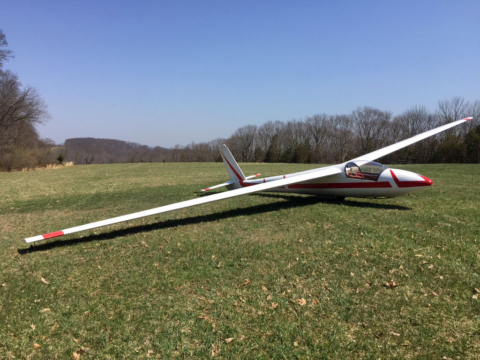
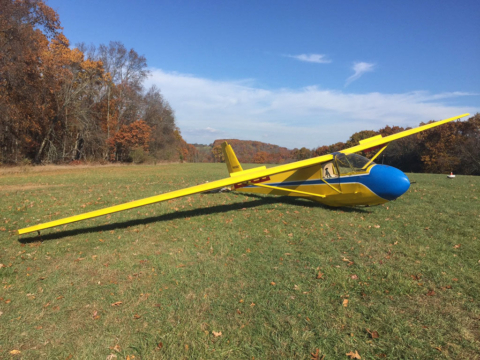
“That was then,” he continues. “Modern gliders are made out of strong, lightweight metal, and the fabric is something called Ceconite, a heavy duty synthetic fabric. And unlike the World War II-era gliders these craft can stay up for sustained flights, and they can circle and ascend in thermal air that’s moving upward.”
Martin E. Hellman, a professor emeritus of electrical engineering at Stanford University, says on his blog that glider and soaring references “are sometimes used interchangeably. For example, the FAA licenses glider pilots, not soaring pilots. But … most glider pilots soar at least some of the time. Soaring involves climbing in natural sources of lift, thereby replenishing altitude lost in the glides between areas of lift. Most glider pilots would say they only got to glide on days they couldn’t find any lift, but say they went soaring if they were able to repeatedly regain altitude in lift.”
And it’s possible for experienced glider pilots to soar to noteworthy altitudes and distances when the conditions are right, according to Schneiderman. “In addition to thermal air currents, there’s something called mountain lift where the wind hits a mountain and goes up,” he elaborates. In a glider it’s pretty remarkable. In a thermal current you go up slowly, maybe 400 to 500 feet per minute. In a mountain lift you’re going up as fast or even faster, to the point where you may need oxygen on board.
“A pilot must carry oxygen and use an oxygen mask when we’re over 12,500 feet, and a passenger needs oxygen at 15,000 feet,” he says. “None of our three planes carry oxygen because none of them are flying that high, but I have recently flown over 10,000 feet, the highest I’ve ever been on the East Coast. That was quite a day!”
If attaining 10,000 feet in a glider sounds impressive, a Wikipedia search reveals that mountain lift was used to set the record for highest altitude by a glider, a mind-boggling 74,334 feet, on September 2, 2018, over El Calafate, Argentina, in a specially constructed craft. According to the same Wiki entry, the current world distance record of 1,869 statute miles (and using mountain lift) was set on January 21, 2003, in South America.
Schneiderman stresses that the club’s emphasis is not on setting records, but on safe enjoyment of the three aircraft shared among the club’s members. “As private aircraft, our planes are inspected annually in accordance with FAA rules, as well as ongoing attention to the craft by our members” he notes. “Any issues are promptly addressed by certified technicians at the airport.”
Elaborating on the issue of safety, he notes that there have been just two accidents in the club’s history. “No one has ever been hurt, ever been taken to the hospital,” he says. “We had one accident when the pilot came in too low and damaged the plane. Another time, a member was riding thermals away from the airport, the thermal stopped, and he did not have a good place to land. He was perfectly fine, but the plane was damaged.”
So, what’s it like to be up there?
“You encounter hawks up there up there,” he responds, “and students love this. It’s pretty neat when you’re flying with the birds. They’re up there riding the thermals without instruments, and their navigation system works much better than ours. On days when I go up around 10,000 feet and I encounter hawks, I say ‘Hi guys!’ and I go where they are and try to match my speed with theirs.
“And it’s quiet,” he continues. “Noisy at first when you’re being towed skyward by a powered plane at the end of a 200-foot rope. Then the tow plane makes a diving turn to the left, you make a climbing turn to the right, and it gets much, much quieter. How quiet depends on the aircraft; on some it’s like driving a car at 50 miles per hour with a window opened a crack. On others it’s very, very quiet. It’s a very interesting sensation, because you learn, in a very real sense, how the principle of wings and lift really works.”
Can anyone who wants to try soaring take a ride with your club?
“If they’re not interested in becoming a pilot, the answer is no,” Schneiderman says. “There are commercial flight operations at the airport, but we choose not to do that. We’re are a club that wants people who have their license, want to get their license, or have a prop or jet plane license and want to get their glider license.
“If someone simply wants to take a ride, or give a ride as a gift, we direct them to a commercial operation. If someone approaches a commercial operation about becoming a pilot, they will refer them to us, so it’s a very good symbiotic relationship,” he continues. He also notes that, according to FAA regulations, the minimum age to solo a glider is 14, to get a private glider license is 16, and the minimum age for certification as a certified flight instructor is 18.
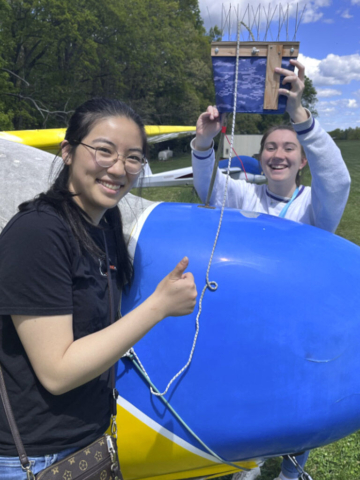
With regards to ensuring the continued health and well-being of the Soaring Tigers, Schneiderman raises two challenges that the club currently faces. The first is the ongoing challenge of recruiting new members, not uncommon for clubs of this kind. He notes that the club currently has 10 members, ranging in age from their mid-30s to mid-70s. The second is continuing to recruit additional licensed flight instructors to sustain the club’s ongoing mission of teaching student glider pilots and enabling power pilots to transition to gliders.
That individual would join the two volunteer glider-certified flight instructors (CFI) and a glider/power pilot who is now working to earn his glider flight instructor rating.
Overall, Schneiderman is optimistic about the club’s future. “We have always had ups and down in membership, and articles like this are helpful in getting the word out and attracting people who’ll want to join the club and soar with us.”
For more information on the Soaring Tigers: 609-924-6939 or soaringtigers.org.
For the history of Princeton University’s Forrestal airport, visit Abandoned and Little Known Airfields: airfields-freeman.com/NJ/Airfields_NJ_Trenton.htm#forrestal.