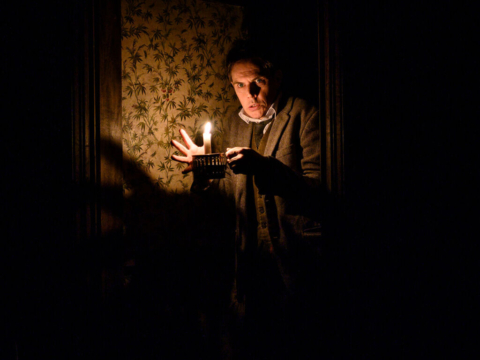
A door in an abandoned mansion that seemed hermetically sealed and immovable suddenly opened during “The Woman in Black” at Princeton’s McCarter Theatre, and I felt my hair raise.
That has to be some indication that Robin Herford’s production of Stephen Mallatratt’s play, the same staging that appeared in London for more than three decades, is effective.
A woman’s screams emanating from speakers in different sections of McCarter’s Matthews Theatre also provide a discernible jolt.
In general, the import based on a story by Susan Hill and featuring alumni from the London production, is workmanlike and involving more often than it is macabre or scary, raised hair and occasional startle notwithstanding.
The show entertains and sustains interest in its plot, but it never evolves into an edge-of-the-seat thriller.
That may be because of the format Mallatratt used to relate Hill’s story. Rather than sticking to directly depicting an English barrister’s unsettling encounter with a ghost, Mallatratt creates a play within a play within a play. His weaving is adept and does justice to the various segments of his script. But sequences of narration and direct exposition weaken the potency of the eerie tale that is the “The Woman in Black’s” main substance by regularly interrupting it.
Layer one of Mallatratt’s play has an everyday Englishman booking a theater to read a manuscript describing his intense brush with the supernatural, one that has profoundly affected his life after it. We meet the man, the barrister, droning monotonously from a thick document a theater director estimates would take five hours to read from a stage.
Layer two is the director, hired to coach the barrister, attempting to condense the unwieldy document into a compact, cogent stage piece with the barrister playing either himself or, more pointedly, the characters he met in the small British coastal town he stayed in while sorting out legal details concerning an estate to which the ghost was attracted. This layer takes the form of revelations and rehearsals.
Layer three acts out scenes from the newly wrought play. This layer foments the most interest because it involves dramatic action more than conversation and shows the creativity of Herford’s staging, especially when the rehearsals from Layer two evolve into scenes that depict what we in the audience most want to know, the secrets townsfolk are withholding about the estate and its late owner.
Intrigue resides in the more direct segments of the play. The other layers trigger curiosity, but “The Woman in Black” takes off when you’re seeing rather than hearing about a strange incident or peculiar event.
Herford and a pair of excellent actors keep Mallatratt’s going from the present-day rehearsals to harrowing scenes from the barrister’s past absorbing enough, but it’s more satisfying and theatrically exciting when “The Woman in Black” takes us to the haunted estate and lets us witness the entrances of the eponymous woman.
Her first entrance was a tad spooky. I felt the ghost before seeing her. She arrived down theater’s right center aisle and lightly brushed her shoulder against mine as she passed on her way to the stage. (I’m not sure whether the touch was intentional or happened because I have a habit of leaning into aisles as I watch a play.)
In this way, the audience is aware of the woman, though not yet informed she is a ghost, before the characters on stage notice and react to her.
Physically terrifying or not, Hill spins a good story, and Mallatratt keeps it suspenseful enough for us to want to know who the ghost is, why she roams, and why she seems destined to perpetually stalk the barrister assigned to settle her sister’s estate.
Herford’s cast provides a study in acting.
Ben Porter is mercurial as he segues from one character to another, adopting a different posture or changing a bit of his costume, for example tying a scarf rather than letting it hang limp around his neck to indicate a new persona.
Porter never fails to find some trait, the wrinkling of his chin, a demeanor of confidence, a pose of swagger, that differentiates the dozen or so people he portrays. He is especially keen in finding the right emotions and right expression of each.
In a trick of Mallatratt’s, Porter plays Arthur Kipps, the barrister, but because the director wants to understand the various seaside citizens Kipps encountered while at the estate, he ends playing everyone but himself in the play the director is crafting.
Kipps, in the play being rehearsed, is assayed by the director who uses the man he’s consigned to play numerous other roles as his model.
Anthony Eden, as the actor/director, is fun to watch because he portrays Kipps in the play within a play but endows him with a personality that varies widely from the one Porter uses. Eden is more reserved as Kipps than he is playing the actor/director who becomes enthusiastic or emotional at the slightest turn of events.
Porter and Eden are both versatile actors who volley off each other well. They share their roles with a third actor, David Acton, who may have been enlisted to play the titular woman, a character neither Porter nor Eden would have had time to cover.
Michael Holt’s set is a world of mysteries revealed as needed. For most of the play, it serves as stark rehearsal hall with barely a chair to rest on.
The rehearsal stage is sparsely furnished. Its main features are a coat rack that contains the costumes each actor wears and a wicker prop basket from Edinburgh that serves many purposes, from a trunk loaded with wardrobe to a plain bench on which characters can sit.
As settings change to a bedroom in the haunted estate, an office, a church, or a dozen locales, Holt combines with lighting designer, Anshuman Bhatia, to form exactly the space needed. Lights come up, and suddenly we’re in a child’s bedroom or a playroom that seems to hold a certain fascination for the ghost. Holt and Bhatia can make a graveyard cross dominate the stage just by drawing it in light. They allow for Herford to use any setting he likes to convey the tensions Kipps experiences after meeting the ghost.
Sebastian Frost and, now, Rob Mead, created a sound design that allows for sudden screams, neighs and pleadings when a horse, its carriage, and its passengers are being mired in quicksand.
Holt is also responsible for the several costumes Kipps and the actor/director wear as they constantly take on new roles.
The Woman in Black, McCarter Theatre, 91 University Place, Princeton. Through Sunday, October 29, Wednesday and Thursday, 7:30 p.m., Friday and Saturday, 8 p.m., and Saturday and Sunday, 2 p.m. $25 to $65. 609-258-2787 or www.mccarter.org.