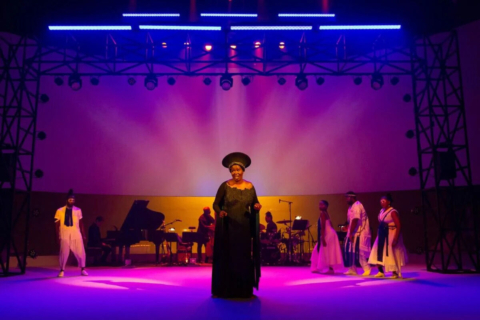
My hope is “Dreaming Zenzile” is a work in progress. Somi Kakoma’s piece about entertainer and activist Miriam Makeba, now at Princeton’s McCarter Theatre, is rich in dramatic material and has a worthy story to tell, but it unfolds in scattered fashion, lacking focus, making too little of key passages in Miss Makeba’s life, withholding information that would make a sequence clearer, or dwelling too long on an event to sustain concentrated interest in it.
The play takes the dreamlike form signaled by its title. It is a flashback of Makeba’s life and experiences that begins at the time of her collapse on stage at an Italian theater and ends the same evening with her death.
A “dream” approach has its uses. It invites a playwright to explore an entire life, important here because Miriam Makeba’s had so many aspects. “Dreaming Zenzile” is often too diffuse, too symbolic, or too straightforward to give the dream compelling cohesion. The wandering and sometimes staccato presentation impedes full involvement. One recognizes all that is going on and easily follows the biographical details of Makeba’s life, but most of “Dreaming Zenzile” moves so quickly from one idea to the next or gives information so baldly and directly in one instance and so incompletely in another, it doesn’t draw you in or settle into a unified piece. Individual segments engage, and musical numbers, of which there are many but few that offer complete songs or emphasize the talent that made Makeba famous, can raise the quality and texture of the show by several notches, but they don’t last long, so “Dreaming Zenzile” never launches, rarely even finds a moment that grabs you and holds more than your objective attention to the end.
Miriam Makeba may not be familiar to contemporary audiences. She performed from the early 1950s until she died in 2008, but her heyday is far enough past that she might not ring the immediate bell Ella Fitzgerald or Nina Simone does. Kakoma, who plays Makeba, makes this point within her script in a sequence is which Makeba wonders out loud if anyone in the audience really knows her and asks the audience why they came to the show, looking at one point in one person’s face and asking in a challenging way, “What are you doing here?”
It seems sometimes as if Kakoma is less interested in Miriam Makeba, the internationally acclaimed singer, and more in Miriam Makeba, the activist, the woman who struggled against authority and status quo, in America and Africa, for much of her life, and who was once Guinea’s representative to the United Nations. At one point, Kakoma has Makeba say she doesn’t enjoy being the celebrity people come to hear perform songs in multiple languages and styles. She has Makeba say she doesn’t even like being obliged to sing her biggest hit, “Pata Pata,” when there’s so much more she’d like to discuss and work towards fixing in America and her native South Africa.
This is all well and good. Makeba can be said to have sacrificed her career to make a case against oppression and for equality, but it misses the point that Makeba is known, and remembered, first and foremost, for her music, and it’s her lauded status as a performer that informs her voice as an activist.
Kakoma, as playwright, can have her character, Makeba, express any sentiment she likes, and what she has Makeba say may be accurate, but from a theatrical point of view, it lacks balance and makes Makeba look resentful and angry about her stage career instead of justly proud of it.
Resentment, anger, and other emotions and sentiments make a character fuller. They can be important elements in presenting a figure on stage, but “Dreaming Zenzile” seems more ready to emphasize the angst than leaven it with some of the joy Makeba spread as an entertainer. There is film enough of Makeba at various stages in her career, as the lithe Josephine Baker-like nightclub artist of her early days to the portlier older woman in rich African robes and headdresses, that shows the verve she gets from performing and how she mesmerizes her audience.
In fairness, Kakoma has Makeba say how alive she becomes when on stage, but as a playwright, she tends to veer away from any full presentation of Makeba’s music. When she does, as in a late number, “Malaika,” the McCarter suddenly lights up in splendor. The audience that may not have seen Makeba has a good idea of what made her great, with Kakoma the performer, demonstrating for once how vibrant and enchanting she could be. If only that happened more often, “Dreaming Zenzile” would benefit exponentially.
Zenzile is the first name of Miriam Makeba, who gained fame using her middle and surname. “Dreaming Zenzile” expands from an actual event in Miss Makeba’s life, a heart attack she has on stage in Caserta, Italy, while performing in a benefit concert organized by the writer Roberto Saviano.
As Makeba is doing a number, she falters in obvious distress and pain. A chorus, dressed in white and representing various people throughout “Dreaming Zenzile,” but initially Makeba’s ancestors, step in backwards to accompany the singer’s spirit home to peace and rest. Makeba resists.
The collapse/death sequence is repeated several times, each with Makeba saying she is not ready to join her mother, father, and others in eternity because, in sheer practicality, she has a show to finish and because in the interval between discomfort and death, she visualizes and relates her life.
Somi Kakoma, the actress, who, professionally, often uses the name Somi, has some marvelous passages in which she shows the breadth of depth of Makeba. Somi Kakoma, the writer, doesn’t give these passages enough definition or flow to make them poignant. They remain separate and superficial.
Kakoma, the writer, sometimes employs direct declarations, ending any build-up, follow-up, or dramatic force, as when she has Makeba challenge the audience about whether they remember her or when she has Makeba give a political harangue. A bigger problem is when sequences become too amorphous, too dreamlike. For instance, Makeba arrives in New York to begin her American career. She coos the words “New York,” you hear jazz music, and see some lively dancing from that chorus in white, but you never get a sense of what happens in New York or why it’s important. Mention and suggestion seem to be enough.
Then, there are scenes that are so protracted they lose their intensity. One example is a vividly choreographed and dramatically wrenching passage depicting when Makeba’s daughter, Bongi, dies during childbirth. What starts as harrowing and moving goes on so long it becomes tiresome. Another example is when Makeba, in New York, has a political and philosophical debate with a young man. The discussion is interesting, but it seems to come from nowhere and leads nowhere when it could have been like Juliet’s meeting of Romeo. It isn’t until the end of the conversation you’re even told the young man is Stokely Carmichael, Makeba’s third husband, marriage to whom causes her to lose American support and go into exile in Guinea, a matter that is just brushed on.
“Dreaming Zenzile” has potential, but it needs a lot of work to fulfill it. As a performer, Kakoma has a lot of range. It needs to be harnessed, and there needs to be more sustained musical numbers. The sangoma (spirit) chorus surrounding Makeba is uniformly terrific, Aaron Marcellus coming into his own as Carmichael, Naledi Masilo inspiring empathy as the dying Bongi, Phindi Wilson being a delight in various ways, and Phumzile Sojola providing a strong bass in choral passages. Hervé Samb and his band were superb.
Lileana Blain Cruz’s direction needs to be tighter and indulge in some judicious cutting and defining. Mimi Plange’s costumes were fun, although I would have liked to have seen Makeba in her patented leopard print in early scenes.
Dreaming Zenzile, McCarter Theater, 91 University Place, Princeton. Through Sunday, March 13, Tuesday through Thursday, 7:30 p.m., Friday and Saturday, 8 p.m., Saturday and Sunday, 2 p.m. $25 to $68. 609-258-2787 or www.mccarter.org.