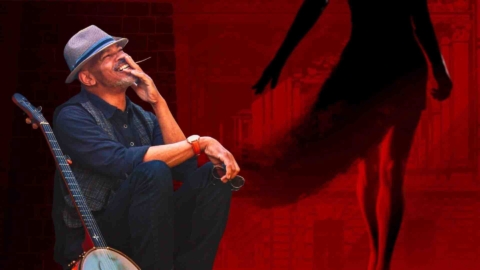
Guy Davis, writer and sole performer of “Sugarbelly and Other Stories My Father Told Me,” at New Brunswick’s Crossroads Theatre through Sunday, June 26, is a master of the story in its most ancient form, the spoken word.
Davis’ yarns harken back to the oldest tales time records. They are handed down through the generations, not only from his father, the revered actor and playwright Ossie Davis, but from his small-town Georgian grandfather, from his renowned biochemist uncle, and from traditional sources.
Davis knows how to weave his story in a way that compels you, delightfully but insistently, to attend to every word. He is as deft as a writer as he is as a tale spinner — runs in the blood, I guess — as “Sugarbelly” revolves around one story, the death by foul play of a young woman Davis calls Sugarbelly in one beat of his story and Rebecca in another, but radiates out to cover a multitude of ground, sentiment, history, and lore.
Davis never declaims his story. He barely puts emphasis on one phrase over another. If a segment of his tale needs punctuation, he turns to music, relying on an assortment of banjos, a guitar, a harmonica, and railroad spikes to add variation and texture. Often, he enlists the audience to join him in responsive refrains, usually finding a way to separate the treble of the female voice with the baritone of the male — the man sitting behind me could successfully sing bass in any ensemble on Earth — and it never seems corny or forced. “Sugarbelly,” for all of its facets, moves in a felicitous continuum that makes each section and interlude seem necessary and proper to the moment.
Davis doesn’t have to emote. His technique for spellbinding is a time-honored one. He catches eyes and measures phrases. He lets the writing do the work and matches his tone and rhythm to the words at hand, words, of course, that were composed by him.
Davis’ organic approach is matched by fluid direction from A. Dean Irby and set composed of randomly hung, empty picture frames and a semicircle of waiting instruments by Maruti Evans, who also contributes an enhancing lighting design, and few well-placed projections of scenes that underscore what Davis is relating.
Skill and artistry reign so supremely on the Crossroads stage, it’s difficult to select what matters the most.
In the end, the dominant element is what it always is and always has been, the story being told.
Davis’ story escalates from a long patch of folklore, the life and death of a West Texas woman called Sugarbelly, to the factual, or at least handed-down, description of an actual woman that was murdered in Davis’s ancestral home of Valdosta, Georgia, to talk about Davis’s paternal family and how it was aware of and could relate both the folk tale and the true-crime saga.
The folklore portion, though it seems weathered with age, is actually Davis’ invention, an imagined account of a young woman’s life and demise based on the real, known story he will tell in “Sugarbelly’s” second act.
You would never know this part of the story was devised or put together in the 21st century. It smacks of legend, painting, as it does, a vivid picture of a time, place, and hardscrabble life that leads to a woman’s destruction just, as is so many great stories, her unhappy life looks ready to be redeemed by love.
Davis has you visualizing existence in backwater Grandview, Texas, at the turn of the last century and listening in sympathy with the plight of a mulatto woman, who mostly resembles her Irish mother and is abandoned, accepted by no one, and left to work out what seems like tawdry survival leavened by the woman’s attractiveness and the affection one good man has for her.
The story on which he bases his lore-like yarn is one from the 1930s, told to him at many a gathering around a Davis kitchen table in Valdosta or New Rochelle, New York, where Ossie Davis and Ruby Dee resided.
This second round of the Sugarbelly story widens the landscape to make what happened in Valdosta, singular and specific as it might seem, into an expanse of history that directly, yet subtly, makes the listener aware of inherent racism, power within the Black enclave of Valdosta, the jealousy rampant in the world whatever a person’s ethnicity or race, and how good and evil vie mightily to prevail one over the other.
Myriad playwrights can take an important lesson from Davis’ approach to making a point and making it stick.
Davis creates quiet drama, haunting drama that makes you think about the times, situations, and effects of each. He doesn’t let fact, dramatic as it may be, go for granted without texture as happens, sadly, in “Sugarbelly’s” companion piece in repertory at Crossroads, “Freedom Rider.”
Through pure craft that lets the power of truth and honesty of sentiment do the heavy lifting, Davis reveals the insidiousness and relentlessness of hatred, some racist, some unmitigated, that permeates and informs a community, Valdosta or Grandview becoming a metaphor for a larger dilemma is a larger society. It is through Davis’s excellently and poignantly places insinuation and direct examples that the workings and repercussions of hate and racism are understood and in a way that moves and lasts.
Please don’t let the seeming simplicity of “Sugarbelly” fool you. Davis provides a mine full of things to consider and ponder while leading sing-a-longs and slowly telling a story in a way you might hear it as his grandfather’s or father’s table.
The only regret I have regarding “Sugarbelly” is it only has a few more days of performances. My hope is Davis’s play will be the next work Crossroad hatches and releases to the wider theatrical world. “Freedom Rider,” for all of my criticism of it, also has merit enough to warrant a visit to the New Brunswick Performing Arts Center before Sunday renders both of these shows into a bit of history.
The Davis dinner tables loom largely in the third beat of “Sugarbelly.” Once more, without being cloying or boastful, Davis takes this last section of “Sugarbelly” to tell about his family, its history, and its accomplishments.
One thread that is funny to me is how Davis’s grandfather, Kent, a self-taught railroad engineer in Valdosta who could read Hebrew and Ethiopian Ge’ez but not English, was angry that Ossie Davis left Howard University for New York to pursue his ambition as a writer rather than join his four siblings into distinguished careers in science and mathematics. (Full disclosure: I interviewed Ossie Davis and Ruby Dee on television in 1981. We went to lunch afterwards and shared a half dozen or so meals in the 20 years after then, some in New Brunswick following meetings at Crossroads. I could listen to Ossie Davis forever and took special enjoyment in hearing more about his and Guy Davis’s family.)
Sugarbelly and Other Tales My Father Told Me, Crossroads Theatre, New Brunswick Performing Arts Center, 11 Livingston Avenue, New Brunswick. Thursday through Saturday, 7:30 p.m., and Saturday and Sunday, 3:30 p.m. $20 to $55. 732-545-8100 or www.crossroadstheatrecompany.org.