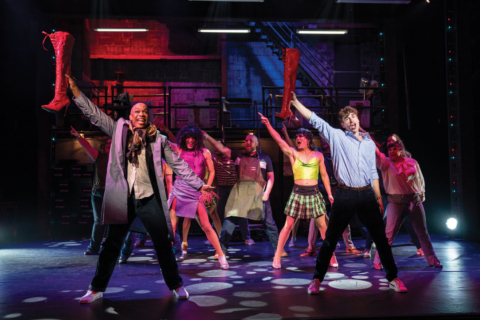
Sheryl Kaller and Hope Boykin’s production of “Kinky Boots” at New Hope’s Bucks County Playhouse reminds me of the little girl who had a little curl right in the middle of her forehead. When it is good, it is very, very good, superb even when Scarlett Walker lashes into her big number, leads Jimmy Brewer and Richard E. Waits convey the deep essence of their characters, and a chorus member, Sarah Lynn Marion, exemplifies everything every performer should do, pivotal role or not.
When it is bad…
Well, it’s not exactly horrid.
It’s never horrid.
When it is bad, it makes you wonder whether Kaller and Boykin’s staging needs another week to jell or whether some coaching here and there, especially in Brewer’s and Waits’s vocals, is warranted. It looks at times as if book scenes were stressed more than musical numbers and that some pieces of the complex puzzle “Kinky Boots” is were not fully considered, let alone fully boiled.
In general, the production is a success. Any criticism I have for Brewer (Charlie) or Waits (Lola) is small next to what each accomplishes, individually and in tandem, to give their characters intensity. Brewer, who plays the fourth-generation owner of a foundering British shoe company, exudes a wealth of sincerity and makes you root for him to not only save his business but achieve his greater goal, to keep his workers, small-town folk he’s known all his life and who have few opportunities for other labor, in their jobs.
Waits, who plays a London drag performer, provides a solid moral core, is immediately and eternally likeable, and also has you pulling for him to catapult from being the star diva at small, specialized clubs to becoming a significant international fashion designer. When Waits commands the stage, as he frequently does, this “Kinky Boots” soars. His is a generous performance that needs some firmer underpinnings to take it all the way home.
Any production of “Kinky Boots” has two outstanding elements working constantly in its favor: a strong, hilarious book by Harvey Fierstein, who excels at the sharp one-liner, and a lively, intelligent score by Cyndi Lauper, who knows how to combine pop rhythms and vibes with the perfect sentiment for the moment, her apt lyrics being the main calling card here.
Fierstein and Lauper make words important in “Kinky Boots.” They drive the production almost as much as the musical numbers because Lauper gives the musical sequences heft and Fierstein is flawless in telling the story of both Brewer’s struggling factory owner and Waits’s scrappy drag queen.
In New Hope, Fierstein’s book dominates. Waits is particularly adept at timing the writer’s most acidic salvos. They establish his character as a quick, witty man who invented a self he could love and admire no matter how society in general responds to that creation. They demonstrate that Lola, nee Simon, sees the world and his/her place in it clearly, emphasizing rose colored frocks and boots over rose colored glasses.
Ultimately, “Kinky Boots” is about people discovering and coming to terms with who they are and who they want to be. Charlie is beginning the harder part of his journey. Lola/Simon is finding how far her powerful creation can go in affecting her life and a larger world.
Kaller and Boykin are at their best in keeping this arc of discovery clear and moving.
So where is all this “bad” to which I allude with my “little girl/little curl” analogy?
It’s in the details. Kaller and Boykin got the broad strokes right. They find, with one exception, Charlie’s overly severe tirade which rings false, the tone for telling the “Kinky Boots” story and taking it to its rightful, inspiring end. The closing number, “Raise You Up/Just Be” is an epiphany that excuses all sins.
The sins, nonetheless, are there, on the Bucks County stage.
The largest of them involves singing. I don’t think I’ve encountered so many missed or unreached notes since the postal delays during the pandemic.
The leads, Brewer and Waits, are most guilty of this. Clearly, as several book scenes prove, both are actors first, although Brewer dances well, and Waits moves in decent rhythm.
In Brewer’s defense, I think his biggest impediment to meeting Lauper’s score is the Northern England accent he is asked to affect.
In book scenes, this local inflection is fine. In musical numbers, its hampers Brewer. It makes him concentrate on the sound of a word rather than the tone and intention of a note. You can hear the power and range of his voice, but then comes a moment when all goes flat or jarring, and it’s invariably because of concentrating on an accented vowel instead of do, re, or mi. This comes out most during “Soul of a Man,” Charlie’s bravura second-act denouement.
The solution is to lose the accent when singing. Listen to British singers. Most of them do not have accents when vocalizing. Frankly, no one in the audience will care if anyone on stage speaks or sings with a local patois. In this production, the accents come and go with reckless abandon anyhow. Hitting the note matters more than alleged authenticity that is inconsequential to begin with.
One group sings wonderfully, the chorus playing the shop workers at Charlie’s factory. They are pitch perfect at pretty much everything.
The same is true with most of Boykin’s choreography. The shop workers and London street ensembles, mostly the same performers, look crisp and move well. Production numbers often have the right tone. The glitch is in the backup dancing for The Angels, who support Waits in his drag numbers and when he is emoting as Lola.
The dancing doesn’t look coordinated. It gets in the way more than it enhances. Kaller and Boykin have one great idea when, during a boxing match, they have The Angels play the corner posts with magenta ropes extending from them to compose the ring. Other than that, the dancers, all of whom are fine, are saddled with cliched basics of unimpressive twirls and kicks.
One glory of this “Kinky Boots” is the supporting cast. Scarlett Walker is stellar in every way as Lauren, the woman Charlie appoints as his administrator. Walker illuminates the stage when she does “The History of Wrong Guys” in response to her boss’s diffidence towards her crush on him.
Michael Thatcher is funny, touching, and always on the mark as a factory worker, Don. David LaMarr is also excellent as shop foreman, George. Ian Knauer makes his stage moments count.
During ensemble numbers, my eyes kept going stage right as Sarah Lynn Marion captured my attention in all the right ways by being so precise and on time with every move she made and so spot-on with any line or lyric her character is given.
Mikaela Nina Secada provides contrast with her strong turn as Charlies’s ambitious girlfriend. She does well with “So Long, Charlie,” a number cut from the original Broadway production, probably because, though decent, it doesn’t match the exact tone of its moment.
Anna Grigo’s set versatilely established various locales in creative ways. Earon Chew Nealey aced hair, make up, and wig design. Except for some garish outfits for The Angels, Haydee Zelideth Antuñano found the right costume for each character. I liked that the shop workers changed clothes as different days passed.
Kinky Boots, Bucks County Playhouse, 70 South Main Street, New Hope, Pennsylvania. Through Saturday, July 30. 7:30 p.m. Tuesday and Thursday, 8 p.m. Friday and Saturday, and 2 p.m. Wednesday, Thursday, Saturday, and Sunday. $70 to $80. www.bcptheater.org or 215-862-2121.