When Hurricane Ida reached New Jersey at the beginning of September, 2021, its official classification had been downgraded to a tropical storm, but the remnants of the environmental disaster show no signs of abating.
The extreme weather, unrelenting in its statewide devastation, left many residents suffering from the effects of widespread flooding, powerful currents, and damage to buildings not constructed to endure a storm of this caliber.
In Ida’s aftermath, 30 New Jersey residents lost their lives, including two from Mercer County. The region was one of 12 counties declared major disaster areas by FEMA and applicable for federal aid. Public schools and universities filed for what NJ.com reported last December as approximately $83 million in damages.
According to a press release from March 16, 2022, FEMA has since provided an estimated $806 million in funding to New Jersey alone, with the money going to applicants via grants for home repairs and replacements, for National Flood Insurance Program policyholders, U.S. Small Business Administration disaster loans, and public assistance “to reimburse New Jersey applicants for debris removal, emergency protective measures, and other eligible costs.”
Almost one year later, Ida’s impact is still apparent, yet a similar scattering of responses to the crisis have failed to establish clear guidelines on how to prevent, and plan for, future environmental tragedies.
The reason why has to do with different groups across New Jersey — scientists, environmentalists, business owners, politicians, and government officials, to name a few — who continue to be in disagreement on the best way to move forward.
Before the coronavirus pandemic and Hurricane Ida were even considered as factors, Governor Phil Murphy signed Executive Order No. 100 on January 27, 2020, effectively creating the NJ PACT, or “New Jersey Protecting Against Climate Threats.”
The entity responsible for leading the reforms was the New Jersey Department of Environmental Protection, which describes NJ PACT on its website as a way to address how climate change influences the state’s “rising sea levels, more intense and frequent storm events and flooding, and increasing temperature.”
EO-100 also called for an NJDEP administrative order, issued by former Commissioner Catherine McCabe, to elaborate on the details of their guidelines. EO-100 says that “the DEP shall, within two years of the date of this Order and consistent with applicable law, adopt Protecting Against Climate Threats (“PACT”) regulations.”
These were to coincide with paragraph 1(C), which suggests regulations on how “to integrate climate change considerations, such as sea level rise, into its regulatory and permitting programs, including but not limited to land use permitting, water supply, stormwater and wastewater permitting and planning,” etc.
But as the clock ticks past the January, 2022, objective, those rules are nowhere to be found —and those looking for answers are taking their disappointment to Gov. Murphy.
NJPACTNOW is a campaign jointly established by more than 30 New Jersey environmental organizations, who, unrelenting in their push for the parameters to be made public, launched a website to collect signatures at www.njpactnow.org. It also links to relevant studies and reports, as well as shares visuals of Ida’s destruction throughout the state.
In a press release from The Watershed Institute, the coalition states that due to the absence of clear policy-making decisions from Gov. Murphy, local groups are “calling on Murphy to fast-track long-promised and delayed critical stormwater and flood hazard rules.”
When NJ PACT began, NJDEP regularly hosted sessions and public meetings to draft proposals, and according to their website, this process was seemingly completed in early 2021. Yet, even with DEP presenting “near-final rules” that year, according to Association of NJ Environmental Commissions Executive Director Jennifer Coffey, “they were waiting for some final data review and approval from legal review.”
Then, just before hurricane season, NJDEP announced that based on their research, there was an urgent need to establish emergency rules, under the Flood Hazard Area Control Act, for construction on flood-prone land.
The “Flood Hazard Area (FHA) Control Act Rules,” adopted in 2007, state the following on NJDEP’s Division of Land Use Protection website: “Unless properly controlled, development within flood hazard areas can exacerbate the intensity and frequency of flooding by reducing flood storage, increasing stormwater runoff and obstructing the movement of floodwater…structures that are improperly built in flood hazard areas are subject to flood damage and threaten the health, safety, and welfare of those who use them.”
NJDEP planned to enforce these regulations by designating that a broader range of the state must abide by new flood hazard and stormwater permitting requirements — the latter based on updated rainfall projections — and raising the base flood elevation for non-tidal areas by two feet, according to West Orange environmental law attorney Dennis M. Toft, who published his insights on Chiesa Shahinian & Giantomasi PC’s website.
NJDEP, in order to more accurately apply science to predictions of bigger, volatile storms, is advocating for rainfall and flooding pattern data to reflect current practices. Federal government data used by FEMA has been referred to as “badly out-of-date,” as referenced in a Scientific American article from February, 2020.
For New Jersey, that means the Natural Resources Conservation Service (NRCS) has been predicting rainfall using only data up to the year 1999, with an update finally available this year, per the NJDEP website. NJPACTNOW explains that forecasts do not account for climate change, or any major storms, from within the last two decades. Their website proposes that a solution to this would be incorporating the more-recent tropical storms, Delaware River floods, and Hurricanes Ida, Sandy, Irene, and Ivan in considerations for drawing, and mapping, future land development.
Gov. Murphy agreed with the sentiments that more needed to be done when he visited Cranford on September 3 of last year, two days after Ida, according to NJ.com.
“We need to take a quantum leap, as a state and a country. We have an infrastructure that is built for a different reality,” Murphy is quoted as saying in the article.
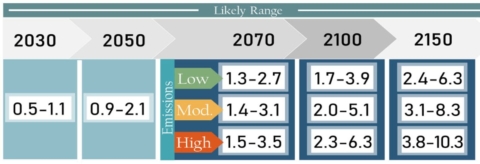
In 2019, NJDEP commissioned a study from Rutgers University and other climate change scientists finding that “sea-level rise projections in New Jersey are more than two times the global average,” according to a press release on their website.
NJPACTNOW’s website says that NJDEP’s plans are to ensure that both pre-existing buildings and newly constructed homes are safe from flooding.
In a New York Times article about New Jersey’s stance on climate change from January 27, 2020, Tracey Tully reports that the reforms will “add a new layer of oversight” in requiring “Department of Environmental Protection permits and approvals to factor in how climate change is expected to impact the project, as well as the effect of its emissions on global warming.”
But these implications drew the attention of state business groups, many of whom disapproved of the restrictions on land use and the science involved.
Almost 20 organizations wrote a letter encouraging Gov. Murphy to intervene, denying the NJDEP’s assertion that present conditions of “imminent peril” warranted emergency rules, which were originally to be filed by June 10, according to an NJBIA article.
“This emergency rule is addressing the wrong problem with the wrong solution,” the letter says, claiming that “inadequate stormwater facilities” are the issue, rather than flood mapping.
NJDEP’s emergency rules also reference the need for “stormwater Best Management Practices to be designed [for] man-made runoff for both today’s storms and future storms,” according to NJBIA’s May 26 recap.
In Toft’s overview, he describes NJDEP’s grandfather provisions as applicable to entities “who have received permits or who have submitted technically complete permit applications before the rule is issued.” The letter calls these grandfather provisions “limited” and able to cause “dire economic consequences on potentially thousands of projects.”
Groups such as the NJBIA, the Chamber of Commerce Southern New Jersey, Princeton Mercer Regional Chamber of Commerce, the Chemistry Council of New Jersey, the New Jersey Association of Counties, and more stood behind the document.
When these parties shared their concerns over the magnitude of the land area subject to NJDEP approval and the use of FEMA resources, another hush fell over the proposals. As of press time, no rules, including the aforementioned emergency actions, have been put into place.
“New Jersey is Ground Zero for some of the worst impacts of climate change. It’s the single greatest threat we face to our communities, our economies, and our way of life. We have no choice but to build our resilience,” NJDEP Commissioner Shawn LaTourette was reported as saying during an August 11 joint hearing.
NJDEP’s 2020 New Jersey Scientific Report on Climate Change states that “the intensity and frequency of precipitation events is anticipated to increase due to climate change,” and “the size and frequency of floods will increase as annual precipitation increases.” It also says that warmer temperatures might be able to intensify tropical storms.
Towards the end of June, a coalition of environmental groups wrote their own letter to Gov. Murphy to express disappointment over the waiting process.
Representatives from The Watershed Institute, New Jersey Audubon Society, New Jersey Conservation Foundation, Clean Water Action, New Jersey League Conservation Voters, New Jersey Environmental Lobby, Save Hamilton Open Space and others signed the document.
“New Jersey cannot afford more delays. As Hurricane Ida and other storms have made clear, New Jersey’s current land use regulations are out of date and not sufficiently protective,” the letter says. “As we approach the one-year anniversary of Ida, many New Jersey residents are still not back in their homes and still lack the funds they need to move out of harm’s way.”
The letter says that NJDEP recognized the problem of insufficient data in previous stakeholder meetings, and in one for NJPACT in 2020, they “acknowledged the need to adjust the mapping of floodplains to adequately reflect recent storms and flooding in New Jersey.”
After thanking NJDEP officials and staff for their work, the coalition says that “the additional time that has been proposed for additional stakeholder meetings on these topics, which have been discussed for more than four years and announced for more than two years, at best can be seen as a delay tactic.”
“At worst, it will provide an opportunity to push through land use permits before the emergency rules go into effect and to ultimately weaken the overall impact of the emergency rules. In short it continues to put people and property in harm’s way,” the letter explains, voicing their desire for Gov. Murphy to take action before the state encounters another storm.
Doug O’Malley, the director of Trenton-based Environment New Jersey, says in the Watershed Institute press release that “New Jersey is surrounded by water on three sides. For many residents, urban and rural, coastal and inland, flooding is a serious disruption, resulting in billions of dollars of property damage, and deadly consequences. We need to ensure new development isn’t putting people in harm’s way and reflects the best science we have.”
“Whole neighborhoods were flooded during Ida. To see everyone’s possessions out on their lawns, knowing they could not afford to replace those items pains me,” The Delaware Riverkeeper Network’s community action coordinator, Fred Stine, says in another quote from the bulletin. “It is often the poorest who are most at risk. No one should have to go through that financial loss and hardship. Anyone who wants to build homes in an area that floods — whether it is on a map or not — is inviting disaster and puts first responders at risk.”
As leaders in the business and environmental fields remain in discussion over how to progress, New Jersey’s storm protection rules remain in a limbo state. No new regulations on floods are in place for another disaster in the wake, and looming shadow, of Hurricane Ida.