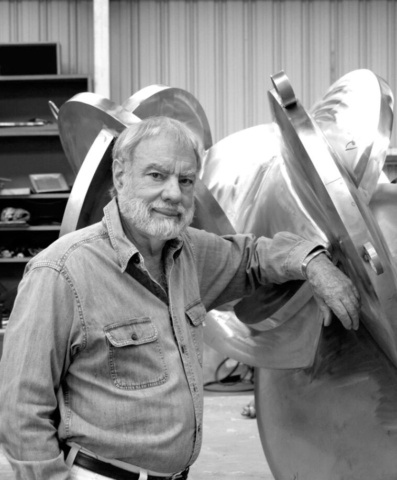
For me, the real magic is finding human feeling in the arrangements and intersections of shapes that when taken alone have none. It is like a composer who is searching for a new melody on the piano. The composer doesn’t invent any of the musical notes — they are all available on the keyboard. No single note carries human emotions, but combinations of notes — chords, arpeggios, etc. — do. The composer tries to find new combinations of the musical notes that sing to him and that then might sing to us as well. And the composer uses tools and technologies as well. The development of musical notation was transformative for composition, and the piano is a tool that organizes and places the musical notes at the composers’ fingertips.
It is the same for sculpture. There are tools and technologies that we use for the genesis of our work, and tools and technologies that we use for the final realization of our work. I have come to think of them separately, but that separation was a new realization for me. David Smith was the most influential sculptor when I was starting out, and for him the welder was the tool for both the genesis and the realization of his work. But I have my tools for exploration, and I have my tools for realization. Since my sculptures come from exploring combinations of shapes rather than previsualizing, any tools or technologies that make my exploration more spontaneous or give it more depth, well, these are cherished and worth any added work to get a sculpture into its final, permanent state.
I think that if I did not have such a strong sense of knowing when it is right, then having almost endlessly increasing possibilities might be confusing rather than liberating. But I love having more possibilities. For me that means there are more sculptures and a wider range of voices to find, and I know they will let me know when I find them.
The genesis of the cast-acrylic sculptures was my desire to explore the containment of light as a sculptural medium. The only tool I could imagine to contain light would be a transparent medium. There were reasons that neither glass or plastic resins could do what I imagined I needed, so I had to invent a new process for casting transparent acrylic at a scale and thickness not previously possible — not for the sake of invention, but to achieve the aesthetic goal I was seeking.
The impetus for the cast bronze sculptures I began in 1987 was my desire to explore the vocabulary of the new shapes that were created when cubic or rhomboid solids penetrated each other. I saw that cubes had a quiet solemnity when viewed alone but spoke with a new and emotionally more complex voice when they penetrated each other. I tried to explore these new voices through cardboard models, but they were awkward and time-consuming and I needed to explore hundreds of possibilities. But my clumsy attempts told me there was something there worth pursuing. I realized I needed a completely new tool, which led me to become involved with the earliest computer 3D modeling programs. I do not naturally take to working at a desk and on a computer, but it was the only way I could explore this new language. And this new language spoke to me so strongly that I kept at a computer process that I really did not take to at all.
Eventually, I wanted to expand the exploration of penetrating solids with curved as well as planar surfaces. The computer software to do that existed, but the problem was that the way I had been able to get the intersecting planer solids out of the computer and into the actual haptic world did not work with curved shapes. This led to my being an early adopter of 3D printing — I could print models of my ideas — and helping to develop the first large-scale 3D printers.
Gravity is both the sculptor’s friend and enemy. It is our friend because mass and gravity are inextricably connected, and mass is what gives sculpture its sense of presence as it exists in the same real three-dimensional world of humans. It is our enemy because gravity makes building things very complicated. We need clamps to hold pieces in place for welding, and we need cranes, hoists, and forklifts to move things around. I always joked that I dreamed of having a gravity-free studio to make the sculptures, and then I would take them out into the gravity world for them to live in.
Another impossible dream had been to have a tool or process wherein material would flow out of the end of my hand so that I could create shapes in space from its movement — to be able to treat a solid material gesturally, so to speak.
Well, sometimes dreams come true. I had vaguely followed the development of virtual reality (VR), but it was presented as a possible way to view sculpture, and that did not interest me at all. Rungwe Kingdon, founder of the Pangolin Foundry in the United Kingdom, knew of my career-long pursuit of tools to enhance exploration of shape, so he invited me to his foundry to try VR as a shape-making tool. His instinct was spot on, and VR became the genesis of the Aeolis series.
In VR I have a gravity-free studio. The visual sense of being in a real three-dimensional space is very good. I can create shapes by the movement of my hands and arms. I can conduct shapes that come out my hands like a conductor does for music. The shapes wait in space, where I leave them; I can move them, stretch them, penetrate them through each other without any interference from gravity. It is almost deliriously spontaneous and direct.
However, getting a sculpture from VR into metal is not easy or spontaneous at all. But it is possible, and the results are worth all the extra time, effort, and expense of getting the sculptures out of the gravity-free studio and into the real world.
The origin of the Aurai collages arose from the computer process that gets sculptures originated in VR into the real world. Throughout my career I had never liked working on paper or canvas, because by their very nature I had to start with their limitations. That beginning limitation inhibited the very exploration that was my way of working. In the complicated computer process of getting the VR sculptures out of VR, I saw shapes that I thought could be interesting as two-dimensional elements.
And I realized that if I printed a large number of those various shapes and cut them out, then I could explore their arrangement, letting the final one be what determined the final proportion and size of the paper or canvas to which they were glued. This was basically a two-dimensional version of how I was working in three dimensions, where the artwork determined its own size and proportion.
So here I am at 80 plus, having spent a very rewarding 60 years exploring the visual vocabularies of geometry in order to find combinations of shapes that talked to me. Sometimes they have been easy to find, and other times they have been elusive. I don’t know why the ones that talk to me do so. I have never wanted to question why some do and most don’t. I am just very grateful that there are ones that do.
And now I can go into my new, gravity-free studio and continue to explore combinations of shapes that I have made with the movement of my own body. Some of them end up as sculptures and some of them even end up as collages that can go on a wall.
Who says old dogs can’t learn new tricks?
Creating Forward
When the COVID-19 pandemic prevented my exhibition at Grounds For Sculpture from opening, my first reaction was disappointment, but hey, I’m a big boy, and good things in life often go awry. But then it seemed like the virus was some sort of evil miasma that was crushing everyone, and what I was experiencing was quite small compared to many others.
It seemed like the virus had its hands around the neck of the very body of joyful creative expression. Museums, galleries, concerts, and theaters closed; art students faced temporarily shuttered studios, and on and on. It seemed like all the arts, which I feel such an honor to be a part of and which I have always viewed as the best part of our all-too-flawed humanity, were under attack by this damned, spiked, tiny ball of evil.
I said to myself, “OK virus, you may keep me from exhibiting but you’re not going to keep me from making sculpture.” So, for this past year, while my exhibition has been closed, I have been making new sculptures that shake their fist at the coronavirus and celebrate the human condition.
Excerpted from “Bruce Beasley 60 Year Retrospective,” the forthcoming Grounds For Sculpture exhibition catalog.