A tiny satellite under construction at the U.S. Department of Energy’s Princeton Plasma Physics Laboratory could open new horizons in space exploration.
Princeton University students are building a device, called a cubic satellite or CubeSat, to test the viability of a miniaturized rocket thruster that is being developed at PPPL. The proposed propulsion device — powered by plasma — could raise and lower the orbits of CubeSats circling the Earth, a capability not broadly available to small spacecraft today. To date more than a thousand CubeSats have been launched by universities, research centers, and commercial interests around the world.
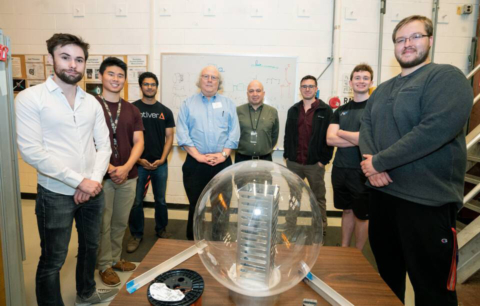
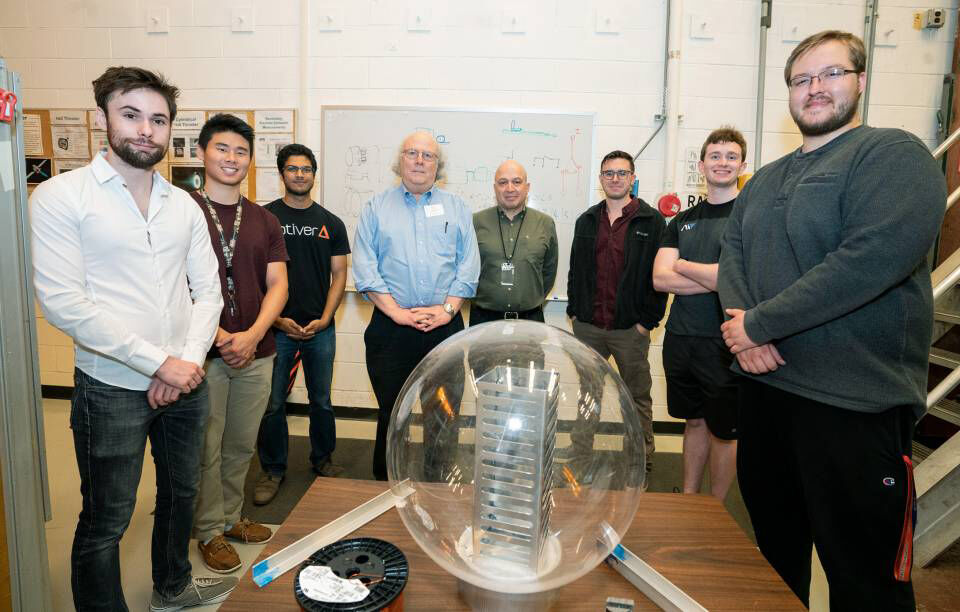
Princeton’s footlong CubeSat, which it has dubbed a “TigerSat,” consists of three four-inch aluminum cubes stacked vertically together. Sensors, batteries, radio equipment, and other instruments will fill the CubeSat, with a miniaturized thruster roughly equal in diameter to two U.S. quarters housed at either end.
PPPL physicist Yevgeny Raitses is leading the development of the thruster. It is a scaled-down version of a cylindrical thruster developed in the PPPL Hall Thruster Experiment, which Raitses leads and launched with PPPL physicist Nat Fisch in 1999.
The experiment investigates the use of plasma — the state of matter composed of free-floating electrons and atomic nuclei, or ions — for space propulsion. The developers’ goal is to develop a miniaturized thruster that can achieve a higher density of rocket thrust and a higher specific impulse than the plasma thrusters that are used for most CubeSats now orbiting Earth. Specific impulse is the technical term for how efficiently a rocket burns fuel.
If successful, the thruster will be many times more efficient than the chemical rockets and cold-gas thrusters typically used on small satellites. High specific-impulse thrusters use much less fuel than the chemical rockets and cold-gas thrusters typically used on small satellites, which would yield the potential for longer, more cost-effective satellite missions.
A high specific impulse could also produce a large enough increase in a satellite’s momentum to enable a spacecraft to change orbits — a feature not available on currently orbiting CubeSats. This would enable a CubeSat to, say, descend to lower orbit to track hurricanes or monitor shoreline changes, then return to a higher orbit where the drag force on a satellite is weaker and requires less fuel for propulsion.
The new thruster would also have the potential to be used in the exploration of deep space.
Building the CubeSat are some 10 Princeton graduate and undergraduate students in the Department of Mechanical and Aerospace Engineering, with Daniel Marlow, a physics professor, serving as faculty adviser.
Princeton Plasma Physics Laboratory, Princeton University, James Forrestal Campus, Box 451, Princeton 08543. 609-243-2000. Steve Cowley, director. www.pppl.gov.