Two centuries ago, on the southern end of Mercer County, Trenton was forging its industrial reputation with iron, steel, and porcelain. Peter Cooper made the first I-beams in the United States to build the first fireproof buildings. John Roebling built the first railroad suspension bridge using wire ropes from his Trenton factory. To the north, at Princeton University, Joseph Henry was pioneering in the field of electromagnetism, which led to the telegraph and the telephone. Fast forward to the 20th century: Albert Einstein came to Princeton’s Institute for Advanced Study, RCA pioneered in satellites and color television, and Western Electric made telecommunications history. Today’s scientists tap this heritage.
To celebrate its 175th anniversary, Mercer County is staging an unusual day-long conference on technology developed within its borders. It is set for Friday, October 4, at the education building of the College of New Jersey (TCNJ). In a tip of the hat to the iconic sign that spans the Delaware River, “Trenton Makes The World Takes,” the conference is titled: “Mercer Makes: Innovation and Technology in the Capital County.” Co-sponsors of the conference include TCNJ, the Historical Society of Princeton, the Trenton Historical Society, and the Princeton Regional Chamber of Commerce. Cost: $20.50 including lunch. Register at www.mercer175.org or call 609-989-6418.
“It’s hard to imagine how many discoveries were and are being made here, when you consider that Mercer County encompasses Trenton’s manufacturing heritage, GM in Ewing, Princeton University, the Institute for Advanced Study, and the RCA/Sarnoff labs,” says County Executive Brian M. Hughes. “We have an amazing legacy.”
When interviewed for this article, the panelists brim with enthusiasm for their parts of the story. Iron, clay, and electromagnets are the focus for the panels on the 19th century. Clifford Zink, architectural historian, will discuss the remarkable accomplishments of Peter Cooper and John Roebling who were giants in Trenton’s iron and steel business. Richard Hunter, archaeologist, will tell about the massive ceramics industry in Trenton. And Michael Littman has entertaining story after entertaining story about Joseph Henry’s scientific adventures. Emily Thompson, a Princeton University history professor, will moderate. In separate presentations, Benjamin Gross, curator of the Sarnoff Library museum (now housed at TCNJ), will discuss RCA/Sarnoff’s legacy, and Christine diBella will tell about research and discovery at the Institute for Advanced Study.
To bring the history forward, Katherine Kish, executive director of Einstein’s Alley, will speak with Dennis Waters, Alexander Magoun, Richard C. Woodbridge, and Greg Olsen. Waters will describe the incredible “pole farm,” giant antennas that relayed phone calls across the Atlantic. Magoun, an outreach historian at the IEEE history center, will bring that up to date with Sarnoff’s inventions from 1950 onward, including those in the area of wireless communications and satellite design. Woodbridge, a patent attorney who is now with Fox Rothschild, will trace the trajectory of innovation as shown in the patents he processed. Olsen, president of GHO Ventures, will show how Princeton University’s collaborations with entrepreneurial scientists can result in commercial success.
This seminar was planned to applaud technology developed and located in Mercer County. A caveat: from the point of view of this newspaper, and of regional organizations such as Einstein’s Alley, strict geographical lines do not present an accurate picture of the creativity and innovation of the greater science community. That’s largely because the two major tech seedbeds — Sarnoff/SRI and Princeton University — are located at the north end of the county. More than half of today’s tech firms are located just across the border — in Research Park (which is Somerset County), and at the Forrestal Center and Princeton Corporate Plaza’s Deer Park Drive (which are in Middlesex).
#b#Steel: Cooper & Roebling#/b#
Those geographical caveats aside, everyone agrees that in the 19th and 20th centuries, Trenton and Princeton were hubs of innovation. Clifford Zink, who has chronicled the Roebling family, will sign his book “The Roebling Legacy” (U.S. 1, June 8, 2011) at the event. Zink grew up in northern New Jersey, with his father working as a fireman, and his mother as a department store manager. He majored in communications and documentary filmmaking at Temple University in 1972 and has a master’s degree in historic preservation from Columbia. His other recent books are on the history of Monmouth County parks and Somerset County parks.
Thanks to recent archaeological discoveries at Petty’s Run, says Zink, we know that in the 1750s Trenton was one of only four sites in the colonies where steel was being made. In the 19th century the skilled labor pool and excellent access to water and railroad transportation made Trenton attractive to Peter Cooper, an industrialist and serial entrepreneur from Manhattan. (He founded Cooper Union as a free college.)
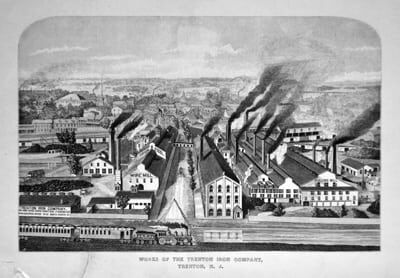
In 1845 Cooper established his Trenton Iron Company on the Delaware River where the baseball stadium, Arm & Hammer Park, now stands. He soon expanded Trenton Iron to the site of the current arena, Sun Center. When John Roebling wanted to move his wire rope making business from Pennsylvania he asked for, and took, Cooper’s advice. The Roebling Steel Works was built near Cooper’s plant. Before Roebling began making his own wire for ropes, he bought Cooper’s wire.
Roebling designed, and his son Washington built, the world-famous Brooklyn Bridge in 1869. Both Roebling and Cooper made wire ropes for the newfangled elevators and cable cars. Cooper’s Trenton plant also made wheels and rails for railroads; he thought they were more profitable than making locomotives.
Cooper’s determination, as well as his deep pockets, helped Cyrus Field do the seemingly impossible, to lay the transatlantic cable — using Trenton Iron wire, of course. Cooper’s company forged the first I-beam in the United States for Cooper Union, but soon all the architects wanted to build fireproof structures, and, a little later, the first skyscrapers, including Trenton’s eight-story Broad Street Bank. Cooper’s I-beams were also used in 1855 when Nassau Hall had to be rebuilt, after a fire.
“Roebling and Cooper were Trenton entrepreneurs making very important contributions to the 19th century,” says Zink. “They changed the way people lived.”
#b#Clay: Lenox & ‘Sanitary Porcelain’#/b#
Like the steel workers, the ceramics workers valued Trenton for its location, says Richard Hunter, who will tell the clay part of the innovation story. Trenton had some 200 potteries that enjoyed good access to raw materials (coal from Pennsylvania, clay from the Amboys and Old Bridge) and access to markets — by rail, ship, canal boat, and train.
Archaeology always appealed to him, Hunter says, because he was always interested, “wherever I happened to live, in how the modern landscape contains elements of earlier landscapes.” He grew up near Liverpool, England. During World War II his father was a parachutist and his mother was a ferry pilot, transporting planes for the Royal Air Force. After English schooling, he earned his PhD from Rutgers, and opened his business in the middle of Trenton 25 years ago. His firm, Hunter Research, excavated and helped to design Petty’s Run Archaeological Site, which opened to the public in May. “I care deeply about Trenton and believe its history should play a part in the city’s revival. It could capitalize on ‘heritage tourism,’ based on its historic sites.”
In contrast to the pioneering steel industry, Hunter says, clay workers employed ancient technology. Rather than making major discoveries, potters tweaked some processes and made “lots of little changes, in design, in kilns, in the way vessels were being formed. Workers emigrated from major ceramics centers in England, such as Staffordshire, and brought knowledge. Trenton workers made it their own. Their biggest accomplishment was capturing the market for pottery in this country that had been dominated by imports from Britain and France.”
Trenton’s pottery industry can be traced to the 1876 centennial, which displayed fine tableware made in Trenton. The biggest of the companies, Lenox, was founded in 1889. Organized as an art studio, rather than a factory, it offered one-of-a-kind artwares in ivory china and its tableware successfully completed with English china. Boehm and Cybis followed Lenox in the 20th century.
“Sanitary porcelain” (sinks, tubs, and toilets) began to be manufactured in that time period. Many smaller companies merged to form mega firms like American Standard. At its peak, from 1900 to 1920, the Trenton potteries had from 4,500 to 5,500 workers. “There were upward of 50 locations in the city,” says Hunter. Trenton’s porcelain makers also became exporters and the industry grew from local to regional, national, and international.
The Roebling/Cooper steel business left town in the early 20th century, but Trenton still had value as a transportation hub and source of skilled metal workers. Some of the heavy manufacturing businesses were situated on railroad lines and needed skilled metal workers. For instance the century-old Delaval (now Siemens Demag Delaval) makes turbines, and Trane still turns out air conditioning compressors.
As with iron, the clay industry shows only remnants of its former glory. The sanitary earthenware business moved to the Midwest in the 1920s. Cybis closed, and Boehm is active on a very small scale. Lenox transplanted its bone china making factory to Kinston, North Carolina, but most products are made overseas. It moved out of Princeton Pike Corporate Center in 2006, leaving its name “Lenox Drive” as a memory.
#b#Electromagnetism: Joseph Henry#/b#
When John Roebling and Peter Cooper were making heavy metal history in Trenton, Joseph Henry was doing all kinds of adventurous experiments at Princeton University, says Michael Littman, a Brandeis alumnus (Class of ‘72) with a PhD from MIT, who teaches about engineering and its influence on American society at Princeton University.
Henry came to Princeton University in 1832 and was considered the scientific successor to Benjamin Franklin. In his 14 years at the university, Henry also made major contributions to the development of the electric motor, the telegraph, and the transformer. He left Princeton to establish the Smithsonian Institute.
Among Henry’s on-campus capers: building a magnet that would lift 3,500 pounds and rigging a wire to send signals to his wife from his laboratory in Nassau Hall to his house. It was the first magnetic relay, and the house — painted yellow — still stands near Nassau Hall. If you take the Princeton Tour Company’s ghost tour, you will hear how, in 1833, a convicted murderer was remanded to Henry’s laboratory to be the subject of galvanic experiments after being spared from his trip to the gallows.
Littman will describe how Henry was a pioneer at the beginning of a new field — the linking of electricity and magnetism (electromagnetism). He will also tell how Henry detected radio waves and explored the differences between static electricity and ordinary electricity. “New opportunities surface at the beginning of many fields,” says Littman, “You might compare it to the time of the steam engine, when new ideas about the use of steam to produce force in a piston resulted in lots of opportunities. You might even compare it to the discovery of lasers or high temperature superconductors. “
One of Littman’s favorite anecdotes is about how Henry jumpstarted the young Alexander Graham Bell into inventing the telephone. The son of a day laborer, Henry did not have a college degree, and he taught himself every branch of science: physics, chemistry, geology, mineralogy, astronomy, and architecture. He had no patience for slackers, so when Bell admitted that he had an idea for the telephone but couldn’t develop the idea because he lacked the knowledge, Henry had a two word reply. “Get it.” Bell dove into his research and soon made the famous first phone call, “Mr. Watson . . . come here.”
#b#Optoelectronics: Greg Olsen#/b#
Mercer County’s preeminence in optoelectronics might, in fact, be traced back to Henry. Optoelectronics is the root technology for many Princeton firms. It can be described, says Greg Olsen, founder of Sensors Unlimited, as different pathways of electrons and photons. “In a laser, when electrons meet photons, particles of light come out. In photo detectors, particles of light go in and electrons come out.”
Optoelectronics flourished at the RCA lab in Princeton in the 1960s when laser technology was discovered. This led to a slew of practical applications, and the lab was busily working on them. The pace was not quick enough for some RCA scientists, including Olsen and Vladimir Ban, who left and founded their first company, Epitaxx, in 1984. It makes optical detectors and receivers for fiber-optic telecommunications and cable television networks. With a facility on Graphics Drive in Ewing, this international firm is owned by JDS Uniphase.
The field mushroomed. After selling Epitaxx, Ban established his own firm, PD-LD (Photo Diode/Laser Diode, which makes lasers, LEDS, and other devices for optical communications, now on Pennington-Hopewell Road). Meanwhile, at the venerable Princeton Service Center, Olsen founded Sensors Unlimited to develop focal plane arrays, cameras, and high speed detectors. An employee-owned firm, Sensors was sold twice; the employees did very well, and Olsen funded his 2005 journey into space with his proceeds.
Currently in the greater Princeton area there are perhaps two dozen optoelectronic research firms, including Discovery Semiconductors on Silvia Street, and Princeton Optronics at 1 Electronics Drive. And there are a dozen substantial optoelectronic manufacturing companies, ranging from Laser Energetics on Quakerbridge Road to the global firm, Schlumberger, at the Princeton Junction railroad station.
If the founding scientists of Epitaxx and Sensors Unlimited were from RCA, a crucial element in the success of their ventures was the deep pockets of Princeton University and the nimble networking of Olsen, who lured an expert in the field, Steve Forrest, to the university.
“Steve had been a research scientist at Bell Labs, a friendly competitor with RCA, and he had worked with Epitaxx as a consultant,” says Olsen. “From Bell he went to the University of South California. I knew if I could get him here, we would have a great consultant for the technology of making optoelectronics with gallium arsenide.”
Forrest came to Princeton with just the right equipment that Sensors and PD-LD needed. The young companies didn’t have enough money to buy it. Forrest’s lab had the equipment but he didn’t have knowledgeable people to set it up. It was a match: the entrepreneurs provided the expertise and then got to use the equipment for their research. Plus they hired many of the students and even shared government contracts.
Forrest was lured away by the University of Michigan’s billion dollar budget (can it be that another institution has deeper pockets than Princeton’s?) but many of the companies he helped start are thriving and his graduate students have leadership positions.
Chief among Forrest’s companies is Universal Display Corporation, which started as a four-person office on the second floor over Redding’s Plumbing on Nassau Street. Now it employs more than 100 workers in two shifts in 40,000 square feet at Princeton Crossroads Corporate Center (Phillips Drive) in Ewing. UDC’s Organic Light Emitting Displays (OLED) use molecules that emit light to produce colors more vibrant than normal LED/LCD displays. Even more powerful are energy efficient PHOLED (phosphorescent OLED) displays for flexible and transparent screens.
“Sensors Unlimited and Universal Display Corporation are two prime examples of how faculty and small technology companies with complementary technical and business skills were able to collaborate and rapidly translate laboratory innovations into commercial reality,” says Joe Montemarano, director of industrial enterprise for the Princeton Institute for Science and Materials (PRISM). Both companies reaped investment from a public/private/state partnership, the now defunct NJ Commission on Science and Technology. “Too bad it no longer exists, as other states have copied New Jersey’s example with good results,” he says.
Other sparks at the university for technical startups are Ed Zschau, who ran the engineering entrepreneurship course for many years, and James Sturm, director of PRISM. Through PRISM, companies can tap the resources of an imaging and analysis laboratory, and a nano-microfabrication lab.
Another university tool for young companies is MIRTHE (Mid Infra-Red Technologies for Health and the Environment), which aims to help the venture community get a better understanding of tech business opportunities with undeveloped markets. MIRTHE is developing trace-gas sensor systems using mid-infrared technologies (www.mirthecenter.org).
A sensor firm with university roots is Sentinel Photonics, which works on sensors for real-time wireless gas detection. It was founded by Stephen So, who was a graduate student at Rice supported by PRISM/MIRTHE, and then did a post-doc at Princeton in a MIRTHE supported lab. He has five employees on Deer Park Drive but might expand into Mercer County early next year.
Now a venture capitalist, Olsen has eight companies in his GHO Ventures portfolio. At age 68, he says that if he had stayed at RCA, “I would have served maybe 40 years there and been given a retirement party. My personality didn’t fit in a large corporate lab. I found myself when I went off on my own.”
One company in his portfolio is Princeton Power Systems, which makes inverters that support the electrical grid. It was started by students in Zschau’s class, including founding CEO Darren Hammell. “Keep an eye on Princeton Power,” says Olsen. “It is 10 years old, and its industry is just coming to the forefront.”
#b#RCA/Sarnoff#/b#
The Pole Farm that broadcast phone calls across the ocean (see sidebar, page 39) was arguably the most flamboyant symbol of broadcast technology in Mercer County, but Joseph Henry was dabbling with radio waves more than 100 years before that. If Henry was the 19th century’s scientist, the big broadcast personality of the 20th century was David Sarnoff, says Alex Magoun, who was in charge of the David Sarnoff Library for 12 years. (See page 41 for an account how the Sarnoff Library museum is ensconced at the College of New Jersey. The museum will host a reception after the October 4 seminars.)
Magoun grew up in Manchester, Massachusetts, where his father was a bond trader and his mother ran the Lynn Historical Society. After majoring in history at Trinity College (Class of 1981) he earned a master’s degree in England, coached track, and got a PhD in the history of technology at the University of Maryland. He did his thesis on the phonograph record and began administering the library in 1998. He is now an outreach historian at IEEE.
Magoun’s October 4 talk, “Beyond and After RCA Labs in Mercer County,” will include how RCA expanded during the Space Age into satellite design and production at its Astro-Electronics Division on Route 571. “If we consider just how much more visual our view of the world is, literally, from space, it’s worth remembering that that experience started with RCA. It led the world in video camera technologies from the 1930s to the 1980s, and Astro made RCA the founder and leader of space-based observation of the weather and the earth’s environment from the 1960s to the 1990s,” says Magoun.
The Astro division — as it was known under RCA, GE, and Lockheed — built the first meteorological and environmental satellites. It also built the Satcom series that served as HBO, TBS, and the Christian Broadcasting Network’s platform for distributing cable TV programming. Magoun will also cover the many exciting discoveries in wireless communications, electronic components, and electronic video at the post-RCA David Sarnoff Research Center (DSRC) on Route 1 North.
David Sarnoff was president of RCA in 1930 when RCA bought the Victor Talking Machine Company in Camden. In 1941 RCA’s researchers were installed in the new RCA Laboratories, positioned halfway between New York and Camden. The lab, renamed the David Sarnoff Research Center (DSRC ) in 1951, would do pioneering work in radio, television, and color television. “Most significantly, it helped to develop High Definition Television (HDTV) standards, as part of the so-called Grand Alliance, and helped pioneer developments in computer vision applications,” says Magoun.
In the 1990s the research center began forming and spinning out its own start-ups out of necessity. General Electric bought RCA in 1986, pocketed the mother lode of valuable patents, and planned to sell off the valuable land, but the DSRC managed to strike a deal. GE would donate the lab to SRI (an independent, non-profit research institute), take a tax deduction, and give the Sarnoff engineers-turned-executives five years to get enough research contracts to support the lab. They met that goal and then turned to venture capital to monetize their intellectual property in video, vision, and solid state technologies. Meanwhile they extended their expertise into New Jersey’s pharmaceutical industry.
The Sarnoff legacies led to the rise of 21 businesses, including Pyramid Vision which is still owned by its parent. Others with valuable technology were Videobrush, a consumer mosaicing software; Sensar, iris recognition technology; Princeton Lightwave, 3-D laser radar imaging cameras; Princeton Server Group, streaming video acquired by TelVue; Locus Pharmaceutical, computational drug discovery; and Delsys Pharmaceutical, automated tablet manufacturing, acquired by Elan.
“It is a sweet and sad story about the spinoffs,” says Magoun. Orchid Biocomputer went public in 2000, the first of what was to be many profitable IPOs, but shares launched at $8 went to $60 then eventually down to 39 cents. Eventually it was sold to LabCorp and does forensic testing and paternity tests. Songbird Medical also had a promising technology in disposable hearing aids that did not pan out.
The DSRC reaped little or no reward from its most famous technology, HDTV. The technical leader, Glenn Reitmeier, is now senior vice president of advanced technology standards and policy at NBC Universal, while Sirius XM Radio recruited over 20 Sarnoff video engineers for its new research lab. That firm now has about 100 researchers on Lenox Drive.
For the next seven years, after the departure of its long-time CEO Jim Carnes in 2002, Sarnoff struggled with a succession of CEOs. It began to depend heavily on military projects. Finally in 2010, instead of being the profit-making division of SRI International, the nonprofit parent took it over. While the sign on the lawn now says SRI international, the technologies under development do not appear to have changed.
#b#Mixed Future#/b#
If Mercer County can take pride in groundbreaking technologies over the past two centuries, what is the future of its technology for this century? As a patent attorney here for the past 40 years, Dick Woodbridge is in a position to make some pretty good guesses.
Woodbridge’s father, a chemical engineer, commuted from Princeton to New York for his job as an insurance executive, but he did inventions on the side. “He had seven or eight patents to his name — several of which I wrote,” says Woodbridge. “I remember seeing the great scientists like Einstein and Oppenheimer as a boy growing up, so my appreciation of Princeton science and high tech goes back to an early age.”
He trained as an electrical engineer at Princeton University (Class of 1965), took a job in Proctor & Gamble’s international division, then earned a law degree at George Washington University. After working in the U.S. Patent Office he had a comfortable slot in a large law firm. When work dried up in the recession of ‘73, he looked at New Jersey and realized the state had the second largest number of patents per capita but a very small number of patent attorneys. So he hung out his shingle here.
In various permutations of his law practice in Princeton, he had his own firm, worked for other firms, and merged to form the second largest IP firm in the state. Currently he is one of a dozen patent attorneys at a Philadelphia-based law firm, Fox Rothschild, at Princeton Pike Corporate Center.
All those years he has been watching the ebb and flow of invention. He sees the unheralded scientists, those outside the big corporations. He sees the recent arrivals to New Jersey — from Israel, Russia, and India. When his office was on Nassau Street, they would walk in the door, and he would walk them through how to start their businesses and protect their intellectual property.
At the forum, he will have some good news, that the number of patents issued per capita in New Jersey is essentially the same as it was 40 years ago. In 1973 it was 4,129. In 2012 it was 4,224.
Not such good news is that New Jersey in 1973 had been third in the United States, behind California and New York. Now the state has slipped to eighth in the nation, though still ahead of the average. The slippage is partly due to the loss of telecommunications Bell Labs and the shrinking of patent engines like RCA Sarnoff.
Western Electric and Lucent had been major patent instigators, as had the dotcom companies — until the dotcom bubble burst. “That was the equivalent of a nuclear bomb to some of the communications companies,” says Woodbridge.
New Jersey could still do better, says Woodbridge, citing a $2 million 2004 study for Prosperity New Jersey. The study labeled the Route 1 high tech corridor as a “natural economic cluster” and strongly recommended that the state should promote this corridor like North Carolina promotes the Research Triangle.
This fit right in to what Woodbridge espoused. In the early 1990s he had joined the late Jim Clingham (vice president at Sarnoff) and Ed Cohen (chairman of the now defunct NJ Commission on Science and Technology) to propose a Princeton and Rutgers Research Corridor that was later reframed and renamed Einstein’s Alley.
“Fifty percent of high tech comes out of the Route 1 corridor,” says Woodbridge, “but the report fell on deaf ears. The Route 1 corridor needs some serious state attention. Nobody in state government really understands the importance of high tech.”
The good news is that pharmaceutical, biotech, and medical device patents have filled some of the gap left by telecommunications. The big companies like Bristol-Myers Squibb and Janssen Pharmaceutical haven’t gone away, and dozens of biotechs have popped up around them. Patent applications bear out this trend. In a three year period (2009 to 2011) there were 294 patents coming from laboratories (pharmaceutical and chemical) compared to 189 patents coming from the digital scientists. A hidden driver for biotech patents is Princeton University; the patent count for just one molecular biologist, MacArthur award winner Bonnie Bassler, totals 20 overall.
And we haven’t even looked at other important centers of innovation. The Institute for Advanced Study, home of Albert Einstein and John Von Neumann, among many others, will be represented at the October 4 seminars. But unmentioned are two entire industries spawned here. Educational Testing Service launched learning and testing research, and George Gallup’s first attempts at polling public opinion made Princeton the market research capital of the nation.
Also not covered are the chemistry-related firms, like TRI (formerly Textile Research Institute) and the $2.6 consumer products company, Church & Dwight. Union Camp, which did paper research, closed on Princeton Pike, but HTI, which uses nanotechnology-enhanced catalysts for direct coal liquification, flourishes on New York Avenue.
But the seminars will show that the focus for “innovation” has changed with the centuries. In the 19th century, “hot” topics were steel, electric motors, the telegraph, and the telephone. In the 20th century it was radio, television, optoelectronics, and satellite communication. For the 21st century, who knows?