Hetty Baiz, a Princeton collage artist and environmental activist, comes by both attributions honestly. From her mother came her sensitivity to color and form and from her father a connection to the realities of the natural world. And these came together for her during summers in a cottage on Lake Carey in the Endless Mountains of northeastern Pennsylvania.
Baiz recalls childhood strolls near the cottage that highlighted the strengths of her mother, an abstract expressionist artist, and her father, a high school teacher and later a health administrator. “My mother was all about color and looking and my father was about identification,” she says. “When we would take walks, my father would be picking things up, and my mother would be looking at the way the heathery purples were blending with the blues.”
The art created a special connection with her mother. When Baiz was five or six, her mother used to take the bus to New York City to study with Hans Hofmann, returning home with a pile of oil paintings nailed together so they wouldn’t smear. Her mother would spread her wild paintings across the floor, then excitedly turn to her husband and say, “What do you think, Chris?” His response, as Baiz recalls, was “Well, I’ll have to live with them.” But Baiz, more in synch with her artist mother, saw them differently. “I’d come out in my pajamas and say, ‘Oh, Mommy, I love them,’ and she would say I was her support system,” she says.
Art materials were always available to the young Baiz, and she says her mother taught her to be very spontaneous and free. “When she would talk about paints, she would say, ‘Put the red down, move the color around so it creates movement — creating a sense of space and form with color.”
These early lessons persist in the animal collages Baiz created as an emotional and artistic response to reading Princeton University professor of bioethics Peter Singer’s “Animal Liberation.” They will appear in the exhibition “Nonhuman Animals: Eat, Test, Love” in the Bernstein Gallery of the Woodrow Wilson School, currently on view through Friday, October 18.
Related events include a panel discussion on ethical treatment of animals on Tuesday, October 8, at 4:30 p.m., followed by an artist reception at 6 p.m.
Three years ago she had done her first series of animal collages, exhibited at the Morpeth Contemporary in Hopewell. With those, she was expressing her angst about fracking by the oil and gas industry, which had leased two-thirds of the county that contained Baiz’s beloved Lake Carey. She was concerned about fracking’s potential effects on the environment as well as animal habitats.
Then a year and a half ago she read Singer’s book about animals that are factory farmed, tested in labs, or otherwise negatively affected by human activities. “There are these amazing, beautiful, and noble animals living under horrific conditions,” Baiz says. “These animals are now raised as products for consumption: a calf in a crate in which it can’t even stand up and that lives its entire life in darkness.”
Learning from Singer that all sentient creatures can experience pain, her response was visceral. “Who are we as one species to inflict pain on another? What gives us a right to do that?” she asks. “Why do we have the right to lord it over another animal, particularly when it causes pain and suffering?”
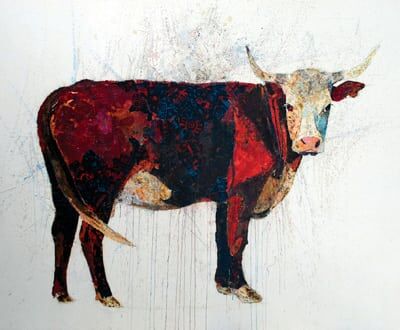
Baiz starts by reading about the animal she will be creating, but does not plan out her work in advance. “I work intuitively,” she says, first sketching a rough outline, then tearing pieces of paper and sometimes other materials to mold the form.
The paper she uses comes from her travels, from papers she paints or prints out, or “papers” she purchases — which can be as diverse as papyrus and banana paper from South America. In the show she also used pieces of a bee’s nest she found by the side of a road — something animals themselves created.
Baiz typically works in the morning and late afternoon. “Sometimes it is very peaceful, tearing little things, and it can be meditative,” she says. “But sometimes it can be overwhelming when you look at the scale. If I’m dealing with a little piece of the nose, I don’t look at the rest of the animal.”
Her favorite part of the process is toward the end, when she adds a visceral touch — spattering the background with paint and leaving the drips where they fall, rubbing the animal with charcoal, splattering it with water, and singeing certain areas with a blow torch. “I can go in and be a little wilder,” she says. “I don’t want it to be too pretty; I want it to have a slight edginess — it is part of the expressiveness of the way I work; burning something is destroying part of animal but also creating interest.”
Her work brings in ideas but at the same time is exquisitely attentive to artistic detail. Thinking about creating a cow, she says that people have had relationships with cows way back in human history. So she printed images she found online of cows in hieroglyphics and cave paintings on thin Japanese paper that she tore up for her cow collage. Also wanting to bring in some of Singer’s ideas on speciesism, which assumes humans are superior to other species, she typed on some of the words that, according to Singer, people use to describe cows, such as “sirloin.” Baiz explains, “The cow is a beautiful, noble creature, but we think of it as sirloin. We have nice little names for animal flesh, words that distance us from fact that we are eating the body of an animal.”
Disturbed to know that cats and dogs are used for laboratory testing, Baiz decided to include them in her show. “When I did the cat, I wanted to do something that wasn’t cute and fuzzy — I was inspired by looking at feral cats — who were roaming at the lake where I go in the summer — to create the essence of a cat,” she says.
Also in her show is a rat, which, she learned is worshiped by certain sects in India; but of course it is also used as an experimental animal. And of course many people view rats as vile creatures and carriers of plague and disease. But not Baiz. “I started looking at what kind of an amazing creature it is,” she says. “There is something beautiful about it; it is intelligent; it has a spirit of its own; and it is a living creature, a sentient thing that has a right to life too.”
For the calf that appears in the show, Baiz did not use paper. “I used discarded pieces of floor tiles that people walk all over,” Baiz says. “The materials themselves express the essence of the calf’s life — it is black and has no eyes because it never sees the light of day.”
Baiz’s condor — a bird that became extinct in the wild in 1987 because of poaching, habitat destruction, and poisoning from the lead shot in carrion they fed on — did not even start with the idea of creating an animal, but rather as an abstract piece. She started it by burning the edges of a huge piece of Japanese washi paper, then used a dremel, a carpentry tool, to scratch the paper, which began to tear and rip.
But that wasn’t enough for her. “I saw images of vultures and condors with their wild look and their claws, and thought ‘Because this has a clawing, scratching feeling, it needs a wild animal,’” she says. So she added a condor, which extends beyond the burnt edging and looks like it is breaking out of the paper’s confines, while using its “captivity” as a time to breathe.
Baiz started doing collage in art school. “The thing I love about it is that it is very freeing; you can use any kind of material,” she says. “Collage allows you to look around in your world and find things that can often be really beautiful in a piece; you are not limited to a palette.” But those tiny pieces of paper, torn and merged together under her careful eye, are indeed a palette themselves, and she uses them to create the same variation in tone, depth, and texture that other artists may achieve with oils.
Baiz grew up in Wilkes-Barre, Pennsylvania. Her father taught high school history and English and later became an administrator with Blue Cross-Blue Shield.
Baiz started college at Bard but transferred to Cornell to work with respected abstract artist Friedel Dzubas, with whom she had done a workshop in high school.
After graduating with a bachelor of fine arts, she stayed in Ithaca, working different jobs at the university while doing her art at a studio downtown.
In 1977 she moved to New York with her husband, Jim Perry, a sculptor who was a fellow art major at Bard. The couple lived in New York for eight years, doing their art and having shows but at the same time living hand to mouth. When she turned 30, and Jim was a few years older, they realized things had to change. “We looked at our income and said, ‘We can’t live this way the rest of our lives,’” she recalls.
She returned to school at Columbia University to earn a master of business administration, and he got a job at the New York Times working as a graphics editor. They moved to Princeton in 1985, and she worked at the university for 17 years, managing the project office in the office of information technology — except for a hiatus between 1990 and 1993.
But summers she was always at the lake in Pennsylvania, where she got involved in environmental issues. Her first foray into environmental activism was with a group working to save a trout stream where a New Jersey company wanted to dump waste, and she was part of the team that presented a published report on the biology of the stream to the Pennsylvania legislature.
When she heard about a group forming in 1990 to preserve the Susquehanna River, she decided to drive up for the meeting. Upon learning that the group, the Pennsylvania Environmental Council, was looking for an executive director, she offered to take the job and moved her family, which now included one and five-year-old sons, to Pennsylvania.
She did this for three years, but eventually the family issues — children with ear infections and a husband, artist James Perry, commuting to New York — got to be too much. “I was a woman on a mission but then realized it was crazy family-wise.”
For the last three years, Baiz has shared her artistic skills with poor women who live in townships outside of Cape Town, South Africa, teaching them to do collage and make frescos and masks. The classes are through a clinic for children established by Ingrid le Roux, a doctor who is also a visiting research scholar at the Center for Health and Wellbeing at the Woodrow Wilson School. The women sell the artwork, which Baiz’s husband teaches them to mat, at a store associated with the clinic that is a popular stop for tour buses.
In conjunction with Baiz’s exhibit is a panel discussion, Tuesday, October 8, at 4:30 p.m. in Bowl 16, Robertson Hall, on the lower level of the Woodrow Wilson School. Panelists are Peter Singer, professor of bioethics at Princeton’s University Center for Human Ethics and professor at the University of Melbourne’s School of Historical and Philosophical Studies; Jeff McMahan, professor of philosophy at Rutgers; and Stanley Katz, moderator, professor of public and international affairs and director of the Center for Arts and Cultural Policy Studies at the Woodrow Wilson School. Baiz will also provide an overview of her work. A reception with the artist follows at 6 p.m. in the Bernstein Gallery.
Nonhuman Animals: Eat, Test, Love, Bernstein Gallery, Woodrow Wilson School, Princeton University. Mondays through Fridays, 8:30 a.m. to 6 p.m. through Friday, October 18. Both a panel discussion, 4:30 p.m. and an artist reception, 6 p.m., are set for Tuesday, October 8. All events are free. Visit wws.princeton.edu/bernstein.